
TL;DR: What Parts Do You Need for an FPV Drone?
To build a typical FPV drone, you need a frame, four motors, propellers, ESC, flight controller, radio receiver, FPV camera, video transmitter or digital air unit, antennas, battery, radio controller, and FPV goggles. For a first 5-inch freestyle build, I would also add a low-ESR capacitor, battery straps, a buzzer, spare props, spare arms, a smoke stopper, and proper soldering tools.
The biggest beginner mistake is buying FPV drone parts one by one because they look good, then discovering they do not work together. Choose the drone type first—tiny whoop, 5-inch freestyle, cinewhoop, racing, or long range—then match the frame, prop size, motor KV, battery voltage, ESC rating, flight controller, receiver protocol, and video system as one complete setup.
From the bench: a clean, compatible FPV build flies better than an expensive pile of mismatched parts. Power is fun; reliability is what gets you home.
👉 Explore the FPV drone parts to build your own FPV drone.
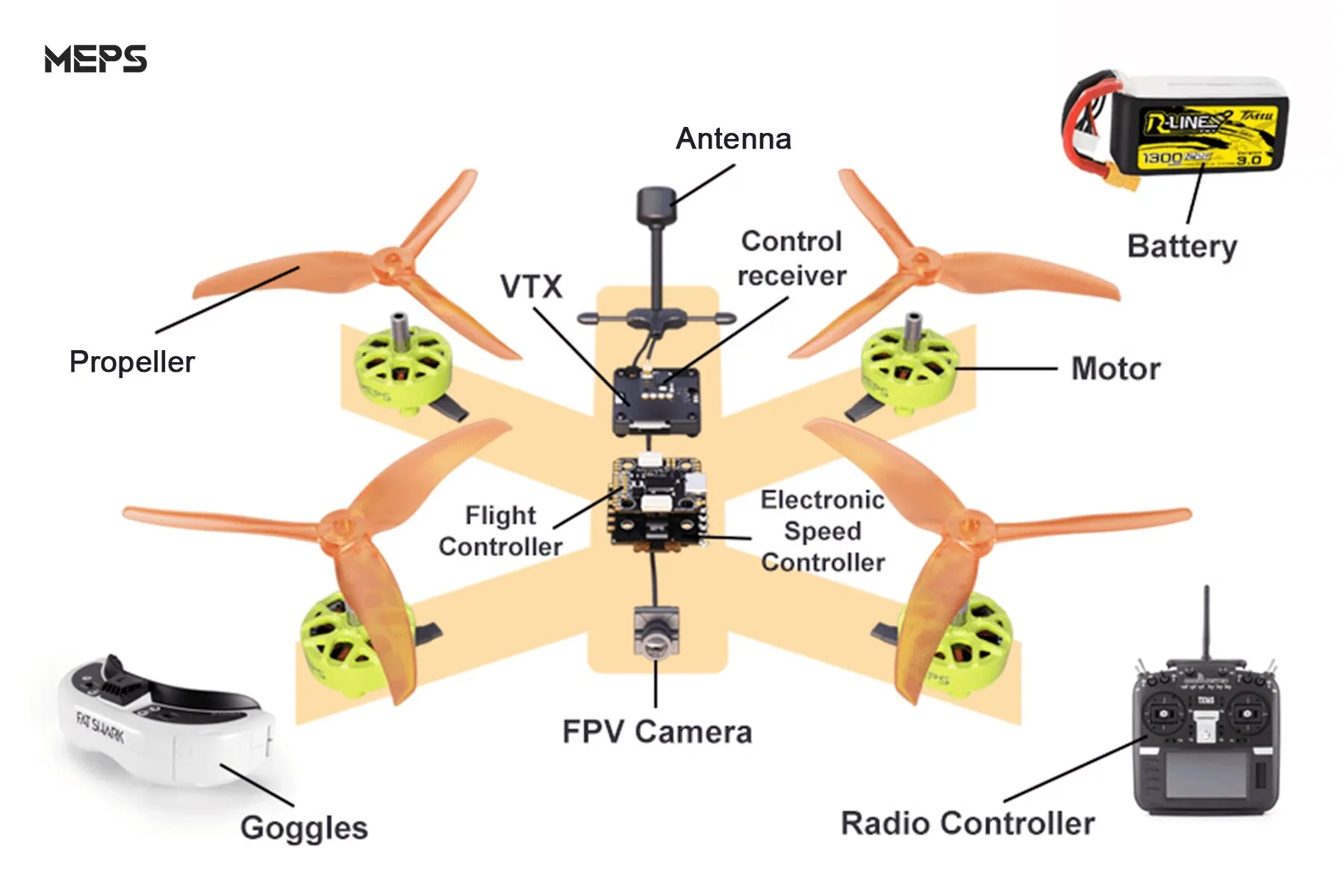
Complete FPV Drone Parts List
An FPV drone consists of several components, each of which plays a key role in its performance. Parts needed to build an FPV drone:
| Component | Function | Required | Builder Notes |
|---|---|---|---|
| Frame | Holds all components | Yes | Match frame size to propeller size and flight style. |
| Flight controller | The “brain” that stabilizes the quad | Yes | Must support your firmware and receiver protocol. |
| ESC | Controls motor speed | Yes | A 4-in-1 ESC is most common on modern builds. |
| Motor | Spin the propellers and create thrust | Yes | KV must match battery voltage and prop size. |
| Propeller | Convert motor power into lift and control | Yes | Cheap, easy to break, always buy spares. |
| FPV Camera | Captures live video | Yes | Choose analog, DJI, Walksnail, or HDZero-compatible camera. |
| Video Transmitter / Air Unit | Sends video to goggles | Yes | Also called VTX for analog; digital systems use air units/VTX modules. |
| Receiver | Receives stick commands from your controller | Yes | ExpressLRS is now a very common choice. |
| Battery | Powers the drone | Yes | LiPo/Li-ion selection affects flight time and punch. |
| Goggles | Displays video feed | Required for FPV | Goggles are the normal FPV experience. |
| Remote controller | Allows the pilot to control the drone | Required for flying | Must bind to the receiver protocol. |
| Antenna | Sends and receives radio/video signals | Yes | Never power a VTX without an antenna. |
| Buzzer / GPS / Capacitor | Safety and reliability extras | Recommended | A buzzer and capacitor save real headaches. |
If you are building your first FPV drone, do not start by buying random drone parts. Start with the frame size and flying style, then choose matching motors, propellers, ESC, battery, and video system. Most failed first builds I see are not caused by bad soldering; they are caused by incompatible components.
How the Main FPV Drone Components Work Together
An FPV drone is not just a remote-controlled aircraft with a camera. It is a chain of systems working together:
- Power system: the battery feeds the ESC and voltage regulators.
- Propulsion system: the ESC drives four motors, and the motors spin propellers.
- Control system: the receiver sends stick commands to the flight controller, and the gyro tells the flight controller how the drone is moving.
- Video system: the FPV camera sends live video through a VTX or digital air unit to your goggles.
- Safety and setup system: Betaflight/iNav settings, OSD, buzzer, GPS, failsafe, and wiring quality decide whether the quad is reliable.
A quad can use excellent parts and still fly badly if the system is unbalanced. For example, high-KV motors, aggressive props, a small battery, and an undersized ESC may feel powerful for ten seconds, then sag, overheat, or desync. FPV is a system game.
FPV Motors
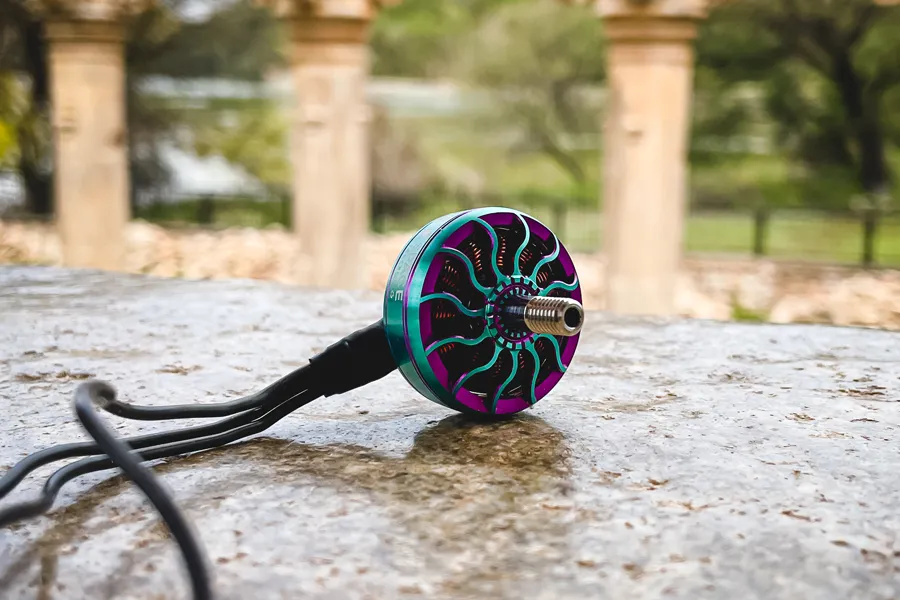
Motors are the muscles of an FPV drone. Each brushless motor spins one propeller. Motor size, KV, stator volume, and build quality affect thrust, efficiency, heat, smoothness, and flight feel.
Motor size is usually written like 2207 or 2306. The first two digits are stator width in millimeters, and the last two are stator height. A 2207 motor has a 22mm wide, 7mm tall stator.
KV tells you how fast the motor wants to spin per volt with no load. Higher KV generally means more RPM and more current draw. Lower KV is usually used with higher voltage batteries.
Read More: How to choose FPV Drone Motor?
Common Motor Choices
| Build Type | Battery | Typical Motor KV | Common Prop Size |
|---|---|---|---|
| 5-inch freestyle | 6S | 1700-2000KV | 5 inch |
| 5-inch freestyle | 4S | 2300-2700KV | 5 inch |
| 7-inch long range | 6S | 1200-1500KV | 7 inch |
| 3.5-inch sub-250g | 4S/6S | Varies widely | 3.5 inch |
| Tiny whoop | 1S/2S | Very high KV | 31-45mm props |
For a first custom build, a 5-inch freestyle frame is usually the easiest platform to assemble and repair if the pilot has a safe outdoor location. A tiny whoop is the better first aircraft for indoor practice, but its small solder pads make it a harder first soldering project.
Before buying a frame, check the FC/ESC mounting pattern, motor mounting holes, camera width, VTX or air-unit space, maximum prop clearance, battery location, and availability of replacement arms. On a crash-prone beginner build, easy repair is worth more than saving 10 grams.
For a first 5-inch build, 6S motors around 1750-1950KV are a safe, modern choice. They provide strong power without demanding extreme current from the battery and ESC.


Builder Tips for Motors
- Do not use motor screws that are too long. Long screws can touch the copper windings and destroy a motor.
- If one motor is hot after a short hover, check screws, prop damage, motor bearings, ESC settings, and filtering/tune.
- Replace bent motor bells early. A vibrating motor can make tuning miserable.
- Keep motor wire length neat, but leave enough slack for arm replacement.
What Brands of Motors are Available
- T-Motor
- EMAX
- BrotherHobby
- Drone Motors From MEPSKING
- Lumenier
All of these brands are well-known in the FPV drone motor market, and their motors have a certain level of performance and quality assurance. Among them, T-Motor, EMAX, BrotherHobby, and MEPS are among the most popular brands in the market. The motors of these brands all have high performance and stability,y and can provide a better flying experience. In addition, all of these brands have different models and specifications of motors to choose from for different types of FPV drones. Users can choose the most suitable motor according to their needs and budget.

FPV Flight Controller
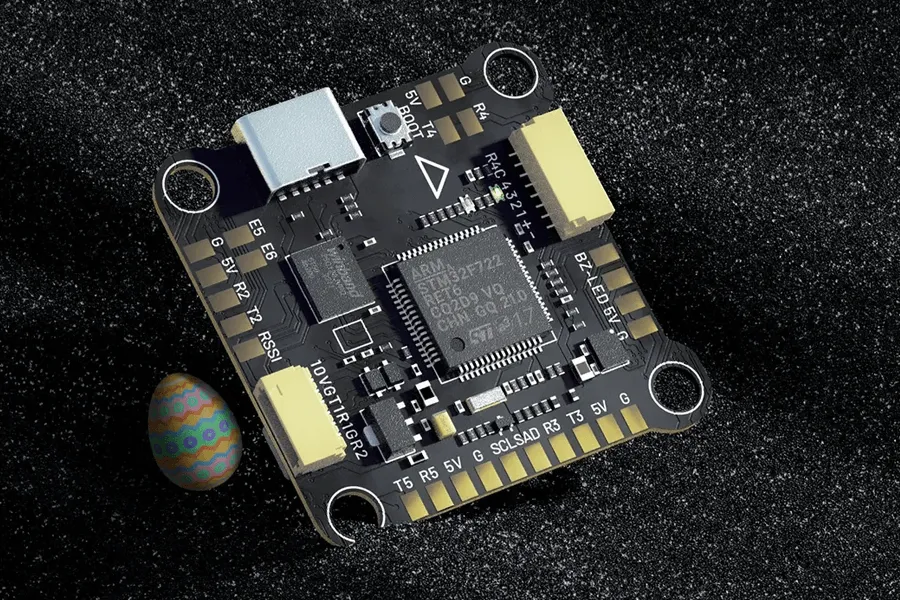
The flight controller, or FC, is the brain of the FPV drone. It reads gyro data, receives your stick inputs, calculates corrections, and tells the ESCs how fast to spin the motors.
Most FPV pilots run Betaflight for freestyle and racing. iNav is common for GPS-oriented cruising and fixed-wing style navigation. ArduPilot is powerful for autonomous projects, but it is not the usual choice for a basic freestyle quad.
What to Look for in a Flight Controller
- Firmware target: make sure the board is supported by your firmware.
- Gyro quality: good gyro filtering helps with clean flight performance.
- UARTs: you need ports for receiver, VTX control, GPS, digital video, and accessories.
- BEC outputs: check whether it provides 5V, 9V, or 10V for your receiver and video system.
- Blackbox: onboard flash or SD support is useful for tuning and troubleshooting.
- Connector layout: pads should be easy to solder and service.
Finding a flight controller with a mount size that fits your frame is probably all you’ll need to do as a beginner. Here is a detailed guide on how to choose fpv drone flight controller.
First-Hand Build Advice
On my own builds, I care more about clean wiring and accessible pads than fancy specs. If I cannot replace a receiver wire or VTX cable in the field without tearing the whole drone apart, that stack is going to annoy me later.
Use soft mounting where recommended, keep motor wires away from the gyro area, and add a capacitor across the battery pads. Clean electrical power makes the whole quad easier to tune.
What Brands of Flight Controllers are Available
- Flight Controller From MEPSKING
- foxxer
- datsun
- tmotor
- rush
- hobbywing
- speedybee
Just a heads-up: the product features and how they apply to different situations can vary from brand to brand. So, it’s important to choose the right brand and model for your needs and the situation.

Electronic Speed Controller (ESC)
The ESC controls how fast each motor spins. Modern FPV drones usually use a 4-in-1 ESC, which combines four ESCs on one board and connects to the flight controller with a harness.
When choosing the best ESC for racing quadcopters, it’s important to consider things like the maximum power, maximum current and KV value of the UAV motor. It’s also essential to match the current and power rating of the ESC to the motor to ensure a good match between the motor and the ESC. Usually, the rated current of the ESC should be greater than the maximum continuous operating current of the motor to ensure that the ESC can withstand the operation of the motor at maximum throttle.
Check these ESC specifications before buying:
- Supported battery cell count, such as 3S to 6S.
- Continuous and burst current ratings, including how the manufacturer tested them.
- Mounting pattern, board dimensions, and stack height.
- Firmware, such as Bluejay, AM32, or BLHeli_32 on existing hardware.
- Motor protocol support, such as DShot.
- Current sensor and telemetry support.
- FC-to-ESC connector pinout.
ESC Ratings That Matter
| ESC Spec | What It Means | Practical Advice |
|---|---|---|
| Current rating | Continuous/burst amps the ESC can handle | Give yourself headroom. A 45A-60A ESC is common for 5-inch. |
| Battery voltage | 4S, 6S, or wider input support | Match your battery voltage. |
| Firmware | BLHeli_S, Bluejay, BLHeli_32, AM32 | Determines features and protocol support. |
| Mounting pattern | Physical stack size | Must match your frame and FC stack. |
| Connector pinout | Harness wiring to FC | Never assume two brands use the same pinout. |
A painful beginner mistake is plugging an ESC-to-FC harness into a flight controller with a different pinout. Check the wiring diagram before powering the stack. If VBAT goes into the wrong pad, the magic smoke appears very quickly.
Selecting an ESC rated for a somewhat higher amperage than what your engine and propeller combination will draw at full throttle is generally the best course of action. Read more about ESC: What is FPV ESC: Comprehensive Guide for Electronic Speed Controller
Here is a list of typical ESC amp ratings for each frame size:
| Frame Size | Typical Amp Rating |
|---|---|
| 2.5in or smaller | <20A |
| 3in | 20A+ |
| 4in | 30A+ |
| 5in | 40A+ |
| 6in+ | 50A+ |
What Brands of Electronic Speed Controllers (ESC) are Available
- T-Motor
- Hobbywing
- Drone ESC From MEPSKING
- Foxxer
- EMAX
All these brands are well-known brands in the FPV drone ESC market, and their ESCs have certain performance and quality assurance. Among them, T-Motor, Hobbywing, and Spedix are some of the most popular brands in the market. All of these brands of ESCs have high performance and stability, which can provide a better flying experience. In addition, all these brands have different models and specifications of ESCs available for different types of FPV drones. Users can choose the most suitable ESC according to their needs and budget.


Propellers
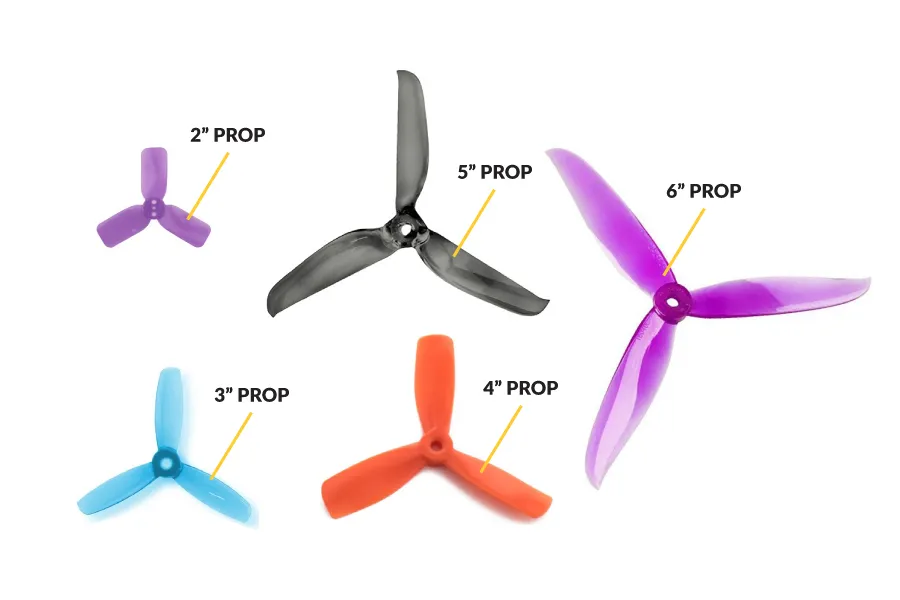
The propellers of FPV drones are one of the core components of drone flight, and they convert the power generated by the motor into lift to enable the drone to fly through the air.
A propeller marked 5×4.3×3 means 5-inch diameter, 4.3-inch pitch, and 3 blades. Most freestyle pilots use tri-blade props because they offer good grip and control. Two-blade props can be more efficient, especially on long-range builds.
Modern FPV props are usually injection-molded polycarbonate or a similar durable plastic, not carbon fiber. Plastic props are inexpensive, relatively safe, and more likely to bend or break instead of transferring all crash energy into the motor.
When choosing a propeller for an FPV drone, the following factors need to be considered.
- Diameter and length: The diameter and length of the propeller are key parameters, and they directly affect the lift and thrust of the drone. In general, the larger the diameter, the more lift the drone will have, but it will also increase flight drag and power consumption. Length, on the other hand, affects the torque and responsiveness of the propeller, with longer propellers providing higher torque and slower responsiveness.
- Propeller type: There are two types of propellers, a two-blade propeller and a three-blade propeller. Two-blade propellers are suitable for drones that fly at high speeds and need longer endurance, while three-blade propellers are suitable for drones that need higher lift and more agility.
- Material: The material of the propeller has a great impact on its strength and stiffness. Common materials available in the market today are fiberglass and carbon fiber. Carbon fiber propellers are usually lighter and stronger, but are more expensive.
- Rotation direction: Since FPV drones require more than two propellers to work, you need to pay attention to the rotation direction of the propellers to ensure that the drone can fly smoothly. Under regular circumstances, FPV drones usually use relative rotation directions, that is, two adjacent propellers rotate in opposite directions.

So, when you’re picking out propellers for FPV drones, you’ve got to think about things like diameter and length, propeller type, material, and direction of rotation. That way, you can be sure the propellers will give the drone enough lift and thrust to get the job done.
Select a prop size and pitch that complements your motors and frame. Five-inch tri-blade propellers are the most popular option for freestyle flying.
A quad needs two clockwise and two counterclockwise propellers, installed to match the configured motor direction. Always remove all propellers before connecting to Betaflight, testing motors, setting receiver endpoints, flashing firmware, or troubleshooting on the bench.
Keep spare props on hand at all times. When you crash, they are the first item to shatter.
How to Choose Props?
- Freestyle: 5-inch tri-blade props with moderate pitch are a good starting point.
- Racing: pilots often choose lighter, aggressive props for fast response.
- Long range: lower-pitch bi-blades or efficient tri-blades can extend flight time.
- Cinewhoop: props must fit ducts and avoid vibration; balance matters.
Always remove props when working on Betaflight, updating firmware, checking motor direction, or testing the receiver. This is not optional. A 5-inch prop can cut skin badly at full throttle.
The Brands of Propellers that are Available
- Gemfan
- HQ Prop
- DALPROP
- T-MOTOR
- APC Propellers
- Drone Propellers From MEPS
All these brands are well-known brands in the FPV drone propeller market, and their propellers have certain performance and quality assurance. Among them, Gemfan and HQ Prop are two of the most popular brands in the market, and their propellers are widely used in FPV flights. The propellers of these brands have good aerodynamic performance, durability and balance, and support a wide range of diameters, inclinations and material options. In addition, these brands of propellers are available in different models and specifications for different types of FPV drones and flight scenarios.
FPV Batteries
The battery powers the entire FPV drone. Most FPV freestyle and racing drones use LiPo batteries because they can deliver high current quickly. Long-range pilots may use Li-ion packs for better energy density and longer cruise time, but Li-ion packs cannot usually deliver the same punch as LiPo.
Battery terms beginners must understand:
- Cell count: 4S has four cells in series; 6S has six. A LiPo cell is about 3.7V nominal and 4.2V fully charged.
- Capacity: mAh indicates charge capacity, not guaranteed flight time.
- C rating: a claimed discharge multiple. Treat it as a comparison within a trusted brand, not a universal laboratory standard.
- Connector: XT30 is common on smaller builds; XT60 is common on 5-inch quads.
- All-up weight: the battery must be included when calculating thrust-to-weight ratio and legal takeoff weight.
A battery with more mAh can reduce flight time if the added mass forces the motors to work much harder. Choose capacity by measuring all-up weight and logging actual consumed mAh, flight time, voltage sag, and motor temperature.
Common Battery Choices
| Build Type | Common Battery | Notes |
|---|---|---|
| 5-inch freestyle | 6S 1050-1500mAh LiPo | Good balance of power and flight time. |
| 5-inch 4S build | 4S 1300-1550mAh LiPo | Older but still common. |
| 3.5-inch sub-250g | 4S/6S 650-850mAh LiPo | Weight matters a lot. |
| 7-inch long range | 6S Li-ion or large LiPo | Choose based on cruise vs power. |
| Tiny whoop | 1S/2S small LiPo | Connector quality matters. |
For battery health, land before cells are over-discharged. Many pilots aim to land around 3.5V per cell under light load, then let the pack recover. Store LiPo packs around storage voltage and use a fire-resistant charging setup.
In short, when choosing batteries for FPV drones, you need to consider the voltage, capacity, discharge rate, size and weight of the battery to ensure that the drone gets the best flight time, stability and performance.
What Brands of Batteries are Available
- Tattu
- Gens Ace
- Turnigy
- Bonka
- CNHL
- Acehe
- Thunder Power
- Venom
All these brands are well-known brands in the FPV drone battery market, and their batteries have certain performance and quality assurance. Among them, Tattu and Gens Ace are among the most popular brands in the market. The batteries of these brands have high performance and stability, which can provide a better flying experience. In addition, these brands have different models and sizes of batteries available for different types of FPV drones. Users can choose the most suitable battery according to their needs and budget.

Remote Controller
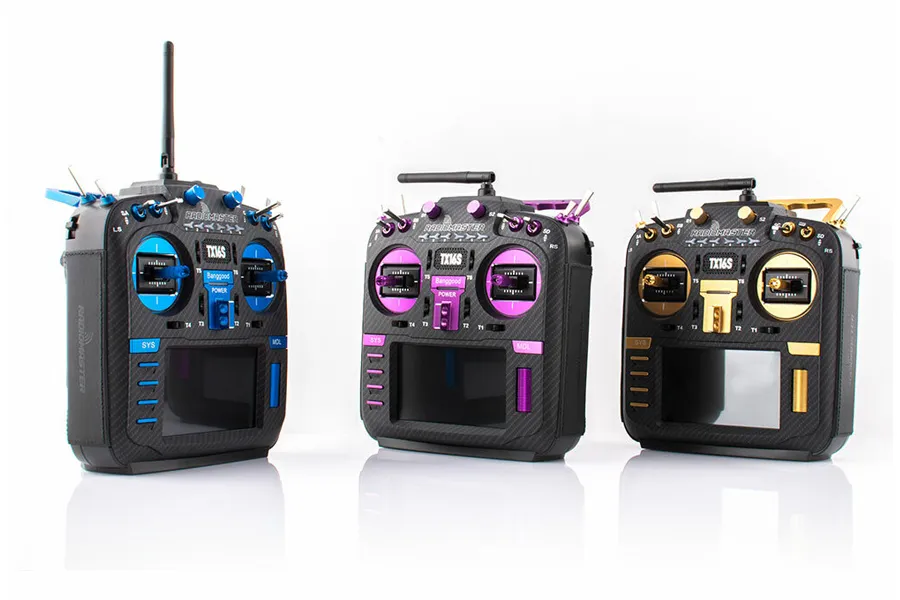
Often referred to as a remote control, a drone remote control is a device that controls the flight of a drone. It sends control signals from the user to the drone by communicating wirelessly with the drone to control parameters such as the drone’s flight direction, altitude, speed and attitude. A remote control usually consists of two parts: a mainframe and a remote control. The host usually contains a built-in battery, as well as circuitry and antennas to process user input signals and send them to the drone. The remote control usually contains control elements such as control sticks and buttons that the user can use to control the flight of the drone. Many remotes also have displays that show video images of the drone and other important info.
For a first radio, prioritize comfortable gimbals, the correct RF module, EdgeTX or another well-supported operating system, replaceable switches, available spare parts, and a module bay if future expansion matters.
When choosing a remote control for your FPV drone, you need to consider the following factors.
- Reliability and stability: The remote control must be able to operate reliably in a variety of environmental conditions and provide stable signal transmission.
- Ease of operation: The control elements of the remote control should be well laid out, easy to operate, and comfortable in your hand.
- Compatibility: The remote control should be compatible with the drone you are using.
- Functionality: The remote control should do what you need it to, like if you need an autopilot function, you need to choose a remote control that has that function.
- Price: The price of the remote control is also an important factor, and you need to find a cost-effective remote control.
What Brands of Remote Controllers are Available
- Radiomaster
- Futaba
- Spektrum
- FlySky
- Radiolink
- Jumper
- Drone Controller From MEPSKING
All of these brands of remote controls have a certain following and user base in the market. FrSky is one of the most popular brands in the FPV drone remote control market, and its products are well-known for their performance and reliability. Futaba and Spektrum are also well-known remote control brands, used in the drone and modelling fields. Their products are known for their excellent quality and accuracy. FlySky and Radiolink are the more cost-effective brands, and their products are suitable for entry and mid-level users. Jumper is a new brand that emerged in recent years, and its remote control products have good performance and various functions, which are loved by some FPV pilots.
FPV Goggles or Monitor
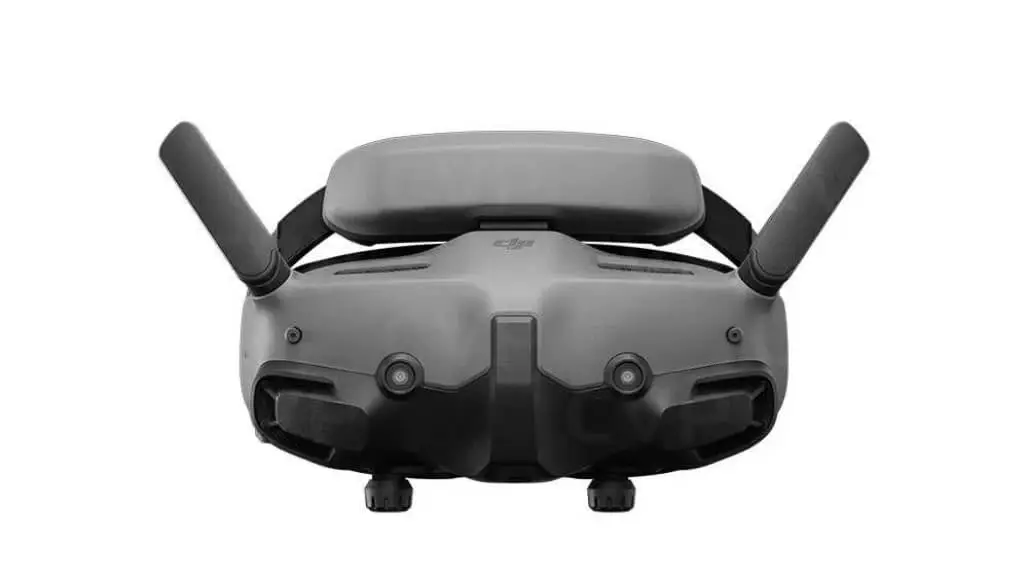
FPV goggles display the live video feed. You can use a monitor, but goggles give the immersive experience most pilots mean when they say FPV.
The goggles must match your video system. Analog goggles will not directly display DJI digital video. DJI goggles will not directly display analog unless supported through an adapter or a separate receiver setup. Walksnail and HDZero also require compatible hardware.
Choosing FPV Goggles
When choosing FPV goggles, consider the following factors:
- Video system compatibility.
- Field of view and screen resolution.
- DVR quality.
- Comfort and IPD adjustment.
- HDMI input/output if needed.
- Receiver module support for analog.
- Battery options.
If the budget allows, goggles are one of the best places to invest. Frames and motors come and go; good goggles can stay with you through many builds.
Popular Brands Offering Reliable FPV Goggles Include:
- DJI
- Fat Shark
- Skyzone
- Orqa
- Eachine
Power Leads, Capacitor, and BEC
These are not glamorous FPV drone components, but they matter.
- XT60 / XT30 lead: connects the battery to the ESC or power board.
- Capacitor: reduces voltage spikes and electrical noise.
- BEC / voltage regulator: provides stable 5V, 9V, or 10V power for electronics.
- Power distribution: often built into the 4-in-1 ESC or stack.
On a 5-inch 6S build, I consider a good low-ESR capacitor mandatory. It is cheap insurance for the ESC, flight controller, and video system.
FPV Frame
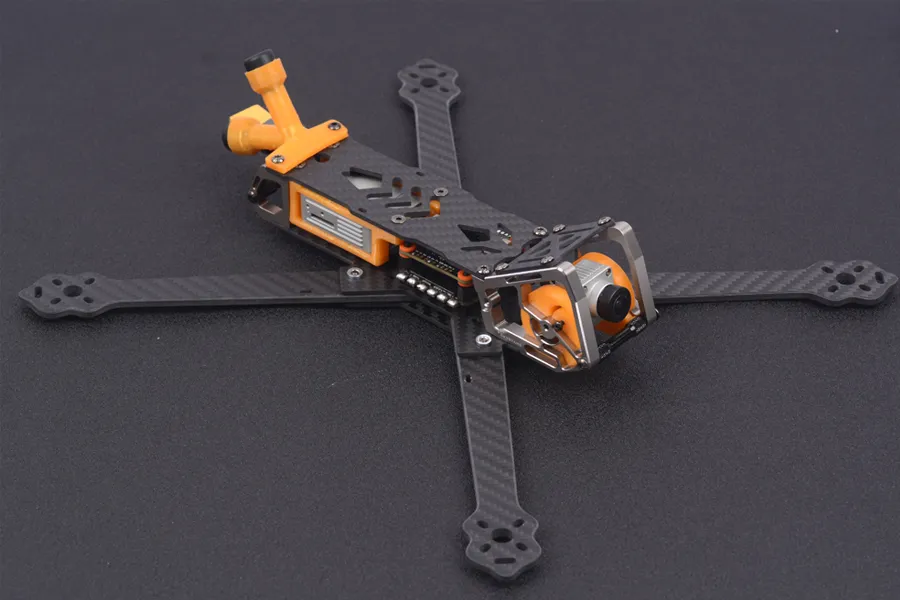
The frame is the foundation of an FPV drone. It holds the motors, flight stack, camera, battery, antennas, and wiring. Most modern FPV frames use carbon fiber because it is light, stiff, and crash-resistant.
A common mistake is calling the frame a “drone rack.” In FPV, pilots almost always say frame. The frame is not just a mounting plate; it strongly affects durability, vibration, weight, prop size, and how easy the drone is to repair.
Look for a robust, lightweight, and resilient carbon fiber frame. Based on your motors and propellers, choose the appropriate frame size. Here is a detailed guide on choosing the best FPV drone frame.
Common FPV Frame Sizes
When you want to build your own FPV drone, you need to first determine what size drone you need. When you buy the parts, first determine what size frame you want to buy, and then choose the other parts according to the size of the frame.
Its advertised size usually refers to the propeller class, not the diagonal wheelbase. A “5-inch frame” is designed around 5-inch propellers and commonly has a wheelbase near 200 to 230 mm.
Below is the explanation of the FPV frame size:
| Frame / Prop Size | Typical Wheelbase (mm) | Best For | Notes |
| Tiny Whoop / 65-85mm | < 100mm | Indoor practice | Ducted, light, safe around people. |
| 2.5 – 3inch | 110 – 150mm | Park flying, small freestyle | IndoQuiet and portable. |
| 3.5inch | 150-180mm | Sub-250g freestyle/cinematic | Great power-to-weight when built carefully. |
| 4inch | 150 – 180mm | Freestyle / Cinewhoop | Freestyle / Cinematic flights |
| 5inch | 200 – 230mm | Freestyle / Racing drone | The classic FPV size. Huge parts ecosystem. |
| 6 – 7inch | 250mm+ | Long-range drone | More efficient, slower response, larger batteries. |
| Cinewhoop | Varies | Indoor/close cinematic | Ducts protect props but reduce efficiency. |
How to Choose a Frame?
For a first build, I usually recommend a 5-inch freestyle frame if you have a safe outdoor flying spot. It has enough space for components, survives crashes better than tiny builds, and teaches you real FPV repair skills.
Look for:
- Arm thickness: 5mm to 6mm arms are common for 5-inch freestyle.
- Stack mounting: 30.5×30.5mm and 20x20mm are common mounting patterns.
- Camera mounting: check whether it fits micro, nano, or full-size cameras.
- Battery mounting: top-mount batteries are common for freestyle; bottom-mount may appear on long-range designs.
- Spare parts: choose a frame with replaceable arms and easy-to-buy hardware.
A frame that is 10 grams lighter but impossible to repair is not a good beginner frame. Crashing is part of FPV. Build for repairability.
For a first custom build, a 5-inch freestyle frame is usually the easiest platform to assemble and repair if the pilot has a safe outdoor location. A tiny whoop is the better first aircraft for indoor practice, but its small solder pads make it a harder first soldering project.
Before buying a frame, check the FC/ESC mounting pattern, motor mounting holes, camera width, VTX or air-unit space, maximum prop clearance, battery location, and availability of replacement arms. On a crash-prone beginner build, easy repair is worth more than saving 10 grams.
What Brands of Frames are Available
There are more common brands of FPV drone frames on the market, five of which are listed below as mainstream brands.
- iFlight
- GEPRC
- AOS
- TBS
- Speedybee
- FPV Drone Frames From MEPSKING
Antennas
Antennas are small, but they can make or break your FPV experience. Your drone usually has at least one video antenna and one radio receiver antenna. Your goggles and radio controller also use antennas.
For analog and many digital FPV systems, circular polarized antennas are common. Match polarization between the drone and goggles: RHCP with RHCP, or LHCP with LHCP. Mixing polarization can cause serious signal loss.
Receiver antennas should be mounted away from carbon fiber, high-current wires, and the VTX antenna. On ExpressLRS builds, I like to keep the active element exposed and protected with a small TPU mount or heat-shrink solution. The throttle, suspect electrical noise, damaged antennas, poor antenna placement, or low-quality power to the VTX.
To sum up, when choosing an antenna for FPV drones, you need to think about things like bandwidth, gain, polarization method, antenna type, weight and size. This is so that the antenna can provide high-quality video transmission and meet the needs of the drone.
What Brands of Antennas are Available
- Foxeer
- TBS (Team BlackSheep)
- Lumenier
- Menace RC
- TrueRC
- Aomway
- FPV Antenna From MEPSKING

Receiver
The radio controller is what you hold. The receiver is the small board on the drone that receives your stick commands. The two must use the same radio protocol.
Popular FPV control links include ExpressLRS, TBS Crossfire, TBS Tracer, FrSky, and DJI controller ecosystems. Today, ExpressLRS is extremely common because it offers strong performance, low latency, and affordable hardware.
For a UART-based ExpressLRS receiver, the receiver TX normally connects to an FC RX pad, and the receiver RX connects to the matching FC TX pad. The receiver uses CRSF in the flight-controller configuration. Always follow the specific FC and receiver diagrams because some inverted or dedicated SBUS pads behave differently.
Choose the antenna for the mission. A tiny ceramic antenna saves space on a whoop. A T-style or diversity receiver provides more flexible antenna placement on larger builds. Keep the active antenna element away from carbon fiber, high-current battery wires, and the video transmitter antenna.
What Matters in a Receiver
- Protocol compatibility: receiver and radio must match.
- Frequency band: 2.4GHz is common; 868/915MHz is often used for longer range, depending on the region.
- Antenna type: ceramic, wire, T-style, diversity, or dual antennas.
- Telemetry: useful for link quality, RSSI dBm, battery data, and warnings.
- UART wiring: receiver TX goes to FC RX, and receiver RX goes to FC TX.
That last point catches many beginners. TX and RX cross over. If the receiver powers on but Betaflight shows no stick movement, wiring and serial port settings are the first things to check.
Read more: How to Pick Receiver for Your FPV Drone?
What Brands of Receivers are Available?
- Fat Shark
- TBS (Team BlackSheep)
- ImmersionRC
- FuriousFPV
- Eachine
- Aomway
- FPV Receiver From MEPSKING

FPV VTX, Digital Air Unit, and Video System
The video transmitter sends the camera feed to your goggles. In analog builds, this part is usually called the VTX. In digital builds, the video module may be called an air unit, VTX, video transmitter, or digital video system.
Common FPV video systems include:
| Video System | Strengths | Trade-Offs |
|---|---|---|
| Analog | Cheap, light, very low latency | Lower image quality, more static. |
| DJI O3 / O4 ecosystem | Excellent image quality and onboard recording | Higher cost, heavier, ecosystem-specific. |
| Walksnail Avatar | Digital HD with flexible options | Requires compatible goggles/VRX. |
| HDZero | Very low-latency digital feel | Image quality differs from DJI-style systems. |
Decide on the video ecosystem before buying the camera, VTX, and goggles. Also check input voltage, power consumption, cooling, dimensions, mounting pattern, antenna connector, camera cable length, and supported goggles.
The following factors need to be considered when choosing a graphics system for FPV drones.
- Picture quality: The picture quality of the graphical transmission system determines the quality of the real-time video seen by the pilot, so you need to choose a graphical transmission system with high picture quality and good clarity in order to observe clearer images while flying.
- Transmission distance: Transmission distance refers to the farthest distance that a map transmission system can transmit video signals. The appropriate transmission distance needs to be selected according to the actual flight requirements.
- Anti-interference: The map transmission system may be interfered with by other electromagnetic signals. It is necessary to choose a map transmission system with better anti-interference to reduce the possibility of signal interference and dropouts.
- Stability: The map transmission system must be reliable and resistant to interference to ensure the signal is not interrupted during flight.
Weight can materially change a small build. For example, DJI lists the O4 Air Unit at about 8.2 g with its camera before the lens mount, while the O4 Air Unit Pro is about 32 g with its camera before antennas. That difference is minor on a heavy 5-inch quad but substantial on a sub-250 g or micro build.
Never power an analog VTX without its antenna. For any video system, provide airflow during long bench sessions, use the correct supply voltage, and follow local frequency and transmitter-power rules.
In short, when choosing a video transmission system for FPV drones, you need to consider factors such as picture quality, transmission distance, anti-interference and stability. Choose a suitable video transmission system according to your actual needs.
VTX Tips That Save Parts
- Never power an analog VTX without an antenna attached.
- Set VTX power legally and responsibly for your location.
- Use the correct antenna connector: U.FL, MMCX, SMA, or RP-SMA.
- Mount antennas away from carbon fiber and battery leads when possible.
- Use VTX table or device control so you can change channel/power from your OSD.
If your video breaks up when you punch the throttle, suspect electrical noise, damaged antennas, poor antenna placement, or low-quality power to the VTX.
What are the Brands of the VTX
- DJI
- Caddx
- Foxeer
- RunCam
- TBS (Team BlackSheep)
- FPV VTX From MEPSKING
All of these brands of VTX products have certain performance and quality assurance, and have a wide user base in the market. Users can choose the most suitable products for themselves according to their needs and budget. Among them, DJI has become the market leader with its digital map transmission products, which are widely recognized for their image clarity and stability. Caddx, Foxeer and RunCam are well-known analog map transmission brands in the market, whose products have high image quality and adaptability. TBS, on the other hand, is a brand that offers both digital and analog mapping products with excellent performance, which is favored by FPV pilots. 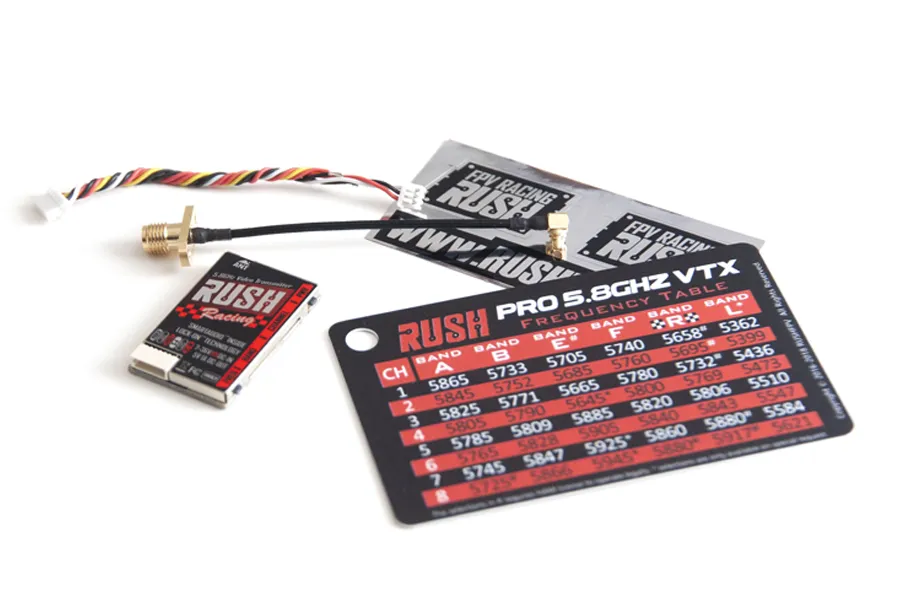
FPV Camera
The FPV camera captures the live view you use to fly. It is not the same as an HD action camera. The FPV camera is chosen for low latency, wide dynamic range, and reliability, not cinematic resolution.
There are two main camera categories:
- Analog FPV cameras: low latency, affordable, works with analog VTX and goggles.
- Digital FPV cameras: used with DJI, Walksnail Avatar, or HDZero systems for higher image quality.
Important camera specs include size, aspect ratio, field of view, sensor performance, low-light handling, and mounting width. A camera with poor dynamic range can make tree gaps disappear when the sun is bright behind them.
For freestyle, I prefer a camera angle that matches my flying speed. Beginners can start around 15-25 degrees. Faster pilots often use 30-45 degrees because the drone tilts forward more at speed. Here are the guides to help you choosing the right FPV camera and Gopro for your drone.
What are the Brands of the FPV Camera
- DJI
- RunCam
- Walksnail
- HDZero
- Foxeer
- FPV Camera From MEPSKING
Optional but Recommended FPV Drone Parts
Building and maintaining an FPV drone requires additional tools and accessories to ensure smooth operation and safety. These include chargers, tools for assembly, and carrying solutions for convenience. Below are some essential items:
Battery Chargers
Reliable chargers are crucial to ensure your drone batteries are charged safely and efficiently. Popular brands for FPV drone chargers include:
Buzzer
A self-powered buzzer is one of the cheapest ways to save a lost drone. If you crash in tall grass, the buzzer can keep beeping even after the main battery ejects.
GPS Module
GPS can provide coordinates, speed, distance, direction to home, and Betaflight GPS Rescue. Current Betaflight documentation describes GPS Rescue as an emergency feature that must be configured and tested carefully; even a correct setup may not bring the quad home. Betaflight recommends at least a 5 Hz GPS update rate for smooth rescue behavior, with 10 Hz and an appropriate baud rate commonly recommended.
GPS does not automatically give a Betaflight freestyle quad DJI-style position hold or obstacle avoidance. Those features depend on the firmware, sensors, and complete navigation setup.
HD action camera
An action camera records higher-quality footage than the pilot camera. It also adds weight, drag, cost, and crash risk. Include the camera and mount in all-up-weight calculations before choosing motors and batteries.
Remote ID module for U.S. operations
For U.S. recreational flying, the FAA states that drones weighing 250 g or more must be registered. Drones that are required to be registered must also comply with Remote ID unless operated under an applicable exception, such as within a FRIA. Recreational pilots must also complete TRUST. Verify current FAA rules for the exact operation instead of assuming a sub-250 g parts list solves every regulatory requirement.
TPU Mounts and 3D-Printed Parts
TPU parts protect antennas, action cameras, receivers, GPS modules, and battery leads. A good TPU antenna mount often prevents a small crash from becoming a repair session.
Prop Guards and Ducts
Whoops and cinewhoops use ducts or prop guards for safer close-proximity flying. They are helpful indoors and around people, but they add weight and can reduce efficiency.
FPV Drone Assembly Tools
To successfully assemble, repair, and maintain your FPV drone, the following tools are essential:
- Hex Drivers: For tightening or loosening hex screws on your drone frame.
- Precision Screwdriver: Useful for smaller screws in delicate electronic parts.
- Soldering Iron: Crucial for connecting wires and electronic components securely.
- Cleaning Tools: To remove flux residue or dirt that accumulates during assembly.
- Iron Stand: Ensures your soldering iron is safely held when not in use.
- Solder: Essential for creating solid electrical connections.
- Solder Wick & Flux: Used to clean and refine soldering points.
- Tweezers: Ideal for handling tiny parts during assembly.
- Snips: For trimming excess wire or zip ties.
- Cable Ties: To organize wires neatly and securely.
- Hook-up Wire: Extra wiring for repairs or modifications.
- Multimeter: Used to measure voltage, resistance, and continuity for troubleshooting issues.
Backpacks for FPV Drones
Carrying your drone and gear safely is important for FPV pilots who travel frequently. Specialized backpacks offer protective compartments for your drone, goggles, transmitter, batteries, and tools. Popular FPV backpack brands include:
- Torvol
- Think Tank
- Lowepro
With these additional sections, this guide now provides a more comprehensive overview of FPV drone components, helping beginners make informed decisions when building their FPV drones.
FPV Drone Parts List by Build Type
These are practical starting ranges, not fixed recipes. Verify each product’s manufacturer data before ordering.
| Build type | Typical onboard parts package | Best for | Main compatibility risk |
| 1S tiny whoop | 65 to 75 mm ducted frame, AIO FC/ESC/receiver, 0702 to 0802 motors, 31 to 40 mm props, lightweight video system, 1S battery | Indoor learning | AIO receiver protocol, motor plugs, battery connector, and video ecosystem |
| 3 to 3.5-inch freestyle | Lightweight carbon frame, 1404 to 1604-class motors, 20×20 stack or AIO, 4S battery, micro video system | Parks, travel, possible sub-250 builds | Final takeoff weight and digital-system mass |
| 5-inch freestyle | 5-inch frame, 2207/2306 motors, 45A to 60A 4-in-1 ESC, supported FC, 5-inch tri-blades, 6S 1050 to 1500 mAh LiPo, receiver, video system | General outdoor freestyle | Motor KV, battery voltage, ESC current, stack pinout, and camera/VTX fit |
| 2.5 to 3.5-inch cinewhoop | Ducted frame, motor/prop combination designed for ducts, compact stack or AIO, digital or analog video, battery selected by final weight | Protected close-proximity filming | Overweight build, heat, prop-to-duct clearance, and camera mounting |
| 6 to 10-inch long range | Efficient frame, lower-KV motors, efficient props, GPS, buzzer, reliable control link, carefully mounted antennas, LiPo or Li-ion mission battery | Cruising and endurance | Current capability, GPS setup, antenna placement, failsafe testing, and legal operation |
Beginner 5-Inch Freestyle Build
A 5-inch FPV drone is one of the most popular setups for freestyle flying and beginners who want to build their first custom FPV drone. It offers a great balance of power, flight time, and durability.
Below is a typical 5-inch FPV drone parts list used by many pilots.
| Component | Recommended Specification | Purpose |
|---|---|---|
| Frame | 5-inch carbon fiber freestyle frame | Holds all drone components |
| Motors | 2207 or 2306 (1700–1950KV for 6S) | Generates thrust |
| ESC | 45A-60A 4-in-1 ESC | Controls motor speed |
| Flight Controller | F7 Flight Controller Betaflight-compatible | Processes flight data |
| Propellers | 5×4.3×3 tri-blade props | Provides lift and control |
| FPV Camera | Analog or HD FPV camera | Captures live video |
| VTX | 25–800mW video transmitter | Sends video signal |
| Receiver | ELRS or Crossfire receiver | Receives radio signals |
| Battery | 6S 1300–1500mAh LiPo | Powers the drone |
| Antenna | Circular polarized antenna | Improves signal quality |
This setup is widely used for freestyle FPV drones because it provides strong performance while remaining relatively easy to build and tune.
Cinewhoop Build
Cinewhoops are built for protected close-proximity filming.
| Component | Practical Starting Point |
|---|---|
| Frame | Ducted 2.5–3.5-inch cinewhoop frame |
| Motors | Matched to ducted prop size and all-up weight |
| Props | Duct-compatible props with good balance |
| Video | Often digital for better live view and recording workflow |
| Battery | Selected by final weight, desired flight time, and camera payload |
| Extras | Soft camera mount, TPU protection, action camera mount |
My take: cinewhoops are easy to make overweight. Every gram matters, especially if carrying a GoPro or DJI Action camera. A heavy cinewhoop may look professional on the bench and fly like a tired brick.
Long-Range Build
Long-range builds prioritize efficiency, signal reliability, GPS setup, and battery planning.
| Component | Practical Starting Point |
|---|---|
| Frame | 6–10-inch efficient frame |
| Motors | Lower-KV motors matched to larger props |
| Props | Efficient bi-blade or low-pitch tri-blade props |
| Battery | Large LiPo or Li-ion pack depending on current draw |
| Receiver | Reliable long-range-capable link with good antenna placement |
| Video | Clean video system with quality antennas |
| Extras | GPS, self-powered buzzer, compass if firmware/build requires it, tested failsafe |
My take: long range is not just “put a bigger battery on it.” Antenna placement, GPS rescue setup, current draw, return margin, and local laws matter more than raw motor power.
Tiny Whoop / Indoor Build
Tiny Whoops are small ducted FPV drones for indoor flying and tight spaces.
| Component | Practical Starting Point |
|---|---|
| Frame | 65mm or 75mm ducted whoop frame |
| FC/ESC | AIO board with built-in ESC and sometimes receiver |
| Motors | 0702, 0802, or similar whoop motors |
| Props | 31–40mm whoop props |
| Battery | 1S or 2S LiPo, usually BT2.0, PH2.0, or similar connector |
| Video | Lightweight analog or digital whoop system |
My take: whoops are safer indoors, but they are not always easier to build. Tiny solder pads and fragile connectors can test your patience. They are excellent for flying practice, less ideal as a first soldering project.
How to Check FPV Drone Parts Compatibility Before Buying
Use this order. It prevents most first-build purchasing mistakes.
1. Define the mission and prop size
Choose indoor whoop, freestyle, racing, cinematic, or long range. Then choose the prop class and frame. Do not start with a random motor sale.
2. Match motor, propeller, and battery voltage
Find manufacturer test data for the exact combination. Check thrust, current, efficiency, and motor temperature. KV alone is not enough.
3. Size the ESC from current data
Confirm battery cell support and add current headroom. Check cooling and whether the stated rating applies to each channel or the whole board.
4. Match the FC, ESC, and frame physically and electrically
Confirm mounting holes, board dimensions, stack height, harness pinout, BEC voltage, firmware target, and USB access.
5. Match the radio receiver to the transmitter
Confirm protocol, frequency band, firmware compatibility, antenna type, and an available FC UART.
6. Match the camera, VTX, and goggles
Choose one video ecosystem. Then confirm camera compatibility, air-unit voltage, mounting space, cooling, antennas, and goggles.
7. Add every gram and every electrical load
Calculate takeoff weight and BEC current with the battery, action camera, GPS, buzzer, antennas, mounts, straps, and Remote ID hardware if required.
8. Verify connectors instead of trusting plug shape
Check XT30/XT60, motor shaft and prop hub, antenna connector, camera cable, and FC/ESC pinout. A connector that fits is not proof that it is electrically correct.
How to build FPV drones?
Without a doubt, beginners can absolutely build FPV drones even without any experience! If you want to build one and are unsure about how to choose from so many parts for a FPV drone, you’ll understand it all after watching this video: How to Choose FPV Drone Parts.
- When selecting a frame, ensure the mounting holes match those of the flight controller.
- Pay attention to the KV value of the motor and choose the appropriate power according to your needs.
- When choosing an Electronic Speed Controller (ESC), make sure its maximum current rating is higher than that of the motor.
- Select the appropriate flight controller (FC) and video transmission equipment (VTX) based on the type of drone.
- For FPV VTX and goggles, choose between analog and digital systems depending on your flying needs and interests.
- Consider the features of ELRS and TBS Crossfire protocols when choosing receivers and VTX modules.
- When selecting a radio controller, opt for one priced above $100 and ensure it fits your hand size and preferences.
If you want to build your own FPV drone, check the FPV parts collection to help you choose components.
Common Beginner Mistakes
After building, repairing, and troubleshooting many FPV quads, these are the mistakes I see most often:
- Buying incompatible parts: the ESC and FC plug fit, but the pinout does not match.
- Using motor screws that are too long: they touch the windings and kill the motor.
- Powering the VTX with no antenna: this can burn out video transmitters.
- Leaving props on during bench testing: dangerous and completely unnecessary.
- Bad solder joints: cold joints cause random resets, video noise, and failsafes.
- No capacitor: voltage spikes and noise make the build less reliable.
- Poor antenna placement: carbon fiber blocks signals more than beginners expect.
- Ignoring weight: every gram affects flight time, throttle feel, and durability.
- Skipping firmware setup: ports, receiver protocol, motor direction, failsafe, modes, and OSD all need checking.
- No spare parts: props, arms, screws, straps, and antennas are consumables in FPV.
Setup Checklist Before the First Flight
Before flying a new build, go through this checklist:
- Remove propellers.
- Check all solder joints and look for solder bridges.
- Use a multimeter for continuity between battery positive and ground.
- Power through a smoke stopper for the first test.
- Confirm flight controller orientation.
- Set receiver protocol and confirm stick movement.
- Set failsafe behavior.
- Check motor order and motor direction.
- Configure VTX channel, band, and power.
- Set OSD warnings for battery voltage, RSSI/LQ, and timer.
- Install propellers in the correct direction only after bench setup is complete.
- Do a short hover test before full-send freestyle.
The first flight should be boring. If the drone lifts smoothly, responds correctly, and lands safely, that is a win.
FAQ: Common Questions About FPV Drone Parts
What is the role of the flight controller in an FPV drone?
The flight controller acts as the brain of the drone, receiving commands from the remote control and adjusting the motor speeds to keep the drone stable and responsive.
Why are brushless motors preferred in FPV drones?
Brushless motors are more efficient, durable, and provide better performance compared to brushed motors, making them ideal for the fast-paced and demanding nature of FPV flying.
How do ESCs affect FPV drone performance?
ESCs control the speed of the drone’s motors, ensuring that the drone responds accurately to the pilot’s commands, contributing to stable and smooth flight.
What size propellers are best for FPV drones?
Larger propellers offer more lift and stability, while smaller ones provide better agility and quicker response times. The choice depends on your flying style and needs.
How does the FPV camera work?
The FPV camera captures live video from the drone and sends it to the pilot’s goggles or monitor, allowing the pilot to view the flight from the drone’s perspective.
What are the advantages of using FPV goggles over a monitor?
FPV goggles offer an immersive experience by placing the video feed directly in front of your eyes, while monitors offer a larger view for more relaxed flying.
Can I use GPS on an FPV drone?
Yes, some FPV drones include GPS modules that offer advanced features like return-to-home, altitude hold, and autonomous flight modes.
How long can an FPV drone fly with a LiPo battery?
The flight time depends on the battery’s capacity and the drone’s power consumption. Most FPV drones can fly for around 5-15 minutes on a single charge.
What is the difference between the transmitter and receiver in an FPV drone?
The transmitter (TX) is the remote control used by the pilot to send commands to the drone, while the receiver (RX) on the drone receives those signals and relays them to the flight controller.
How long do FPV drones last?
The flight time of an FPV drone battery depends on several factors, including the drone’s weight, flying style, throttle management, and battery capacity. On average, FPV drones with a 1300mAh battery can fly for about 5-7 minutes, while larger capacity batteries can provide up to 20 minutes of flight time.