
TL;DR: What Size Motor Do I Need for My FPV Drone?
For most FPV drones, motor size depends first on propeller size, then on battery voltage, all-up weight, and flying style. A 5-inch freestyle FPV drone usually uses 2207 or 2306 motors. A 3-inch quad often uses 1404–1505 motors. A 7-inch long-range quad usually uses 2507–2806.5 motors. Tiny whoops use small motors such as 0702, 0802, 1002, or 1102.
Here is the short answer I would give at the flying field:
| Frame Wheelbase (mm) | Prop Size | Motor Size (Stator) | KV Range (Typical) | Battery (S) |
|---|---|---|---|---|
| 65–85 mm | 31–40 mm (1.2–1.6″) | 06xx – 08xx | 18,000–25,000 KV | 1S |
| 85–120 mm | 2″–2.5″ | 11xx – 14xx | 8,000–12,000 KV | 2S–3S |
| 120–140 mm | 3″ | 14xx – 15xx | 3,500–6,000 KV | 3S–4S |
| 155–180 mm | 4″ | 16xx – 20xx | 3,000–4,500 KV | 4S |
| 195–225 mm | 5″ | 22xx – 23xx | 1,700–2,800 KV | 4S–6S |
| 250–270 mm | 6″ | 23xx – 25xx | 1,500–1,900 KV | 4S–6S |
| 300–330 mm | 7″ | 25xx – 28xx | 1,200–1,800 KV | 6S |
| 360–390 mm | 8″ | 28xx – 30xx | 900–1,200 KV | 6S–8S |
| 400–500 mm | 9–10″ | 30xx – 35xx | 800–1,000 KV | 6S–8S |
My practical rule: choose the lightest motor that can spin your prop without overheating. Bigger motors can make more torque, but they also add weight, current draw, and rotational mass. The best FPV motor is not always the largest one; it is the one that matches the whole build.
Considerations for FPV Motor Sizes When Choosing a FPV Motor
After building and flying everything from 65mm whoops to 7-inch long-range quads, I can tell you this: choosing FPV motor size is not about chasing the biggest stator or copying someone else’s parts list. The right motor size is the one that matches your prop size, all-up weight, battery voltage, and flight style.
The right FPV motor sizes depend on your frame and propeller size:
- 3″ drones → 1404–1505 motors
- 5″ freestyle/racing drones → 2207 or 2306 motors
- 7″ long-range drones → 2507–2806.5 motors
In short: smaller motors (06xx–14xx) suit micro builds and whoops, while mid-size motors (22xx–23xx) power most 5″ FPV drones, and larger motors (25xx–28xx+) are for long-range or heavy-lift platforms. Matching motor, prop, and battery ensures efficiency, thrust, and flight performance.
This guide explains how FPV motor sizes relate to frame, prop, KV, and battery voltage—so you can confidently pick the best FPV motor for racing, freestyle, cinewhoop, or long-range flying. If you want to learn more about how to choose a FPV drone motor, read this guide on How to choose fpv drone motor a detailed guide
What is the Size of A Drone Motor?
What Do FPV Motor Sizes Mean? (Drone Motor Sizes Explained)
In FPV, motor size is not just a number—it describes the physical dimensions of the stator, which is the part that actually generates power. Understanding motor size helps you avoid mismatched builds and choose motors that truly fit your flying style, whether it’s freestyle, racing, cinematic, or long-range.
FPV Drone Motor Components
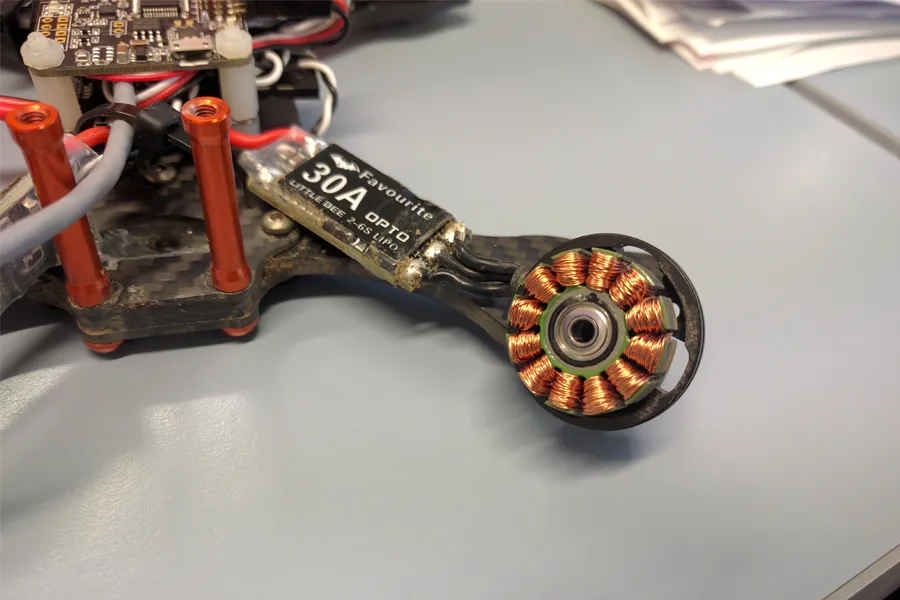
There are two major components to an FPV drone motor: rotor and stator.
- Rotor – the rotating component with the magnets arranged in a radial manner
- Stator – the portion with electromagnets that is non-rotating
If you want to learn more about the internal structure of FPV drone motors, click on the blog: What is the Structure of Drone Motor?
FPV Drone Motor Sizes Explained
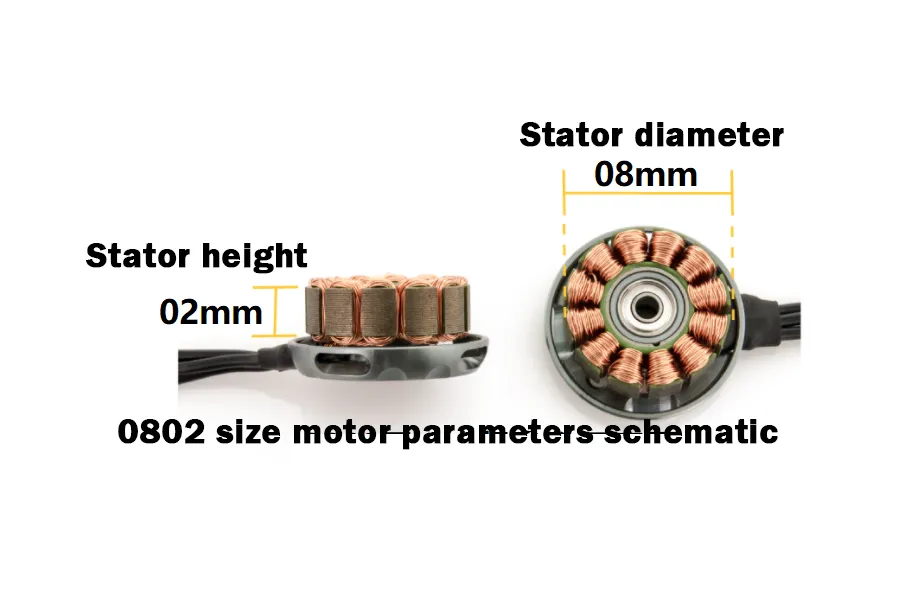
A group of four numerals, such as 2207, 2306, or any other number, represents the size of a specific motor model. It indicates the rotor’s height and diameter in millimeters (mm).
- First two digits → stator diameter (in millimeters).
- Last two digits → stator height (in millimeters).
For example:
- 2207 Motor: 22 represents the stator width (or stator diameter), 07 represents the stator height, both measured in millimetres.
- 2306 Motor: 23 represents the stator width (or stator diameter), 06 represents the stator height, both measured in millimetres.
This is important because FPV motor size describes the stator, not the outer bell size. The stator is what largely determines torque, prop control, and how the motor behaves under load.

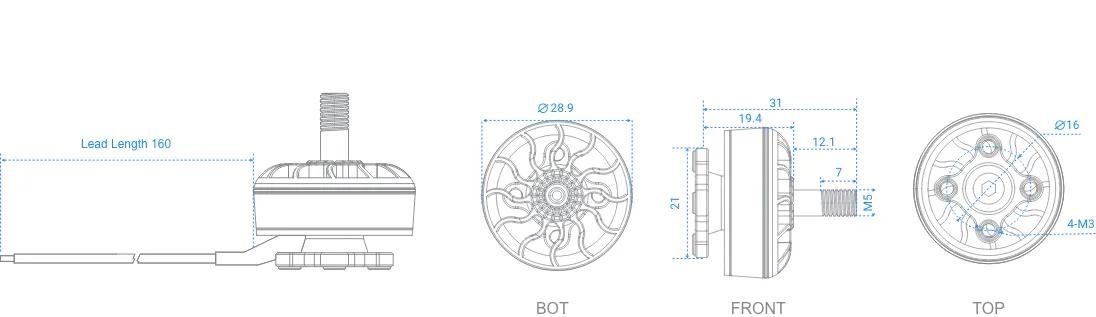
How to read FPV motor dimension drawings provided by manufacturers? Just like the meps motor 2306, for example:
- length of rotor shaft: 30mm±5
- inner diameter: 16mm±05
- outer diameters: 29.31mm±2

Compatibility of FPV Motor Sizes with Other Component Sizes
In FPV drone builds, motor size, propeller size, and frame wheelbase are tightly linked. If one of them is mismatched, your quad will either underperform or risk hardware failure. The frame sets the maximum propeller clearance, the propeller determines the torque demand, and the motor stator size must provide enough thrust to spin those props efficiently.
Rule of thumb:
- Frame wheelbase decides the maximum prop size.
- Prop size dictates the required motor torque.
- Motor stator size should be chosen to balance efficiency, power, and durability for that prop/frame combo.
Pro Tip:
- Using too small a motor on a large prop (e.g., 1407 on 5″) causes overheating & ESC overload.
- Using too large a motor on a small prop (e.g., 2806.5 on 4″) wastes efficiency and feels sluggish.
- Always leave at least 10–15 mm prop tip clearance on the frame to avoid vibration and air turbulence.
Motor Size and Frame Size
- 65–85mm tinywhoop frame → 0702 – 1103
- 3″ frame → 1203 / 1404
- 4″ frame → 1404 / 1505
- 5″ frame → 2207 / 2306
- 7–8″ frame → 2507 / 2806+
- 9-10″ frame → 2810 – 3214
Motor Size and Propeller Size
- Larger motors can spin larger or higher-pitch props
- Smaller motors struggle with heavy prop loads and overheat faster
| Motor Size (Stator) | Typical Drone Type | Safe Prop Size | Common Pitch Range | Notes |
|---|---|---|---|---|
| 0702 | Tinywhoop (65mm) | 31–35mm (1.2–1.4″) | 1.5–2.0 | Ultra-light indoor whoops, very low torque |
| 0802 | Tinywhoop (65–75mm) | 35–40mm (1.4–1.6″) | 1.9–2.3 | Most popular indoor FPV motor |
| 1002 | 75mm Tinywhoop | 40mm (1.6″) | 2.0–2.5 | Better punch, still indoor-safe |
| 1103 | Outdoor Whoop / Toothpick | 2–2.5″ | 2.5–3.5 | Strong torque, handles wind better |
| 1203–1404 | 2.5–3″ builds | 2.5–3″ | 2.5–3.5 | Lightweight freestyle |
| 1505–1606 | 3.5–4″ builds | 3.5–4″ | 3.0–4.0 | Mid-size freestyle |
| 2207 | 5″ Racing / Freestyle | 5″ tri-blade | 3.5–4.6 | High RPM, race-focused |
| 2306 | 5″ Freestyle | 5″ tri-blade | 3.0–4.3 | Balanced torque & efficiency |
| 2407–2507 | 6″ builds | 6″ | 3.0–4.0 | Heavy freestyle |
| 2806 / 2808 | 7–8″ Long Range | 7–8″ bi/tri-blade | 3.0–4.0 | Cinematic & LR |
| 3110 / 3212 | 9–10″ Long Range / Cinematic | 9–10″ bi-blade | 2.5–3.5 | High torque, low RPM efficiency |
FPV Motor Size and ESC & Battery
- Bigger motors draw more current → need higher-rated ESCs
- 6S setups favor larger stators with lower KV
- 4S setups favor smaller stators with higher KV
In FPV builds, motor size sets the ceiling for how aggressive the rest of the setup can be.
Why FPV Motor Size Matters So Much?
Motor size affects more than peak thrust. It changes how the drone feels in the air.
A correctly sized motor gives you:
- Clean throttle response.
- Good prop control.
- Cooler motor temperature.
- Better efficiency.
- Less voltage sag.
- More predictable recovery from dives.
- Lower risk of ESC overload.
A mismatched motor can cause:
- Hot motors.
- Poor flight time.
- Sluggish throttle response.
- Propwash oscillation.
- Desyncs under hard throttle.
- Excessive current draw.
- Heavy, dull flight feel.
From a builder’s point of view, the best test is simple: after a normal flight, touch the motor carefully. Warm is normal. Too hot to hold is a warning. If all four motors are very hot, the motor/prop/tune combination may be wrong. If only one motor is hot, check that motor, prop, bearing, arm damage, ESC output, and screws.
Taller Stator vs Wider Stator
Because the mass of a wider motor is farther from the rotational axis, it takes more energy to alter the RPM when the motor is spinning, resulting in greater inertia. Therefore, even if they have the same stator volume and torque output, broader and shorter motors are typically less responsive than narrower and taller motors. Smaller magnets on the motor bell of wider and shorter motors can also lower the motor’s output.
However, because they have more surface area on top and bottom, wider motors provide better cooling. Motor performance is highly dependent on temperature. A motor’s capacity to produce magnetic flux diminishes with temperature, which affects torque output and efficiency.
A motor stator’s width and height essentially serve as a compromise between cooling and responsiveness. Depending on how you fly, you should make a choice. For example, bigger stator motors may provide greater cooling for slow cinewhoops hauling a heavier GoPro. Taller stator lengths may be preferable for sports drones or racing drones that react quickly. Larger stators also make it possible for larger bearings, which can enhance performance, lifespan, and smoothness.
Not necessarily are larger stators better. For instance, 2207 motors can manage standard 5” propellers. However, utilizing considerably heavier 2506 motors with the same KV may not yield any appreciable advantages since they would still generate the same thrust with the same propellers, or the weight may even result in less responsiveness. Higher KV motors are an option if you want to increase performance without gaining weight. However, because of the higher torque requirements, the 2506 motor in this case would probably perform better with 6” propellers than the 2207.
In short:
Taller Stator (e.g. 2207 vs 2205)
Characteristics:
- Higher torque per amp
- Faster transient response
- Better control at low and mid throttle
- Slightly heavier rotor
Best for:
- FPV racing
- Tight technical tracks
- Pilots who want instant throttle authority
A taller stator increases the magnetic interaction length. This allows the motor to “grab” the rotor harder, making it feel more locked-in and predictable during rapid throttle changes.
Wider Stator (e.g. 2306 vs 2207)
Characteristics:
- Smoother power delivery
- Better sustained RPM
- Higher rotational inertia
- Slightly slower throttle changes
Best for:
- Freestyle
- Cinematic FPV
- Long, flowing lines
The following content will describe in detail how to choose the FPV motor size.
Motor Size vs KV: Do Not Confuse Them
Motor size and KV are different.
- Motor size tells you the physical stator dimensions and torque capability.
- KV tells you roughly how fast the motor wants to spin per volt with no load.
For example, a 2207 1950KV motor and a 2207 2750KV motor have the same stator size but are meant for different battery voltages and setups. The 1950KV version is commonly used on 6S 5-inch builds, while the 2750KV version is more likely to suit 4S builds.
Common 5-Inch KV Pairings
| Battery | Typical 5-Inch KV Range | Notes |
|---|---|---|
| 4S | 2300–2700KV | Older/common freestyle and racing setup. More amps for similar power. |
| 6S | 1700–2000KV | Modern standard for many 5-inch builds. Lower current for similar power. |
| 6S heavy freestyle | 1600–1900KV | Useful for heavier GoPro builds or aggressive props. |
Higher KV is not automatically faster in the real world. If the motor pulls too much current, overheats, or sags the battery, the quad may feel worse even if the spec sheet looks exciting.
How I Actually Choose FPV Motor Sizes?
When I choose a motor for a build, I do it in this order.
Step 1: Determine Your Frame Size
Start with your frame size, usually defined by the motor-to-motor diagonal distance (wheelbase) or by the prop size the frame supports.
Your frame directly limits:
- Maximum propeller diameter
- Motor mounting pattern
- Total weight and thrust requirements
For example:
- 75–85mm frames → Tinywhoop (31–40mm props)
- 120–140mm frames → 3-inch props
- 210–225mm frames → 5-inch props
- 280mm+ frames → 7–10 inch long-range builds
Once the frame size is fixed, everything else must match it.
Step 2: Match the Propeller Size
Props set the load. Motor size has to support that load. If you choose the motor first and ignore the prop, you usually end up with a quad that runs hot, feels lazy, or wastes battery.
- Smaller props (31–40mm): lightweight, fast response, indoor flying
- Medium props (3–5 inch): freestyle, racing, balanced performance
- Large props (7–10 inch): long range, efficiency, payload carrying
Step 3: Look at all-up weight
Two 5-inch quads can use the same prop size and still want very different motors. A light analog freestyle build and a heavy GoPro build do not need the same torque reserve.
Step 4: Match the flight style
This matters more than most spec sheets suggest.
For example:
- for freestyle, I usually want a motor that feels predictable and strong in recovery
- for racing, I care more about immediate acceleration and clean throttle transitions
- for long range, I care more about efficiency and low-throttle control
- for cinewhoops, I care about smoothness, heat control, and carrying weight without feeling strained
Step 5: Match Battery Voltage
Battery voltage affects KV choice. In general:
- 4S builds use higher KV.
- 6S builds use lower KV.
- Larger long-range builds use lower KV for efficiency and heat control.
Step 6: Check Thrust Data and Current Draw
If a manufacturer provides thrust test data, do not only look at maximum thrust. Check:
- Prop used in the test.
- Voltage used in the test.
- Current draw at useful throttle ranges.
- Efficiency in grams per watt.
- Motor temperature if listed.
- Whether the test prop is similar to what you will actually fly.
A motor that wins a max-thrust table may not be the best motor for real freestyle or long-range flying.
Step 7: Leave ESC Headroom
If the motor/prop combo pulls high current, your ESC must handle it. A 5-inch 6S freestyle build commonly uses a 45A–60A 4-in-1 ESC. Smaller builds need less; heavy builds may need more.
Do not pair aggressive high-KV motors and high-pitch props with an undersized ESC. That is how a “budget build” turns into a smoke machine.
Drone Motor Sizes Chart:
Use this FPV motor size chart as a practical starting point.
| Frame Wheelbase (mm) | Prop Size | Motor Size (Stator) | KV Range (Typical) | Battery (S) |
|---|---|---|---|---|
| 65–85 mm | 31–40 mm (1.2–1.6″) | 06xx – 08xx | 18,000–25,000 KV | 1S |
| 85–120 mm | 2″–2.5″ | 11xx – 14xx | 8,000–12,000 KV | 2S–3S |
| 120–140 mm | 3″ | 14xx – 15xx | 3,500–6,000 KV | 3S–4S |
| 155–180 mm | 4″ | 16xx – 20xx | 3,000–4,500 KV | 4S |
| 195–225 mm | 5″ | 22xx – 23xx | 1,700–2,800 KV | 4S–6S |
| 250–270 mm | 6″ | 23xx – 25xx | 1,500–1,900 KV | 4S–6S |
| 300–330 mm | 7″ | 25xx – 28xx | 1,200–1,800 KV | 6S |
| 360–390 mm | 8″ | 28xx – 30xx | 900–1,200 KV | 6S–8S |
| 400–500 mm | 9–10″ | 30xx – 35xx | 800–1,000 KV | 6S–8S |
This drone motor size chart is not a hard rule. It is the range most pilots start from before adjusting for quad weight, battery voltage, prop pitch, and flight style.
Matching Drone Motor Size to Propeller Size
The size of your propellers should match the motor size for optimal efficiency and performance.
- Larger motors generally work better with larger props (e.g., a 2207 motor with 5-inch props), providing more thrust and stability.
- Smaller motors are suited to smaller props (e.g., a 1404 motor with 3-inch props), offering faster response times but less overall thrust.
Choosing the right combination ensures your drone performs as expected, without overloading the motors or underutilizing their potential.
Battery Compatibility and Voltage Selection
Voltage Considerations (3S, 4S, 6S): The voltage of your battery (measured in S, where each cell is 3.7V) significantly impacts motor performance. Higher voltage (e.g., 6S) can produce more power and efficiency, but requires motors with a lower KV rating to maintain balance and avoid overheating. For instance, a 6S setup might pair well with a 1700KV motor, while a 4S setup could use a 2300KV motor for similar performance.
Typical pairings:
- 4S → ~2300–2600KV (5-inch freestyle/racing)
- 6S → ~1600–1900KV (5-inch performance builds)
- 6S long range → ~1200KV or lower
Ensuring your drone motor’s KV rating matches your battery voltage will help prevent issues like excessive heat, poor efficiency, or even motor burnout.
2207 vs 2306: The Most Common 5-Inch Question
If you spend time around American FPV pilots, this is one of the most common motor sizing debates.
Here is the practical answer:
2207is the classic “do-everything” 5-inch size2306is also a proven 5-inch size and often feels a little smoother and more free-revving- neither is universally better; the rest of the build decides which one makes more sense
On most 5-inch freestyle quads:
2207is a safe default if you want strong overall control and a familiar feel2306is a great pick if you want a balanced freestyle setup with good efficiency and smooth throttle feel2306.5or2208starts making more sense on heavier builds or when you want a more planted feel
If a pilot is unsure, 2207 and 2306 are still the two sizes I would tell them to shortlist first.
Bench-Test Data That Supports the Sizing Logic
This article should not rely on theory alone. Real motor sizing decisions should be backed by thrust and power data.
One useful example is the MEPS SZ2306 V2 motor page, which includes a dedicated data-test section and states that the 1950KV version can reach 1081.9W max power on its tested setup. The same page also claims a 25% improvement in efficiency and up to 40% longer flight time for the V2 design when paired with 5-inch 3-blade 5145 props. That lines up with what many pilots expect from a properly matched 2306 motor on a 5-inch freestyle build: strong output without stepping into oversized long-range stator territory.
A second useful reference is the MEPS SZ2207 V2 product page, which also includes a data-test section and positions the motor for 5-inch racing and freestyle setups. While the text on the page emphasizes burst power and smoother throttle response rather than listing the full chart values in crawlable text, it still supports the real-world pattern pilots see: 2207 remains one of the most versatile 5-inch motor sizes because it sits in the sweet spot between torque, response, and weight.
The takeaway is simple: when test data and field experience agree, 5-inch quads consistently land in the 2207 to 2306 window for a reason.
Recommendations: Drone Motor Sizes for FPV
Drone Motor Size Guide:
| Drone Type | Frame Size | Recommended Motor Size | KV for 4S | KV for 6S | Battery Type | Best Use Case |
| TinyWhoop | 65mm | 0702, 0802, 0603 | 19,000-32,000 | – | 1S | Indoor FPV, Racing, Freestyle |
| 75mm | 0802, 1002 | 19,000-25,000 | – | 1S | Indoor/Outdoor FPV | |
| 85mm | 1003, 1103, 1203 | 10,000-14,000 | – | 2S | Indoor/Outdoor FPV | |
| Toothpick | 2″ | 1002, 1003 | 16,000-22,000 | – | 1S | Lightweight outdoor freestyle/racing |
| 2″ | 1202.5, 1003 | 10,000-14,000 | – | 2S | High-speed outdoor flying | |
| 2.5″ | 1203, 1403, 1104 | 10,000-14,000 | 6,000-10,000 | 2S-3S | Powerful outdoor freestyle/racing | |
| Freestyle/Racing | 3″ | 1104, 1204, 1304 | 4,000-7,000 | 3,000-6,000 | 3S-4S | High-performance freestyle, racing |
| 3.5″ | 1404, 1504 | 3,500-5,000 | 2,500-4,500 | 4S-6S | Large micro-class FPV | |
| Freestyle | 4″-4.5″ | 2205, 2304.5 | 2,500-3,500 | 2,200-3,300 | 4S-6S | Light & agile freestyle FPV |
| Freestyle/Racing | 5″-5.5″ | 2207, 2306, 2306.5 | 2,100-2,750 | 1,700-2,100 | 4S-6S | Standard FPV drone, freestyle, racing |
| Freestyle/Long Range | 6″ | 2308 | – | 1,300-1,800 | 6S | Versatile, mid-range freestyle/cruising |
| Long Range | 7″ | 2408, 2508, 2806.5 | 1,600-1,900 | 1,000-1,400 | 4S-6S | Long-range FPV, endurance flights |
| Heavy Lift/Long Range | 8″ | 2808, 2809, 3110 | – | 900-1,200 | 6S-10S | Cinematic filming, mapping, industrial use |
| Heavy Lift/Long Range | 9″-10″ | 2814 3110 3115 3214 | – | 900 | 6S-12S | Cinematic filming, mapping, industrial use |
Best Motor Sizes for Micros:
TinyWhoops:
65mm:
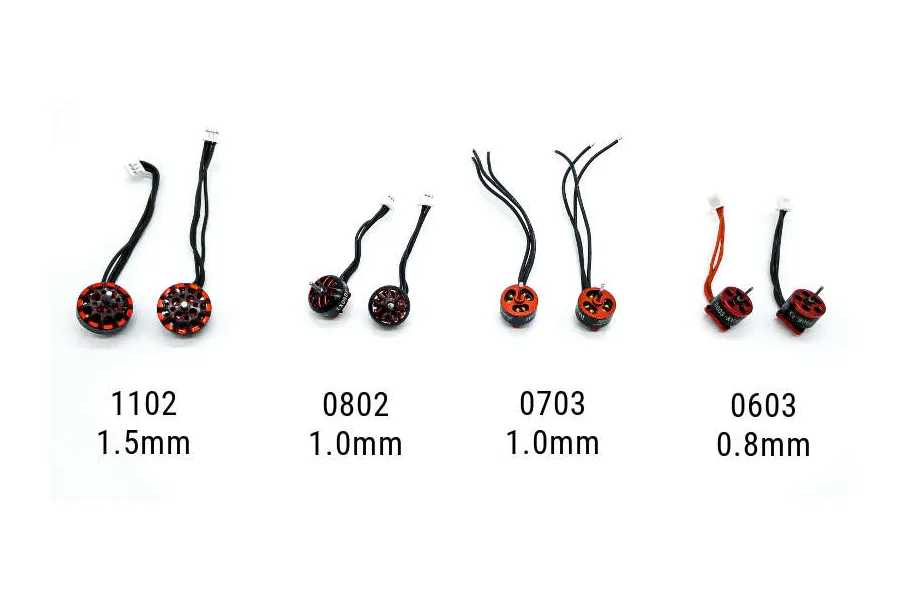
For a micro drone of this motor size, often classified as a tiny whoop, the perfect FPV motor size varies depending on the application of your drone.
- If weight is your priority, a 0702 motor will fit your needs with it also being zippier and coming in a large range of ultrahigh KVs.
- If torque and power at the cost of efficiency are your priority, for a 65mm, 0802 is the best choice.
- With 0603 being for the chunkier builds like a Meteor 65 pro.
For these drones, the KV options are vast, ranging from 19,000 up to 32,000, so for more control, choose a lower KV, but for raw thrust, high KV is the only way. The MEPS 0802 motors are a great choice for this.

Optimal KV Range:
- 1S: 23,000-30,000 KV for triblade props, 30,000+ KV for two-blade props
75mm:
For a larger micro drone with a more efficient and powerful performance, 75mm with 1s is the best as it’s good for indoors and can fly outdoors with ease while getting more flight time.
Motor Sizes: 0802, 1002, 1102, 1103
Optimal KV Range:
- 1S: 20,000-25,000 KV
- 2S: 12,000-14,000 KV
- 3S: 8,000-11,000 KV
Recommended Propellers: 40mm (1.6″) triblade or two-blade
In a 75mm light-weight build, 0802 with a KV ranging from 19,000 to 25,000 is more than enough for high performance and efficiency. If power is your true goal or you are using a 75mm frame with larger ducts, such as the Meteor 75 pro or the Fractal 75 pro max, a 1002 motor with the same KV range will work well at the cost of some weight and efficiency.
85mm:
These ducted whoops are truly no longer for indoor and are no longer outdoor rippers, mainly running 2s batteries with an XT30 connector. There are many different sizes for motors which can be employed, but the ideal ones used on most BNF drones are xx03, meaning something like a 1003, 1103, or 1203 will work fine with these larger whoops. The recommended KV is from 10,000 to 14,000 max for 2s. The MEPS 1103 motors are a great fit for this drone class.

Best Motor Sizes for Toothpicks:
2” 1s: A toothpick of these specifications will be using smaller motors for a lighter weight with motor sizes ranging from 1002 at minimum, with 1003 being on the high end. The recommended KV would be from 16,000 to 22,000 at the high end.
2” 2s: These toothpick drones are truly powerful and can cover a larger outdoor area. Motor recommendations range from xx2.5 to xx3, such as 1202.5 and 1003 motors. Use the same KV as the 85mm drones, which employ the same sized propeller. The MEPS 1103 motor is a great option for this size.
2.5”: These drones almost always use 2s and 3s, so for a build of this spec, larger motors must be used, such as xx03 to xx04, such as a 1203, 140,3 or 1104, and similar sizes. The recommended KV would be anywhere from 10,000 to 14,000 on 2s and 6,000 to 10,000 on 3s. The lower KV MEPS 1103 motor is a great option for 3s power.
Best Motor Sizes for Freestyle & Racing Flight:
Small Sized Drones:
3”: This is where drones start to leave the micro class as they grow larger and much more powerful. These drones commonly run on 3s-4s batteries and use larger motors. The recommended drone motor size would be something like an xx04, such as an 1104, 1204 or 1304 motor. For 3s, the recommended KV would be anything from 4,000 and 7,000, and for 4s, anything from 3,000 to 6,000 should provide plenty of power for this class.
3.5”: This class of drones is the limit for a micro and these drones commonly use 4s-6s batteries. For FPV motor size, the recommended size for this class of large micros is xx04 motors, such as 1404,1504 and similar sizes. The recommended KV for 4s is 3,500 to 5,000 and for 6s, the recommended KV would range from 2,500 to 4,500. The MEPS 1404 motors would be a great choice with a build of this size for drone motor.

Medium Sized Drones:
4”- 4.5”: These drones are almost full-sized freestyle drones. They may be of similar size, but the performance is dramatically different, with the 4-4.5” drones being much lighter and nimble. The recommended FPV motor sizes for this frame would be xx04.5-xx05, such as a 2205 or 2304.5 motor. The recommended KV for 4s is 2,500-3,500, and for 6s, the recommended KV would be 2,200 to 3,300.
Full Sized Drones:
5”-5.5”: What size motor should I use for a 5-inch drone? A 5 inch FPV drone typically uses 2207 or 2306 motors with a KV rating between 1750KV-2400KV, depending on battery voltage and flight style. The 2207 motor is overall larger and gives more torque and thrust, while the 2306 motor is generally smoother and more efficient, due to the wider and shallower stator for better cooling. The recommended KV for 4s is 2,100-2,750, and the recommended KV for 6s would be 1,700-2,100.
5″ Racing Drone:
Motor Sizes: 2205, 2206, 2207, 2208, 2306, 2308
Optimal KV Range:
- 4S: 2,500-3,000 KV for racing applications
- 6S: 1,900-2,300 KV for racing applications
5″ Freestyle Drone:
Motor Sizes: 2206, 2207, 2208, 2306, 2307, 2308
Optimal KV Range:
- 4S: 2,300-2,700 KV
- 6S: 1,700-2,100 KV (Lower KV motors provide a smooth, predictable feel while maintaining good power efficiency)
- 8S: 1,500-1,700 KV

6”: This drone sits in the middle of a 5” freestyle drone and a 7” long range drone. A 6” drone is versatile as a cruiser and light freestyle drone, mainly used with 6s power. These drones use slightly larger motors with the recommended size being xx08, such as a 2308 motor. The recommended KV for 6s is anywhere from 1,300-1,800.
Motor Sizes: 2207, 2208, 2306, 2307, 2308, 2407
Optimal KV Range:
- 4S: 2,100-2,500 KV
- 6S: 1,500-1,900 KV
Best Size for Large Drone Motors
7 Inch Drone Motor
7-inch drone motors are commonly used for long-range FPV flights or efficient cruising, often equipped with high-capacity batteries to extend flight time. Compared to 5-inch and 6-inch drones, 7-inch builds require larger motors with higher torque to drive the longer propellers.
- Recommended Motor Size: xx08-xx09, such as 2408, 2508, or 2806.5
- Recommended KV Ratings:
- 4S Battery: 1,600-1,900KV
- 6S Battery: 1,000-1,400KV
- Key Features:
- Low KV motors with larger propellers improve efficiency and reduce current draw
- Higher torque enhances load capacity and stable cruising
- Ideal for long-range FPV or extended flight applications
A great motor choice for 7-inch drones is the MEPS SZ2806.5, which offers a perfect balance of power and efficiency. Another great option for this is the GEPRC 2809 SPEEDX2 motors, as they are a great value and provide great thrust-to-weight ratios.

8 Inch Drone Motor
8-inch drone motors are designed for even larger drones, primarily used for professional aerial photography, mapping, and industrial applications. These drones typically run on higher-voltage batteries (such as 6S or above) for improved efficiency and use high-thrust motors to support larger propellers.
- Recommended Motor Size: xx09-xx10, such as 2808, 2810, 2814, 3108, 3110, 3115, 3214
- Recommended KV Ratings:
- 6S Battery: 900-1,200KV
- 8S-10S Battery: 600-900KV
- Key Features:
- Higher torque for heavy-lift applications, such as professional aerial cinematography
- Low KV motors maximize efficiency, reduce power consumption, and extend flight duration
- Ideal for endurance flights, mapping, patrolling, and search-and-rescue operations
For 8-inch drone motors, a solid choice is the MEPS NEON 2808 and NEON 2812, which deliver reliable thrust and optimized flight efficiency for long-duration operations.
9 – 10 Inch Drone Motor
9–10 inch drone motors are built for large FPV platforms, including long-range cruisers, cinematic rigs, and heavy-lift drones. These setups prioritize efficiency, stability, and sustained torque rather than fast throttle response, and they almost always run on high-voltage battery systems.
- Recommended Motor Size: xx10–xx12, such as 2812, 3110, 3115, 3210, 3212, 3215
- Recommended KV Ratings:
- 6S Battery: 700–900KV
- 8S Battery: 500–800KV
- 10S–12S Battery: 350–600KV
- Key Features:
- Extremely high torque to drive large 9–10 inch propellers efficiently
- Low KV design improves electrical efficiency and reduces heat under load
- Optimized for smooth throttle response and long flight times
- Ideal for long-range exploration, cinematic payloads, mapping, and industrial missions
For 9–10 inch drones, a reliable option is the T-Hobby V3115, offering strong torque output, excellent cooling, and stable performance for demanding long-range and cinematic builds.
Best Motor Sizes for Cinewhoops:
2”: This small indoor Cinewhoop uses the same-sized motors as the other 2” prop spinning drones, with the ideal motor size being xx03, such as 1003 and 1103. And the ideal KV is 10,000 to 14,000. A great choice is the MEPS 1103 motor.
Motor Sizes: 1003, 1103, 1203, 1303, 1404
Optimal KV Range:
- 2S: 7,500-15,000 KV
- 3S: 6,000-8,000 KV
- 4S: 5,000-6,000 KV
2.5”: This is the step up from the 2.5” Cinewhoop using a 4s battery, with it being one of the most versatile drones you can get. They do well both indoors and outdoors, with the recommended FPV motor size being xx04, such as 1404, and the recommended KV being 4,000-6,000. The MEPS 1404 motor is a great fit for this.
3”: This is a Cinewhoop to be mainly used outdoors in some larger indoor applications. The recommended FPV motor size would again be xx04, such as a 1504 motor. The recommended KV would be from 3,500-4,300 for 4s and 3,000-3,800 for 6s. The MEPS 1404 motors would work well on this build as well.
3.5”: This is a Cinewhoop for outdoor use with much better performance and efficiency than the others. The recommended motor size would be xx04-xx05.5, such as a 2004 or 2005 motor. The recommended KV for 4s would be 2,300-2,80,0 and 1,700-2,200 for 6s. The MEPS 2004 motors are a great option for a build like this.
Common FPV Motor Size Mistakes
These are the mistakes I see most often:
- choosing motors by KV only
- using a heavy, aggressive prop on a motor that is too small
- assuming bigger motors are always better
- ignoring quad dry weight and payload
- copying race setups onto freestyle builds
- using long-range motor sizes on light freestyle builds and losing responsiveness
Best FPV Motor Sizes by Build Type
If you want the short version, this is where I would start:
- for tiny whoops, look at
0702,0802, and1002 - for 3-inch and 3.5-inch quads, start with
1404or1504 - for 5-inch freestyle, start with
2207or2306 - for 5-inch racing, start with
2207and compare it with lighter or more aggressive KV options - for 7-inch long-range, start with
2806.5or2807
That is the practical version of a drone motor sizes guide. It is not just about what fits. It is about what flies well.
Drone Motors Matching from MEPS
For detailed information, you can check the article: MEPS Motors Size Choosing Guide
FAQ
What’s a Brushless Motor?
What’s a Brushless Motor? Simply put, an FPV drone motor has no brushes, as the name suggests. The rotor and the stator are the two distinct parts that make up a brushless motor. The core component that the rotor is attached to is called the stator. The stator is composed of a network of radial electromagnets that, when a current flows through the windings, alternately turn on and off to create a momentary magnetic field. A set of permanent magnets housed in the rotor is positioned near the electromagnets of the semi-permanent stator. Rotation is produced by the stator and rotor magnets’ attractive and repulsive interactions. After the rotor is constructed, its shaft is placed into two ball bearings in the stator to keep the rotor rotating smoothly and linearly.
The brushless motor cannot be driven directly, even though it is powered by DC current. Rather than requiring brushes or a commutator, the brushless motor is directly connected to the control electronics. Because the rotor and stator do not come into direct contact, brushless motor longevity is exceptional. In terms of efficiency, the brushless motor outperforms the brushed motor as well. In applications requiring high power outputs and efficiency—such as tiny and micro multicopter applications—brushless motors are widely used. If you want to learn more about the differences between brushed and brushless motors, check out the guide
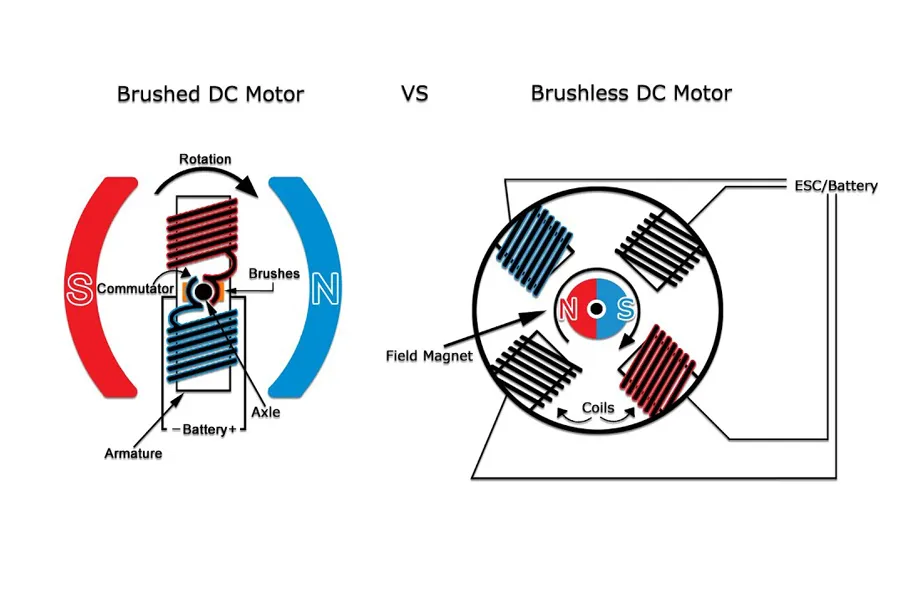
Brushed vs Brushless Motor: What’s the Difference?
Typically, mini drones and lightweight configurations use brushed motors. Because of the brushes on its lower half, it may be powered directly by direct current DC; nonetheless, it is not very effective in scenarios when maximum power is required. Brushless motors, on the other hand, might be a better choice if you’re designing a racing drone, which will place a high demand on the motor because of its weight and capacity.
What Size Motor is a 5 Inch FPV Motor?
The 2207 and 2306 motor sizes are the most popular for 5-inch drones. While 2306 motors are renowned for their superior responsiveness, 2207 motors often offer more power. The common 16x16mm (M3) mounting style is used by many 5-inch drone motors, guaranteeing wide compatibility with the majority of frames.
2207 Motor VS 2306 Motor
- 2207: Delivers more torque and punch, with faster throttle response. Great for racing and aggressive freestyle.
- 2306: Smoother low-end control with better efficiency and cooling. Ideal for longer flight times or cinematic flying.
Is a bigger FPV motor always better?
No. A bigger motor can add weight, reduce efficiency on small props, and make a light quad feel less lively. Bigger is only better when the prop load, battery, and build weight justify it.
Conclusion
The best way to use a drone motor size chart is not to treat it like a rulebook. Treat it like a starting map. Then refine your choice based on prop size, quad weight, battery voltage, and what kind of flying you actually do.
If you want the simplest advice from a pilot’s perspective, it is this:
- light quads want light motors
- heavy props want more torque
- 5-inch freestyle still lives in the
2207to2306zone for good reason - motor size makes sense only when it matches the whole build