
If your FPV drone feels underpowered, unstable, or unresponsive, the issue might not be your motor—it could be your ESC.
An Electronic Speed Controller (ESC) is one of the most critical components in any drone. It directly controls motor speed, responsiveness, and overall flight performance.
In this guide, you’ll learn:
- What an ESC is and how it works
- Types of ESCs (4-in-1 vs single ESC)
- ESC ratings, firmware, and protocols
- How to choose the right ESC for your drone
- Best ESC recommendations for FPV drones
Whether you’re building your first drone or upgrading to a high-performance setup, this guide will help you make the right choice.
What is An FPV ESC?
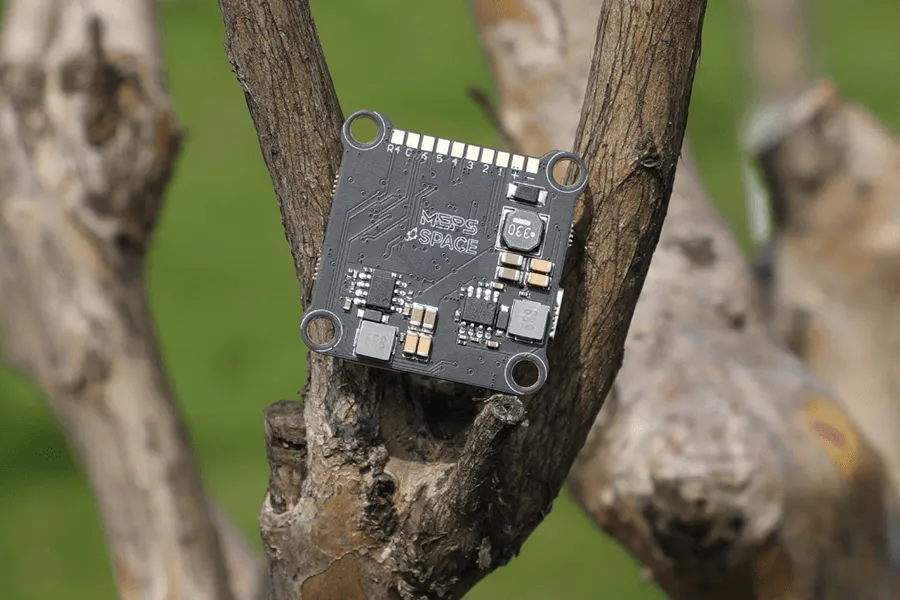
Electronic speed controller (ESC) is a device that regulates the speed of a brushless motor by converting signals from the flight controller into controlled motor output.
In FPV drones, ESCs are responsible for:
- Controlling motor speed
- Stabilizing flight
- Delivering power efficiently
- Translating flight controller commands into motion
Without an ESC, your motors cannot spin or respond to your inputs.

How do Electronic Speed Controllers Work?
An ESC receives throttle signals from the flight controller and converts battery power (DC) into three-phase AC to drive brushless motors.
It rapidly switches current through MOSFETs, allowing precise control of motor speed. This is what enables smooth flight, fast response, and stable control.
The Different Types of ESCs
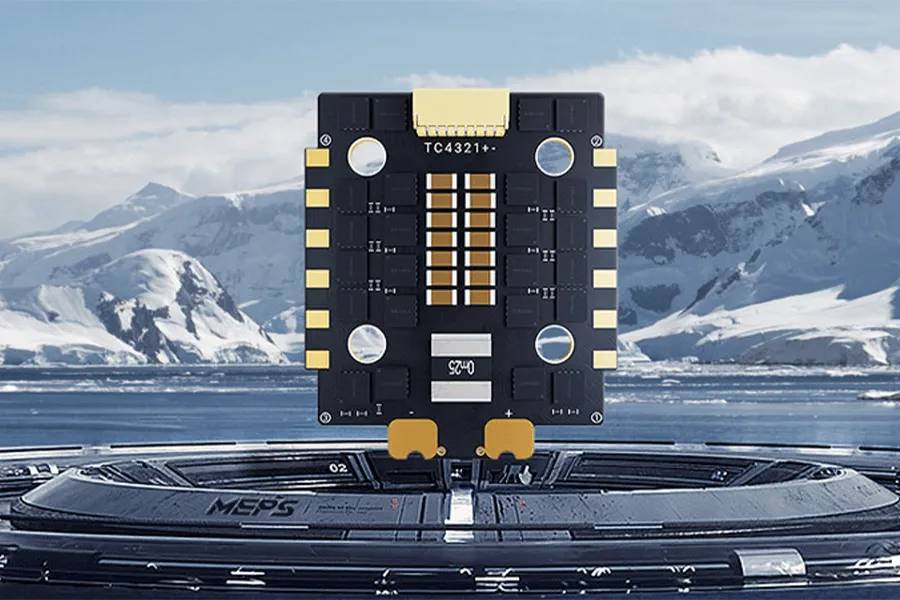
There are two primary types of ESCs to take into account: single ESCs and 4-in-1 ESCs. Your FPV drone’s overall design and performance are influenced by the distinct advantages and considerations that each type offers.
4-in-1 ESC
As the name implies, the 4-in-1 ESC combines four separate ESCs into a single circuit board. For synchronized motor control and peak performance, each ESC manages a motor on its own. The following are the main attributes and advantages of 4-in-1 ESCs:
- Simplified Installation: The 4-in-1 ESC’s small size makes it simple to connecting 4 in 1 ESC to the flight controller, which makes the construction look neater and more put together. During the build process, installation becomes simpler and requires less time and effort because there are fewer solder joints and electrical connections.
- Weight Distribution: The drone’s overall balance and responsiveness are improved by distributing the weight uniformly throughout the one board that houses the ESCs. The drone’s flight qualities may be positively impacted by this weight distribution, increasing its maneuverability and agility.
- Various Size Options: To support a range of drone layouts, 4-in-1 ESCs are available in different sizes. The three most popular sizes are 4in1 ESC 20×20, 16×16, and 30×30 mm. Larger FETs (Field-Effect Transistors) in ESCs make them more robust and long-lasting. FPV drones with frames that are 5″ or larger are typically equipped with 30x30mm lenses.
Despite the many advantages of 4-in-1 ESCs, it’s important to remember that if one ESC on the board is broken, the board as a whole needs to be replaced. But contemporary 4-in-1 ESCs are usually dependable, which lowers the chance of an ESC failing on its own
Single ESC
Conversely, single ESCs are responsible for managing a single motor and were more widely used in the past; however, their usage has decreased recently. Key characteristics of a single ESC are as follows:
- Replacement Ease: Individual replacement is a benefit of single ESCs. It is not necessary to replace the entire board if one ESC malfunctions or is damaged. This lowers costs and improves the convenience of maintenance and repairs.
- Considerations for Soldering and Wiring: Using individual ESCs usually necessitates additional soldering and wiring, which can take longer and make the drone heavier because of the weight of the power distribution board and wires (PDB). Furthermore, an “All-In-One” (AIO) flight controller with an integrated power distribution board (PDB) for power supply is frequently required to connect individual ESCs.
- Better Cooling: Single ESCs are usually installed on the drone’s arms, where they are exposed to more direct airflow, which improves cooling. ESC performance can be enhanced overall, and overheating can be avoided with better cooling.
4-in-1 ESCs are becoming more popular because of their simplified installation and advantages in weight distribution, even if single ESCs may still be easier to replace and provide better cooling.
ESC Specifications You Actually Need to Check
When comparing ESCs, do not focus only on the amp rating.
Check these specifications together:
| Specification | Why It Matters |
| Current rating | Determines how much motor current the ESC can handle |
| Voltage rating | Determines which battery cell counts are supported |
| Mounting pattern | Must fit the frame and FC |
| Firmware | Determines configuration and available features |
| DShot support | Determines FC-to-ESC communication |
| Bidirectional DShot | Enables RPM telemetry for RPM filtering |
| Telemetry | Provides ESC data to the flight controller |
| Current sensor | Helps monitor power consumption |
| BEC | Provides regulated power for compatible electronics |
| Cooling | Important for high-current and long-duration flights |
What Does the ESC Amp Rating Mean?
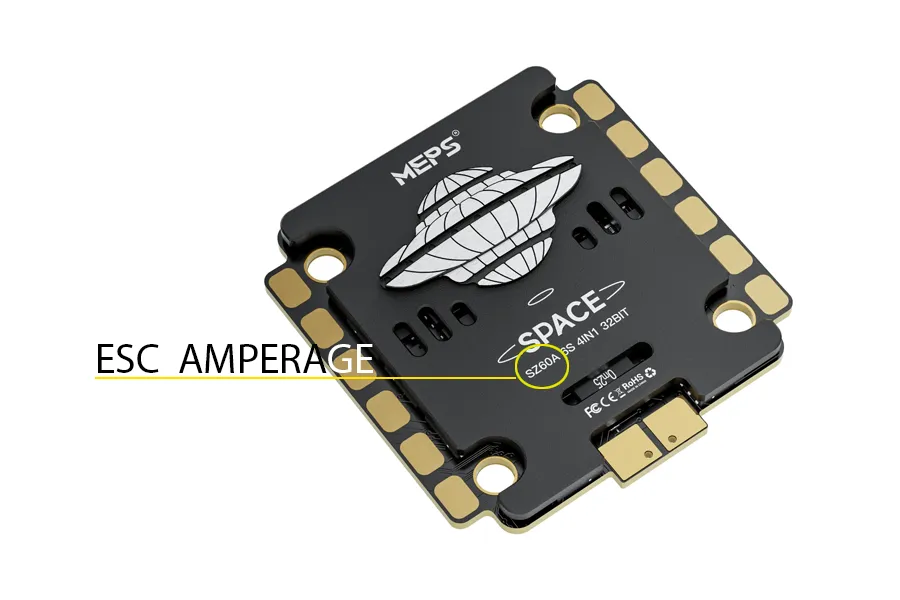
The amp rating tells you how much current the ESC is designed to handle. For example:
- 35A ESC
- 45A ESC
- 55A ESC
- 60A ESC
- 80A ESC
A higher amp rating does not mean the ESC constantly sends more current to the motor.
Continuous Current vs Burst Current
ESC specifications may list both continuous and burst current.
- Continuous current refers to the current the ESC can handle during sustained operation.
- Burst current refers to a higher current level that the ESC can handle for a limited period.
Do not compare two ESCs based only on their headline burst rating. Continuous current, thermal performance, MOSFET quality, PCB design, and test conditions also matter.
What ESC Amp Rating Do You Need?
The motor draws the current it needs according to the battery voltage, motor characteristics, propeller load, and throttle. There is no single amp rating that works for every FPV drone.
As a practical starting point:
| FPV Build | Typical ESC Range | Main Considerations |
| 2.5–3″ Micro | 15A–30A | Low weight and compact size |
| 3–4″ | 20A–45A | Motor current and battery voltage |
| 5″ Freestyle | 45A–60A | Current headroom and durability |
| 5″ Racing | 45A–60A | Response, weight and current capacity |
| 6–7″ | 50A–80A | Motor load and thermal performance |
| 7–8″ Long Range | 60A–80A+ | Continuous load and cooling |
| Cinelifter / Heavy Lift | 80A+ | High current and high-voltage systems |
These are starting ranges, not hard rules. Always check the motor’s current draw with the actual battery and propeller combination.
MEPSKING’s current ESC range covers applications from small builds through 5-inch freestyle/racing and larger high-voltage systems.
What Voltage ESC Do You Need?
Your ESC must support the maximum voltage of your battery. Common FPV battery configurations include:
- 1S
- 2S
- 3S
- 4S
- 6S
- 8S and above for specialized builds
For example, a fully charged 6S LiPo reaches approximately 25.2V. Therefore, a 6S build needs an ESC specifically rated for 6S operation or higher. Never select an ESC based only on its current rating. A 60A ESC that does not support your battery voltage is not suitable for the build.
45A vs 55A vs 60A ESC
This is one of the most common questions when building a 5-inch FPV drone.
45A ESC
A 45A ESC can be a practical choice for:
- Moderate 5-inch builds
- Lower-current motors
- Lightweight racing builds
- Pilots who want to reduce weight and cost
55A ESC
A 55A ESC provides more current headroom and is suitable for many higher-performance 5-inch and 6-inch builds.
60A ESC
A 60A ESC is a common choice when you want additional current capacity for aggressive freestyle, racing, or larger builds.
For example, the MEPS SZ60A supports 3S–6S operation and a 60A current rating, with a 30.5 × 30.5mm mounting pattern.
The key point is: Do not buy a 60A ESC simply because 60A is larger than 45A. Choose the rating based on the actual power system.
How to Choose an ESC for Drone?
The easiest way to select an ESC is to work backward from the complete power system.
Check the Motor’s Maximum Current
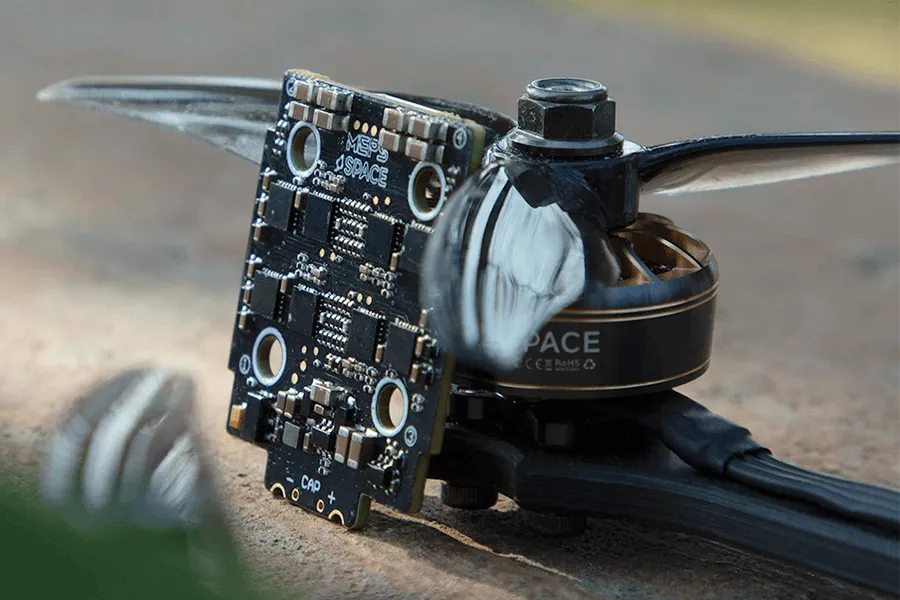
Start with the motor specification.
Look for the motor’s maximum or tested current draw with the propeller and battery you plan to use.
For example, if your motor can draw approximately 40A under the intended setup, choosing an ESC with additional current headroom is sensible.
Do not simply multiply the motor’s maximum current by four and use that as the rating of one 4-in-1 ESC. Each channel of the 4-in-1 ESC needs to safely handle the current of its individual motor.
Check the Propeller
The propeller has a major effect on motor current. A larger or higher-pitch propeller generally puts more load on the motor and can increase current draw. That means the same motor can require different ESC capacity depending on the propeller.
For example:
- Motor + low-load prop → lower current
- Motor + aggressive high-pitch prop → higher current
This is why ESC selection should always consider the motor, propeller, and battery together.
Match the Battery
Battery voltage changes motor power and current behavior. A 4S and 6S version of the same drone may use different motor KV values and have different power requirements. Always verify:
- ESC maximum battery voltage
- Motor KV
- Motor current
- Propeller
- Battery cell count
Consider Your Flying Style
Your flying style also affects ESC requirements.
Freestyle
Freestyle builds often benefit from a durable 4-in-1 ESC with sufficient current headroom for repeated throttle punches and aggressive maneuvers.
Racing
Racing builds prioritize fast motor response, low weight, efficient power delivery, and sufficient current capacity.
Long Range
Long-range builds usually prioritize efficiency and thermal reliability rather than simply choosing the highest amp rating available.
Cinematic / Heavy Lift
Cinematic and heavy-lift builds may require substantially higher current capacity because of larger propellers, heavier aircraft, and longer high-load operation.
Which ESC Is Right for a 5-Inch FPV Drone?
For a typical 5-inch build, a 45A–60A 4-in-1 ESC is a useful starting range.
For example:
- Moderate build → 45A
- Higher-performance freestyle → 55A–60A
- Aggressive racing → 55A–60A
- High-current motor/prop combination → 60A or higher
The mounting pattern is also important. Many 5-inch builds use 30.5 × 30.5mm or 20 × 20mm electronics. Current MEPSKING options include 45A, 55A and 60A 4-in-1 ESCs from brands such as MEPS, T-HOBBY, Flywoo, iFlight and Skystars.
If you are building a 5-inch FPV drone and want to combine a capable flight controller with a high-current ESC, the MEPS NEONCORE 60A 4-In-1 FPV ESC is a practical option to consider.
Why Choose the MEPS NEONCORE 60A ESC?
The NEONCORE 60A is designed for FPV builds that need a capable 4-in-1 ESC with a standard 30.5 × 30.5mm mounting pattern.
Its 60A rating makes it particularly suitable for many 5-inch freestyle and racing setups, especially when paired with motors and propellers that can produce higher current demands.
Key points:
- 60A current rating for high-performance FPV builds
- 4-in-1 design for cleaner and simpler wiring
- 30.5 × 30.5mm mounting for compatibility with many 5-inch frames and stacks
- Suitable for 5-inch freestyle and racing builds
- Provides additional current headroom for aggressive throttle use
Who Should Choose It?
The NEONCORE 60A is a good option if you are:
- Building or upgrading a 5-inch FPV drone
- Running a relatively high-performance motor and propeller combination
- Looking for more current headroom than a lower-rated ESC
- Prefer a 4-in-1 ESC rather than four individual ESCs
- Building a freestyle or racing quad where ESC durability and power handling matter
Which ESC Is Right for a 7-Inch FPV Drone?
A 7-inch drone generally places a different load on the power system than a 5-inch quad.
Depending on the motor, propeller, battery, and flying style, you may need approximately 60A–80A or more.
For long-range builds, do not focus only on maximum current.
Also consider:
- Continuous thermal performance
- Motor efficiency
- Propeller load
- Battery voltage
- ESC cooling
- Weight
For heavier aircraft and high-voltage systems, dedicated high-current or high-voltage ESCs may be more appropriate.
FPV Drone ESC Recommendations
Choosing the right FPV drone ESC is essential for reliable performance, efficient power delivery, and flight safety. Here are three top-rated 4-in-1 ESCs recommended for different needs and budgets.
MEPS SZ60A 6S 4-in-1 FPV Drone ESC
If you’re building a powerful 5-inch or long-range quad, the MEPS SZ60A is a premium pick. Rated at 60A continuous current and up to 6S voltage, this ESC delivers excellent efficiency, low heat, and clean throttle response—ideal for aggressive freestyle and cinematic flying. Built with high-quality MOSFETs and a sturdy heatsink, it’s made to handle high loads without breaking a sweat. Plus, its wide compatibility with BLHeli_32 firmware ensures precise control and easy tuning. It’s a favorite among pro pilots who demand durability and smooth performance.

T-Hobby F55A ProII 6S 4-in-1 ESC (AM32)
The T-Hobby F55A Pro II is a high-end ESC built for elite performance. Supporting up to 55A continuous current and featuring the advanced AM32 firmware, it offers faster response times, smoother throttle resolution, and improved efficiency over traditional BLHeli firmware. With a built-in 10V/2A BEC and aluminum alloy heatsink, it’s engineered for power-hungry setups like 6S racing or cinematic drones carrying heavy payloads. If you want top-tier reliability, especially in demanding flights, this is the ESC to get.

Quick ESC Selection Guide
– Beginner → 35A–45A ESC
– Freestyle → 50A–60A ESC
– Racing → 60A+ ESC
Browse ESCs: https://www.mepsking.shop/drone-parts/esc
Which Drone ESC Firmware Should You Choose?
The ESC receives the throttle signal from the flight controller. For several years, the primary means of conveying information to the ESC regarding the motor’s speed was through a pulse-width-modulated signal (PWM). However, modern flight controllers and ESCs communicate using a faster digital protocol called D-Shot. The ESC will receive a signal from the flight controller and convert that signal into motor speed. This change in motor speed can happen very quickly, due in part to the fast communication between the flight controller and the ESC, and the connections between the ESC and the motors. The FPV drone electronic speed controller utilizes an onboard microprocessor, so firmware is required to control the hardware. The firmware plays a crucial role in deciding the communication protocol that will be utilized by the flight controller to interact with the ESC.
- BLHeli: This was found on older 8-bit ESCs. It is capable of running one-time protocols. A subsequent model of 8-bit microprocessor called the F390 was able to process the faster analog Multishot.
- BLHeli_S: This is also present on the 8-bit ESC, but has more modern hardware, runs quieter, and is capable of running all protocols (Oneshot, Multishot) up to D-Shot 600.
- BLHeli_32: This is a relatively new firmware that will run on the new 32-bit ESC. It’s capable of faster D-Shot iterations like the D-Shot 1200, with features like telemetry.
- KISS: This is a proprietary ESC firmware that can only run on KISS ESC. It has Oneshot and D-Shot capabilities and has telemetry and other features.
This firmware is user-upgradeable. Settings on the ESC can be changed using software on Mac and PC.
FPV Drone ESC Protocols
In the world of FPV drone ESC, protocols are like operating systems (OSs). They control how quickly the flight controller (FC) and the ESC can talk to each other, which is very important for how well a quadcopter flies and how easy it is to control. The speed of the motor signal between the ESC and the FC is determined by the ESC. The following list of ESC protocols is often used in FPV drones:
- Standard PWM
- Oneshot125
- Oneshot42
- Multishot
- DShot (DShot150, DShot300, DShot600)
See the detail of FPV ESC protocols: FPV ESC Protocol Guide: Understanding ESC Communication Protocols for FPV Drones
Below is a list of ESC protocols arranged from slowest to quickest, along with an estimate of their average latency.
| Protocol | Latency |
|---|---|
| Standard PWM | 1000-2000 µs |
| Oneshot125 | 125-250 µs |
| Dshot150 | 106.7 µs |
| Oneshot42 | 84 µs |
| Dshot300 | 53.3 µs |
| Dshot600 | 26.7 µs |
| Multishot | 15-25 µs |
| Dshot1200 | 13 µs |
DShot has various speeds, indicated by the number at the end of the names. The speed you choose depends on the PID Loop Frequency set in Betaflight. For best results, you should always utilize DShot in Betaflight. The number at the end of the names indicates the different speeds that DShot offers. The PID Loop Frequency that Betaflight has selected determines the speed you select.
- For 2KHz/1.6KHz, use DShot150.
- For 4KHz/3.2KHz, use DShot300.
- For 8KHz, use DShot600.
ESC Wiring & Setup
How to Connect FPV ESC?
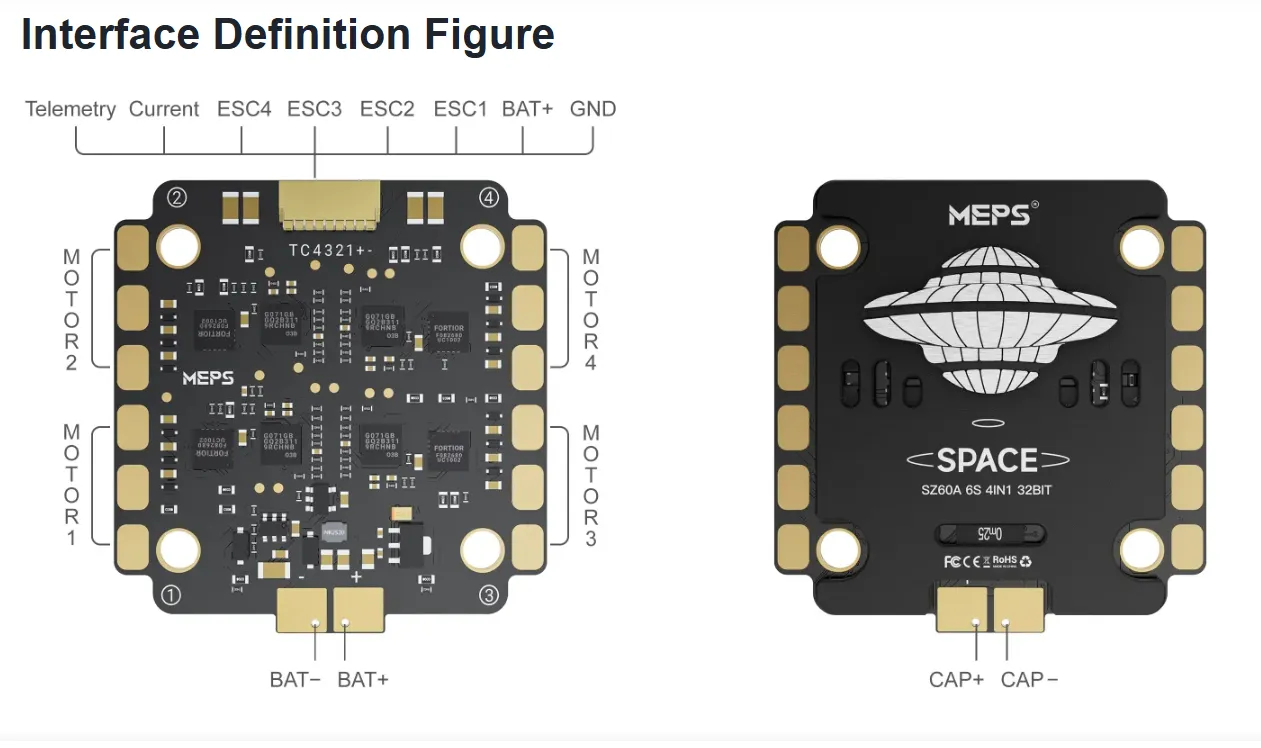
Connecting your FPV drone ESC to the rest of your build is a straightforward process, but getting it right is essential for smooth and safe flights. Each ESC typically has 7 pads or wires—4 for signal and power, and 3 for the motor.
Step-by-Step Connection
Step 1: Power Connection
On one end of the ESC, you’ll find two large pads or wires—positive (+) and negative (–). These are connected directly to your LiPo battery, often through a Power Distribution Board (PDB) or built-in power pads on your flight controller stack.
Step 2: Signal and Ground Wires
Next to the power pads, you’ll usually see two smaller pads or wires:
- Signal wire (often white or yellow): Sends control signals from the flight controller to the ESC.
- Ground wire (usually black): Completes the circuit and helps reduce electrical noise and interference.
Connect both the signal and ground wires to your flight controller. Each motor has its own ESC, so connect each one to the matching motor output pad (usually labeled M1, M2, M3, M4, etc.).
Tip: While some builds run without the ground wire, it’s best to include it for signal stability, especially on high-power setups.
Step 3: Motor Connection
On the other side of the ESC, you’ll find three pads for the motor wires. Connect the three motor wires in any order. If the motor spins in the wrong direction, you can either:
- Swap any two of the wires to reverse the spin, or
- Use the BLHeli Configurator to change motor direction digitally (supported on BLHeli_S and BLHeli_32 ESCs).
Step 4: Optional: Telemetry Wire
Some modern ESCs include a telemetry wire that sends live data (like current draw, RPM, temperature) back to the flight controller. While not required, it’s a useful feature for tuning and monitoring performance.
Once everything’s connected, power up your build without props first and test each motor through your Betaflight Configurator or ESC software to ensure everything spins the right way and responds correctly.
How to Calibrate FPV ESC?
Steps on how to calibrate the drone:
- Turn off the propeller or put the motor off the battery to begin on autopilot.
- Put the aircraft in manual flight mode.
- Adjust the remote control’s throttle lever to its highest setting.
- Attach the battery.
- The ESC/motor ought to beep at this point to show that it is in ESC calibration mode. This usually consists of two or three brief beeps, but the motor refuses to turn.
- At this point, rapidly reduce the throttle lever to zero.
- To show that it has accepted the revised calibration range, the ESC ought to beep.
- Check that the motor is reacting correctly now by gradually increasing the throttle.
Tips for Optimizing FPV Drone ESC Performance
To maximize the performance of the Electronic Speed Controller (ESC), it is essential to follow some valuable tips. First, it is essential to program the ESC accurately, in line with the specifications of your model aircraft or drone. This practice ensures precise speed adjustment and optimal operation of the entire system. Proper programming allows you to tailor the ESC to the specific needs of your aerial vehicle, ensuring precise control and quick response to your demands.
In addition, it is vital to perform regular checks on the ESC connections to ensure that they are strong and well-insulated. Any loose connections or damaged cables could cause malfunctions or even irreparably damage the ESC. Maintaining secure connectivity is crucial to ensure the operational stability of the system and to prevent costly problems due to bad connections.
Another aspect to consider is the temperature of the ESC during use. It is important to constantly monitor the temperature to avoid overheating, which could damage the device. The ESC should operate at an optimal temperature to ensure maximum performance and durability. If you notice excessive overheating, you may need to take additional cooling measures or consider changing the usage settings.
Finally, the power aspect cannot be overlooked. Always be sure to use a battery that is compatible with the ESC and strictly adhere to the manufacturer’s recommended power specifications. Adequate power supply is essential to ensure the stable and reliable operation of the ESC. Using an incompatible battery or exceeding the recommended power specifications could seriously affect the performance of the ESC and, consequently, the safety of your flight. Pay attention to these basic tips to maximize the potential of your ESC and enjoy a safe and high-performance flying experience.
Capacitor in ESC
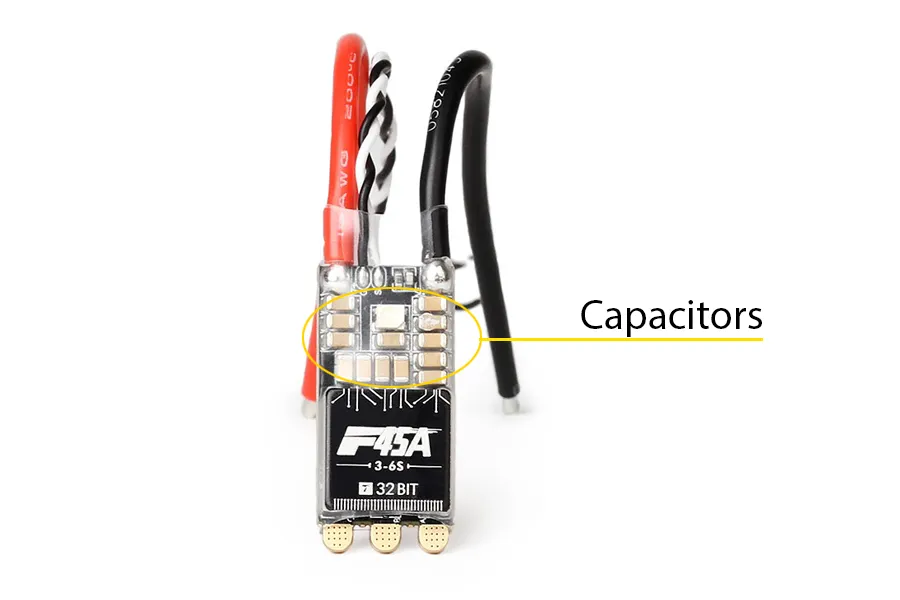
Capacitors help reduce voltage spikes and electrical noise, improving stability and protecting your electronics.
For most FPV builds, a low-ESR capacitor (e.g., 1000µF 35V for 6S setups) connected to the battery leads can significantly improve performance and reduce noise.
Common ESC Problems & Fixes
As with any electronic component, ESCs can encounter problems and require troubleshooting. One of the most common problems is overheating of the ESC. This can be caused by excessive power demand from the motor or poor heat dissipation. In these cases, it is advisable to check the specifications of the ESC and make sure it is adequate for the motor’s needs.
Other common problems include control signal malfunctions, abnormal noises during operation, and loss of power. If problems occur, it is advisable to contact the ESC manufacturer or refer to the instruction manual for specific troubleshooting. In some cases, it may be necessary to replace the defective ESC with a new one.
Best Practices for ESC Maintenance and Care
To ensure long life and reliable performance of the ESC, it is important to follow some best practices for maintenance and care. First, it is advisable to keep the ESC clean from dust, dirt, and moisture. Use a soft, dry cloth to gently wipe the ESC and make sure it is completely dry before using it.
In addition, it is critical to store the ESC in a safe and secure place when not in use. Avoid exposing the ESC to extreme temperatures or high humidity. Protect the ESC from shocks or drops that could damage internal components.
Finally, it is advisable to perform regular preventive maintenance checks on the ESC. Check the connections, check the temperature during use, and monitor the overall performance of the ESC. If you notice any abnormalities or problems, take prompt action to avoid greater damage.
Additional Protection and Features
Modern ESCs have various protection features such as protection against overcurrent, over-temperature, and other features that protect the ESC from damage. Choosing an ESC with good protection features can extend its service life and ensure stable performance.
Understanding these factors will help you better select, configure, and maintain your ESC. Paying attention to these details can make a big difference in the performance of your FPV drone, providing a smoother, more responsive, and stable flying experience.
Conclusions: Harness the Power of ESC to Improve Model Aircraft and Drone Performance
The ESC is a critical component for model aircraft and drone enthusiasts. Understanding how the ESC works, the different types available on the market, and how to choose the right one for your model aircraft or drone is essential for optimal performance and safe flights.
Following best practices for ESC maintenance and care will ensure long life and reliable performance over time. In the event of problems or malfunctions, promptly troubleshoot or replace the defective ESC to avoid greater damage.
By harnessing the power of ESC, model aircraft and drone enthusiasts can improve the performance of their models and enjoy safe and controlled flights.
You can find many kinds of ESCs on the market, but only a few can work well!
FAQs
What is the difference between 8 bit and 32 bit ESC?
32-bit processors are used by BLHeli_32, whilst 8-bit processors are used by BLHeli_S ESC. Undoubtedly, 32-bit processors are more potent than their 8-bit counterparts and provide for a wide range of new features. Telemetry, greater PWM rates, customizable LEDs, and many other capabilities are made possible by the 32-bit ESCs. Despite losing the option to employ speed filters, which enable smoother flight, the 8-bit versions are still widely used and accessible (mostly due to their reduced cost).
What amp ESC do I need?
For most FPV drones, the ESC amp rating you need depends on your motor size, battery voltage (S rating), and flying style. The amp rating should match the maximum current rating of the brushless motor to ensure that the ESC can handle the load. A 20A ESC is enough for small 2-3 inch drones on 2S–4S. For 4-5 inch freestyle or racing drones on 4S or 6S, a 35A to 45A ESC is standard. If you’re flying hard or using powerful motors, go with a 50A or higher ESC to avoid overheating or failure. When in doubt, a high-quality 45A 4-in-1 ESC is a safe and versatile choice for most 5-inch builds.
Write by volarelettrico.it 08/10/2023
Update by Kunkun 06/21/2025