




FAQ & Help Center
How can we help you today?
Categories
Betaflight

1.What is Betaflight?

Betaflight is the world's leading multi-rotor flight control software. The FPV drone racing and freestyle community choose Betaflight for its performance, precision, cutting-edge features, reliability and hardware support.

You can use Betaflight to complete firmware upgrade and debugging tests before takeoff (receiver, map transfer, motor, GPS, LED and other functions).

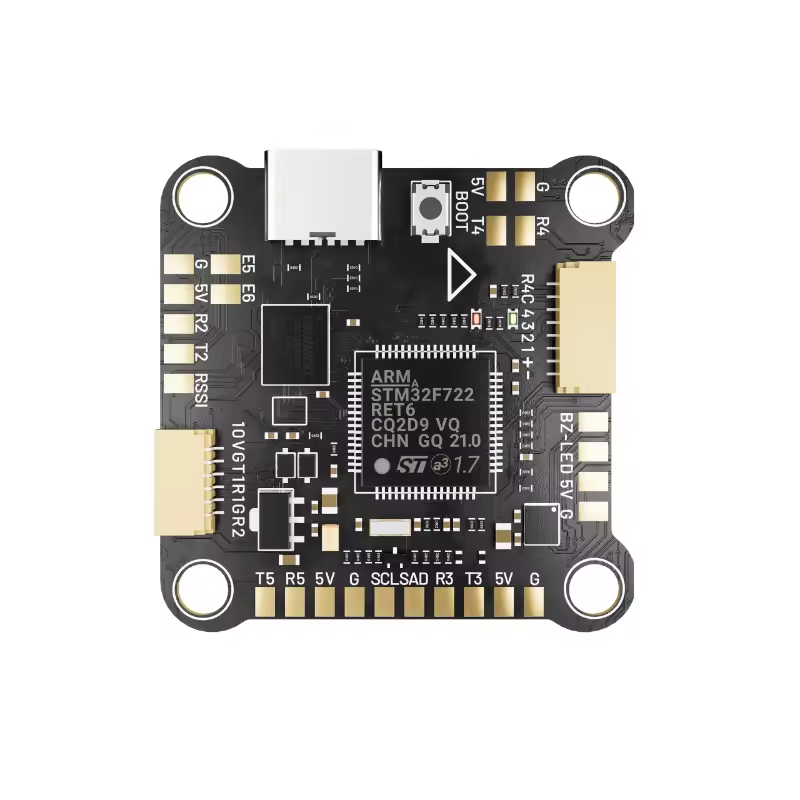
Betaflight supports most manufacturers: STM32F411, STM32F405, STM32F722, STM32H725, STM32H735, STM32H743, AT32F435.

2.Which Betaflight Configurator version should I use?

● For firmware 4.4.0: Use Betaflight Configurator 10.9.0 or later.

● For firmware 4.5.0-zulu and 4.5.0 release candidates: You must use version 10.10 or better.

● Note: Beta versions may have bugs — not recommended for novice pilots to update.

● Download: https://github.com/betaflight/betaflight-configurator/releases

● Installation package: betaflight.zip

Firmware

1.What is ESC firmware and why does it matter?

Firmware is the backbone of any ESC; it's the software that breathes life into these components, determining the range of settings you can tweak.

Each ESC firmware is only compatible with certain hardware.

2.BLHeli_S vs Bluejay — which should I choose?

Both are designed for ESC with 8-bit processors and are interchangeable. However, Bluejay is generally favoured for its superior performance, robust feature set and consistent updates.

BLHeli_S: An improved version of the base BLHeli code. Has motor PWM that is synchronous to the MCU master clock (generated by hardware), making the motor silent. Supports very high motor speeds.

Bluejay: BLHeli_S-based firmware capable of bi-directional DShot — a great choice if you want to run RPM filtering on your rig. Aims to clean up and simplify the original BLHeli_S source code.

3.What is BLHeli_32 / AM32?

BLHeli_32 and AM32 are designed for ESC with 32-bit processors, unlocking possibilities that 8-bit predecessors couldn't handle.

Features include ESC Telemetry, customizable startup tones, and support for higher PWM frequencies.

All BLHeli_32 MCUs (F0, F3, F4, G0 etc) support the "ByRPM" feature with Rev32.9 code, and support "any" PWM frequency range (determined by the hardware manufacturer).

If you have a regular setup, just install and go fly. Or configure/update by connecting to your ESCs through the Flight Controller using BLHeliSuite and a USB cable.

Receiver

1.What is a receiver and what types are there?

A receiver is used to receive radio control signals from your transmitter and convert them into signals that the flight controller can understand.

Parallel PWM Receivers: Uses multiple IO pins per channel. As of 2016, not recommended for new purchases due to the amount of IO pins used. Some new FCs do not support parallel PWM.

PPM Receivers (PPM SUM / CPPM): 12 channels via a single input pin. Not as accurate or jitter-free as serial communications, but readily available.

Serial Digital Receivers: Examples include ExpressLRS and TBS. Recommended for new purchases.

2.What is ExpressLRS (ELRS)?

All ExpressLRS receivers and transmitter modules are cross-compatible, regardless of brand, since they are based on the same open source design.

Compatible brands include: Happymodel, BetaFPV, Radiomaster.

3.How does ExpressLRS versioning work?

ELRS firmware version uses a three-part number system: A.B.C.

A: major version number.

B: minor version number.

C: patch number.

All releases with the same major version number are cross-compatible, but not with different major versions. For instance, 2.0 will work with 2.1, 2.2, 2.5 etc, but 2.x firmware won't bind with 3.x.

5.Which receiver and transmitter module firmwares are supported (v3.0.0)?

We collected the following models of receiver and transmitter module firmware (version 3.0.0). Please refer to the ExpressLRS Configurator for the full supported device list.