
In every FPV drone build, the ESC protocol determines how the flight controller communicates with the ESCs and motors.
This communication method—known as an FPV ESC protocol—controls how quickly and accurately motor signals are transmitted. The right drone ESC protocol can improve flight responsiveness, reduce latency, and enhance overall flight performance.
Over the years, ESC communication protocols have evolved from simple analog signals to advanced digital systems like DShot. Understanding these protocols helps FPV pilots choose the best configuration for freestyle, racing, or long-range flying.
In this guide, we’ll explain:
- what an ESC protocol is
- how different FPV ESC protocols work
- the differences between PWM, OneShot, Multishot, and DShot
- which ESC protocol Betaflight users should choose today
What Is an ESC Protocol in FPV Drones?
An ESC protocol is the communication method used between the flight controller (FC) and the electronic speed controller (ESC).
The flight controller calculates motor output based on sensor data and PID loops. It then sends commands to the ESCs using a specific FPV ESC protocol.
This signal tells each motor:
- how fast to spin
- when to accelerate or decelerate
- how to stabilize the drone
In modern FPV, the dominant and essential protocols are the DShot family (DShot300, DShot600, DShot1200), which have completely replaced outdated analog protocols like Multishot, Oneshot125, and standard PWM. If you want locked-in, propwash-free flights in 2026, Bidirectional DShot is your only real option.
Without a reliable drone ESC protocol, the motors cannot respond accurately to control inputs.
Evolution of FPV ESC Protocols
ESC protocols have evolved alongside flight controller technology.
Early FPV drones used simple analog signals, but modern builds rely on high-speed digital communication.
Timeline of ESC protocol development:
| Year | ESC Protocol | Key Improvement |
| Early RC era | PWM | Basic motor control |
| 2014 | OneShot125 | Reduced latency |
| 2015 | Multishot | Faster analog updates |
| 2016 | DShot150/300 | Digital communication |
| 2018+ | DShot600/1200 | High-speed digital control |
| 2020+ | Bidirectional DShot | RPM filtering support |
This evolution significantly improved how FPV drones handle aggressive maneuvers and rapid throttle changes.
Types of FPV ESC Protocols
Modern FPV drones support several ESC communication protocols.
The most important ones include:
- PWM
- OneShot125
- Multishot
- DShot
- ProShot
Each protocol uses a different method to transmit throttle commands from the flight controller to the ESC. Different protocols affect how fast your drone can respond.
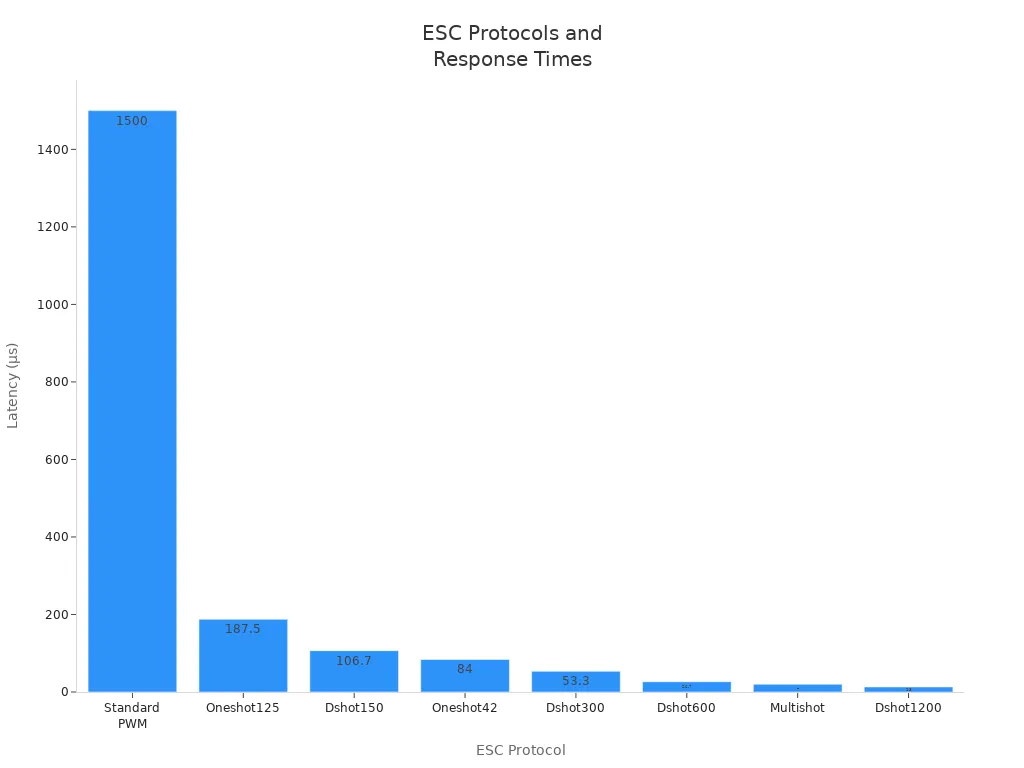
Here is a table that shows the most common ESC communication protocols and their response times:
| Protocol | Latency |
| Standard PWM | 1000-2000 µs |
| Oneshot125 | 125-250 µs |
| Dshot150 | 106.7 µs |
| Oneshot42 | 84 µs |
| Dshot300 | 53.3 µs |
| Dshot600 | 26.7 µs |
| Multishot | 15-25 µs |
| Dshot1200 | 13 µs |
PWM (Pulse Width Modulation)
PWM is the original ESC protocol used in RC aircraft.
In this system, throttle commands are encoded using the width of an electrical pulse.
Characteristics:
- simple design
- high latency
- susceptible to signal noise
Because of these limitations, PWM is rarely used in modern FPV drones.
OneShot125
OneShot125 was designed to reduce signal latency compared to PWM.
Key improvements:
- faster signal updates
- lower delay between FC and ESC
However, OneShot still relies on analog signals, which means it can suffer from signal calibration issues.
Multishot
Multishot further improved analog ESC communication.
Features:
- extremely fast signal updates
- lower latency than OneShot
But Multishot also increased noise sensitivity, which made the configuration more difficult.
As a result, Multishot quickly became obsolete once digital ESC protocols appeared.
DShot (Digital Shot)
DShot is the modern standard FPV ESC protocol used in most drones today.
Unlike analog systems, DShot sends digital commands rather than pulse widths.
Advantages:
- no calibration required
- error detection
- more reliable signal transmission
- supports advanced features like bidirectional telemetry
Common DShot versions include:
| Protocol | Data Rate |
| DShot150 | 150 kbit/s |
| DShot300 | 300 kbit/s |
| DShot600 | 600 kbit/s |
| DShot1200 | 1200 kbit/s |
For most FPV drones, DShot300 or DShot600 provides the best balance between performance and stability.
ProShot
ProShot is a high-speed digital FPV ESC protocol developed as an alternative to the DShot communication system.
Like DShot, ProShot is a digital ESC protocol, meaning it transmits throttle commands as digital data packets instead of analog pulse signals. This improves signal reliability and eliminates the need for ESC calibration.
The primary goal of ProShot ESC protocol was to provide:
- lower communication latency
- faster ESC update rates
- improved motor responsiveness
In theory, ProShot offers faster signal transmission than most traditional drone ESC protocols, which could benefit high-performance FPV racing setups. However, due to due to several practical limitations, ProShot never became a mainstream FPV ESC protocol.
| Limitation | Impact |
| Limited ESC support | Few compatible hardware options |
| No strong telemetry support | Cannot enable RPM filtering |
| Minimal performance advantage | DShot already fast enough |
| Betaflight optimized for DShot | Ecosystem favors DShot |
| Industry adoption momentum | DShot became the standard |
Why ESC Protocols Matter for FPV Performance?
Choosing the correct FPV ESC protocol directly affects how your drone flies.
Key factors influenced by ESC communication include:
- control latency
- motor response speed
- flight stability
- CPU load on the flight controller
Modern protocols allow faster communication between the flight controller and ESCs, which improves control precision.
For example:
| Protocol Type | Signal Type | Typical Latency |
| PWM | Analog | Slow |
| OneShot | Analog | Medium |
| Multishot | Analog | Faster |
| DShot | Digital | Fastest |
Today, most FPV pilots prefer digital ESC protocols like DShot because they offer higher reliability and better performance.
ESC Protocols Supported by Betaflight
Modern firmware like Betaflight supports several ESC communication protocols.
However, most builds today use DShot-based protocols.
Typical Betaflight ESC protocol options include:
| Protocol | Recommended Use |
| PWM | Legacy hardware |
| OneShot125 | Older ESCs |
| Multishot | Rarely used today |
| DShot150 | Low-power FCs |
| DShot300 | Most common |
| DShot600 | High-performance builds |
For most modern FPV drones, DShot300 with bidirectional DShot enabled is considered the optimal configuration.
Dshot
In modern FPV, the dominant and essential protocols are the DShot family (DShot300, DShot600, DShot1200), which have completely replaced outdated analog protocols like Multishot, Oneshot125, and standard PWM.
Check the guide to know more about the Dshot: What Is DShot in FPV? Complete Guide for 2026
DShot vs Analog ESC Protocols
One of the biggest improvements in modern FPV systems is the shift from analog to digital ESC communication.
Key differences include:
| Feature | Analog Protocols | DShot |
| Signal type | Analog | Digital |
| Calibration | Required | Not required |
| Noise resistance | Lower | Higher |
| Error checking | No | Yes |
| Advanced features | Limited | RPM telemetry |
Because of these benefits, most modern flight controllers default to DShot ESC protocol in Betaflight.
What Is Bidirectional DShot?
Bidirectional DShot is an advanced feature that allows ESCs to send motor RPM data back to the flight controller.
This enables one of the most important modern flight improvements: RPM filtering.
With RPM telemetry, the flight controller can:
- detect motor vibrations
- apply targeted filtering
- reduce noise in the PID loop
The result is smoother flight performance and better prop wash handling.
How to Choose the Right FPV ESC Protocol?
Choosing the correct FPV ESC protocol depends on your hardware and flight style.
Consider the following factors:
- flight controller processing power
- ESC compatibility
- PID loop frequency
- flying style (freestyle vs racing)
Most pilots cannot feel a difference between DShot300 and DShot600, so stability usually matters more than raw speed. Below are the choosing steps.
Step 1 – Check ESC and Firmware Compatibility
Before choosing any drone ESC protocol, first verify what your ESC actually supports.
Most modern ESC firmware supports digital protocols like DShot, but older ESCs may only support analog protocols.
| ESC Firmware | Supported ESC Protocols |
| BLHeli_S | DShot150 / DShot300 / DShot600 |
| BLHeli_32 | DShot150 / 300 / 600 / 1200 |
| AM32 | DShot150 / 300 / 600 / 1200 |
| Older ESCs | PWM / OneShot |
Pilot tip:
If your ESC supports DShot, you should almost always use it instead of analog protocols.
Step 2 – Prefer Digital Protocols Over Analog
Modern FPV drones almost always use digital ESC communication protocols.
Compared with older analog systems like PWM or OneShot, digital protocols provide several advantages.
| Feature | Analog ESC Protocols | Digital ESC Protocols |
| Signal reliability | Lower | Higher |
| Calibration required | Yes | No |
| Noise resistance | Lower | Higher |
| Advanced features | Limited | Supported |
Because of these benefits, DShot has become the default FPV ESC protocol in Betaflight.
Analog protocols are now mostly used only for legacy hardware.
Step 3 – Choose the Right DShot Speed
Once you decide to use DShot, the next step is selecting the appropriate speed.
Common DShot speeds include:
| ESC Protocol | Data Rate |
| DShot150 | 150 kbit/s |
| DShot300 | 300 kbit/s |
| DShot600 | 600 kbit/s |
| DShot1200 | 1200 kbit/s |
From a real FPV pilot’s perspective, DShot300 and DShot600 are the most practical options.
Typical recommendations:
| Drone Type | Recommended ESC Protocol |
| Tiny Whoop | DShot300 |
| 3–4 inch micro | DShot300 |
| 5 inch freestyle | DShot300 or DShot600 |
| FPV racing | DShot600 |
| Long-range FPV | DShot300 |
Most pilots cannot feel any difference between DShot300 and DShot600 during actual flying.
Step 4 – Consider Flight Controller Processing Load
Higher-speed ESC protocols require more processing power from the flight controller.
If your FC is already running high gyro loop and PID loop frequencies, using very fast protocols like DShot1200 may increase CPU load.
| ESC Protocol | CPU Load |
| DShot150 | Low |
| DShot300 | Moderate |
| DShot600 | Higher |
| DShot1200 | High |
For this reason, many Betaflight developers recommend DShot300 as the most balanced option.
Step 5 – Enable Bidirectional DShot (If Supported)
A major reason modern pilots use DShot is the ability to enable bidirectional communication.
When Bidirectional DShot is enabled:
- ESCs send motor RPM data back to the flight controller
- Betaflight can activate RPM filtering
- Motor noise and vibration are reduced
This leads to:
- smoother flight performance
- better prop wash handling
- cleaner gyro signals
If your ESC supports it, enabling Bidirectional DShot is one of the best upgrades for flight performance.
Step 6 – Avoid Legacy or Rare Protocols
Some protocols appear in Betaflight settings but are rarely used today.
Examples include:
| Protocol | Current Status |
| PWM | Obsolete for FPV drones |
| OneShot125 | Mostly replaced |
| Multishot | Rarely used |
| ProShot | Limited support |
Although ProShot offers fast digital communication, it never became popular because:
- limited ESC firmware support
- lack of telemetry features
- DShot already performs extremely well
Step 7 – Test Stability After Setup
After selecting your ESC protocol, always test motor behavior before flying.
Recommended checks:
- spin motors in Betaflight configurator
- confirm motors start smoothly
- check for desync issues
- verify CPU load
If you experience instability, lowering the protocol speed (for example DShot600 → DShot300) often improves reliability.
FAQ
What ESC protocol should I use for FPV drones?
For most modern FPV drones, the recommended FPV ESC protocol is DShot300 with bidirectional DShot enabled.
DShot300 offers a strong balance between signal speed, stability, and flight controller CPU load. It also supports advanced features like RPM filtering, which improves flight smoothness and reduces motor noise.
Unless you are using very old ESC hardware, DShot300 is the best default ESC protocol for freestyle, racing, and cinematic FPV drones.
Is DShot600 better than DShot300?
Not necessarily. While DShot600 transmits data faster than DShot300, most FPV pilots cannot feel a noticeable difference during actual flying.
In real-world builds, many pilots prefer DShot300 because it:
- reduces flight controller CPU load
- maintains stable ESC communication
- still provides an extremely fast motor response
For most FPV drones, DShot300 already provides more than enough performance.
See more: DSHOT300 vs DSHOT600, What are the Differences Between Them?
Can I still use OneShot or Multishot?
Yes, but these protocols are considered legacy options and are rarely used in modern Betaflight builds.
Does DShot reduce ESC desync?
Yes. Because DShot uses digital packets instead of analog pulse signals, it is less prone to noise and timing issues.
Can older ESCs use DShot protocol?
Not all ESCs support DShot ESC protocol.
Older ESC firmware may only support analog protocols such as:
- PWM
- OneShot125
- Multishot
Most modern ESC firmware such as BLHeli_S, BLHeli_32, and AM32 supports DShot protocols.
Before selecting an ESC protocol in Betaflight, always verify which protocols your ESC firmware supports.