
Indoor FPV is one of the most accessible and beginner-friendly ways to enjoy FPV flying. Tiny Whoops—those ultra-light 65–85mm quads—excel in small spaces, letting you fly confidently inside apartments, offices, or tight technical tracks. But when it comes to performance, motors are the single most important upgrade for speed, throttle feel, and flight efficiency.
In this guide, we break down the best FPV motors for Tiny Whoops (1S–2S) in 2025, comparing motor size, KV, weight, throttle behavior, and real-world performance. Whether you’re into cinematic indoor cruising, high-speed racing, or acrobatic power loops inside your living room, you’ll find the perfect Tiny Whoop motor here.
How to Choose FPV Motors for Indoor Whoops & Tiny Drones
Choosing the right motor for indoor Whoops and tiny FPV drones is less about raw power and more about control, weight, and efficiency. A well-matched motor can dramatically improve flight smoothness, response, and crash resilience in tight indoor spaces.
Motor Sizes Explained
Below are the most common motor sizes for Tiny Whoops and tiny indoor quads:
| Motor Size | KV Range | Battery | Prop Size | Best Use |
|---|---|---|---|---|
| 0603 | 16000–19000 | 1S | 31mm | Smooth indoor cinematic |
| 0703 | 19000–27000 | 1S | 31mm | Indoor racing |
| 0802 | 16500–22000 | 1S | 40mm | Balanced freestyle |
| 1002 | 11000–14000 | 2S | 45mm | HD / heavier builds |
These sizes indicate stator width (mm) × stator height (mm).
Understanding KV in Tiny Whoop Motors
- Lower KV offers smoother throttle control and longer flight times
- Higher KV delivers a stronger punch and faster acceleration, ideal for racing
For indoor flying, excessively high KV can make the drone twitchy and harder to manage, especially for beginners.
Battery Voltage Compatibility
- 1S setups dominate Tiny Whoops and indoor flying
- 2S–3S is common for toothpick and open-prop micro drones
- 4S can work on select micro motors, but only with proper tuning and small props
Always match motor KV with battery voltage and prop size to avoid overheating.
Best FPV Motors for Tiny Whoops–Complete 2025 Ranking
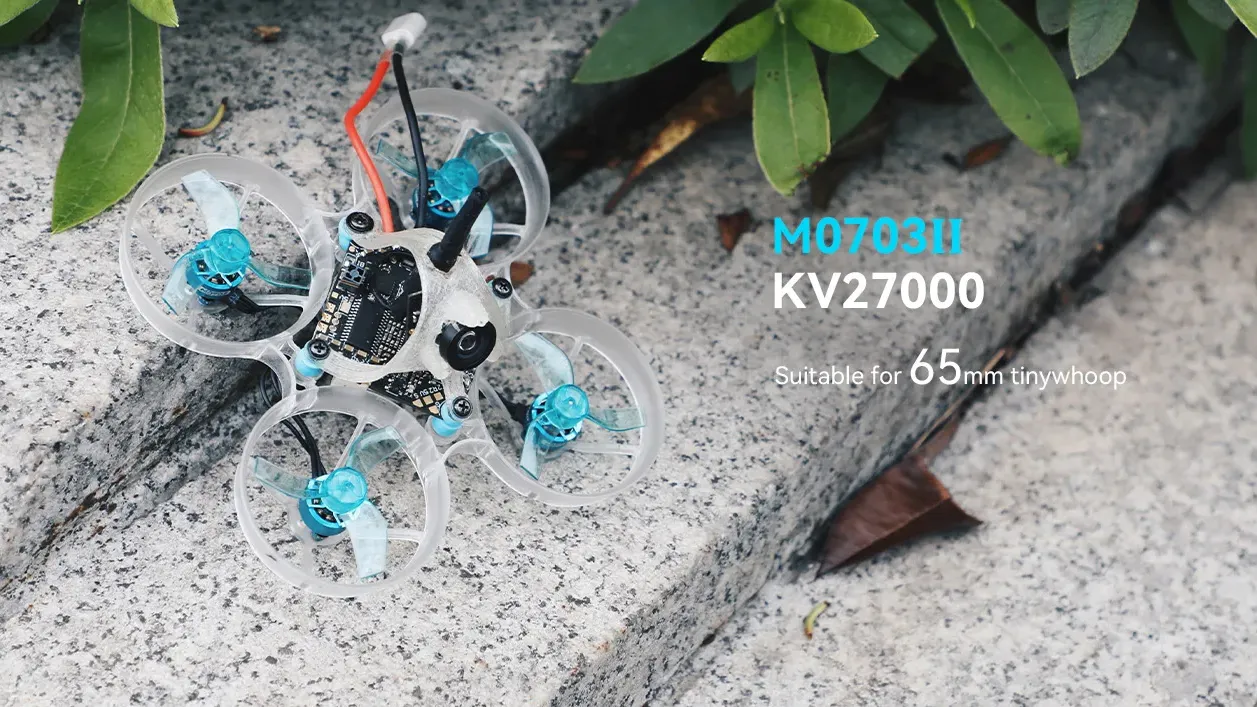
T-HOBBY M0703
The T-HOBBY M0703 earns its place in the 2025 ranking as a high-performance, ultra-light 1S motor optimized for 65mm Tiny Whoops. Weighing just 1.7g, it delivers excellent acceleration and responsiveness, making it a strong choice for indoor racing and fast-paced freestyle flying.
Available in 19000KV and 27000KV options, the M0703 allows pilots to fine-tune their setup:
- 19000KV for smoother throttle control and efficient cruising
- 27000KV for maximum punch and aggressive flight
Built with N52 high-strength magnets and a durable, impact-resistant structure, the motor offers reliable performance despite its minimal weight. Some users note a tight 1mm shaft fit, which can make prop changes slightly more difficult, but this also helps keep props secure during hard maneuvers.
Why it ranks in 2025:
- Extremely light for maximum agility
- Strong power output for a 0703 class motor
- Excellent for high-speed 65mm builds
Best for: 65mm 1S Tiny Whoops, indoor racing, pilots who prefer fast and responsive flight characteristics.
T-HOBBY M0802
The T-Hobby M0802 earns its spot in our 2025 ranking as one of the best-value entry-level motors for 1S Tiny Whoops. Despite its small size, it delivers impressive punch and fast throttle response, making it a noticeable upgrade over most stock 0802 motors.
With multiple KV options available, pilots can easily match the motor to their flying style:
- 25000KV–27000KV for aggressive indoor acro and racing
- 19000KV–22000KV for smoother control and better efficiency
Earlier durability concerns from the two-piece bell design have been largely resolved in newer V2 and unibell versions, which offer improved crash resistance and stronger wire connections. At just ~1.6–1.9g, the M0802 keeps building lightweight and responsive on 65mm–75mm frames.
Why it ranks in 2025:
- Excellent power-to-weight ratio
- Proven performance for indoor flying
- Affordable and widely recommended for beginners
Best for: 1S 65mm / 75mm Tiny Whoops, indoor freestyle, first motor upgrades.

T-HOBBY M1104
The T-HOBBY M1104 earns its ranking as a top-tier performance motor for lightweight toothpick and micro freestyle FPV drones. Known for its exceptional power, smooth throttle response, and low weight, it is a favorite among pilots flying 2S–3S micro builds.
Rated at 7500KV and weighing just 5.6g, the M1104 delivers strong punch and excellent recovery, often described by users as a “little beast” for its size. It performs best on 2S–3S setups, paired with 2–2.5 inch propellers, while advanced pilots have successfully run it on 4S with careful prop selection and tuning.
The unibell design adds durability and crash resistance, making it well-suited for aggressive micro freestyle. While the motor can run hot with improper tuning or oversized props, proper setup results in smooth, powerful, and reliable performance.
Why it ranks in 2025:
- Outstanding power-to-weight ratio
- Smooth and responsive on 2S–3S
- Proven choice for toothpick and micro freestyle builds
Best for: 90–110mm frames, 2–3 inch props, toothpick FPV, and lightweight freestyle drones.
FLYWOO ROBO 0802.4 Motor
The FLYWOO ROBO 0802.4 is designed specifically for pilots who prioritize smooth throttle feel, efficiency, and long flight time over raw punch. With a motor weight of approximately 1.8g, it is well-suited for 65mm and lightweight 75mm Tiny Whoop platforms, especially when paired with 31–40mm props.
Unlike high-KV racing-focused 0802 motors, the ROBO 0802.4 leans toward steady-state efficiency and predictable handling, making it an excellent choice for indoor cruising, training flights, and endurance-oriented builds. The motor delivers a noticeably calmer throttle response, which helps reduce oscillations and battery sag during longer indoor sessions.
Two KV options allow pilots to fine-tune performance:
- 16500KV – Optimized for maximum efficiency, smoother throttle control, and longer flight times
- 19500KV – Slightly more responsive and lively, while still maintaining excellent efficiency
The motor uses a bushing structure, which contributes to smooth operation and low noise, though it is less crash-resistant than unibell designs. As a result, it performs best on lightweight frames with conservative prop choices rather than aggressive freestyle setups.
Common Mistakes When Choosing Tiny FPV Motors
Choosing KV That’s Too High
High KV motors may feel powerful, but indoors they often:
- Reduce control precision
- Increase battery sag
- Make the drone harder to fly smoothly
Ignoring Weight
A heavier motor can:
- Kill agility
- Reduce flight time
- Make crashes more violent
Weight matters more than peak thrust in indoor environments.
Mismatching Motors, Props, and Voltage
Running large or heavy props on high KV motors—especially on higher voltage—can lead to:
- Overheating
- Motor damage
- ESC failure
Overlooking Durability
Indoor flying means frequent crashes. Non-unibell motors or weak wire connections may not survive long-term use.
Overbuying for Skill Level
Beginners often choose motors that are too aggressive. A smoother, more forgiving motor usually leads to:
- Faster skill progression
- Better consistency
- Fewer broken parts
FAQ: Tiny Whoop Motors
What is the best motor size for Tiny Whoops?
0802 is the best all-round size for indoor whoops.
What KV should I choose for indoor flying?
Stick to 18000–22000KV for general indoor flying with 40mm props.
Do heavier motors perform better?
Heavier motors produce more torque but reduce efficiency and agility—best for 2S builds.
Can Tiny Whoop motors overheat indoors?
High KV motors on high-pitch props may overheat. MEPS and THOBBBY motors run cooler due to efficient design.