
When we started flying FPV drones, we had doubts about which motors to use. Sometimes we choose motors that look better without considering the differences between types of motors.
This article looks at the different types of motors for FPV drones. We’ll look at motors for drone racing and freestyle flights. There are differences between them. We’ll also look at the best motors for each type of flight.
What are FPV Freestyle Motors?
Freestyle motors are built to deliver control, balance, and smooth power output, not raw top speed.
Key Characteristics
- Mid KV (1700–2150KV for 6S 5-inch)
- Higher torque for quick recovery during tricks
- Smooth throttle curves for cinematic lines
- Strong durability for inevitable freestyle crashes
Pros of Freestyle Motors
- Better Control and Stability. Freestyle motors usually have a lower KV rating, providing more torque, which enhances control and stability during complex maneuvers, such as flips, rolls, and smooth transitions.
- Durability. Freestyle motors are often built with stronger materials and a more robust design to withstand the stresses of aggressive flying and frequent crashes, making them more durable.
- Smooth Throttle Response. The design of freestyle motors emphasizes a smooth and linear throttle response, allowing pilots to make precise adjustments during flights, which is crucial for executing intricate tricks and stunts.
- Longer Lifespan. Due to their lower RPMs and more rugged construction, freestyle motors typically have a longer lifespan, making them a reliable choice for pilots who frequently push their equipment to the limit.
- Versatility. Freestyle motors can perform well in various flying conditions and are versatile enough to be used for different FPV styles, including cinematic flying, where smoothness is key.
Cons of Freestyle Motors
- Heavier Design. Freestyle motors tend to be heavier than racing motors, which can make the drone less agile and slower to accelerate, impacting overall performance in high-speed scenarios.
- Lower Top Speed. The lower KV rating, while providing more torque, results in a lower top speed compared to racing motors, which can be a drawback in situations where speed is a priority.
- Higher Power Consumption. Freestyle motors often consume more power, especially during intense maneuvers, leading to shorter flight times if not managed with a proper battery setup.
- Less Efficient at High Speeds. These motors are optimized for control rather than speed, making them less efficient during fast-paced flying, where maintaining high speeds over time is necessary.
- Specialized for Freestyle. While versatile, freestyle motors are specifically tuned for smooth, controlled flight and may not perform as well in competitive racing environments where speed and quick maneuvers are essential.
What are FPV Racing Motors?
FPV racing motors are optimized for maximum speed, acceleration, and responsiveness. Every design decision focuses on shaving milliseconds off lap times.
Key Characteristics
- Higher KV (usually 2400–2800KV for 5-inch)
- Ultra-light construction to reduce inertia
- Lower torque but extremely fast RPM climbs
- Snappy throttle to quickly hit gates
- Prioritizes burst power over efficiency
Pros of Racing Motors
- High Speed and Acceleration. Racing motors typically have a high KV rating, allowing for rapid acceleration and high top speeds, which are crucial in competitive racing scenarios.
- Lightweight Design. Racing motors are often designed to be as light as possible to reduce the overall weight of the drone, enabling quicker maneuvers and faster response times.
- Efficiency at High Speeds. These motors are optimized for maintaining high speeds with minimal loss of efficiency, making them ideal for short, intense bursts of speed needed during races.
- Compact Size. Many racing motors are compact and streamlined to fit within the aerodynamic designs of racing drones, contributing to improved speed and agility.
Cons of Racing Motors
- Reduced Durability. The focus on lightweight and speed often means that racing motors are less durable and more prone to damage during crashes or rough landings.
- Shorter Lifespan. Racing motors tend to wear out faster due to the high RPMs they operate at, leading to a shorter overall lifespan compared to motors designed for other purposes.
- Less Torque. High KV motors typically produce less torque, which can result in less control and stability, especially in slower, more precise maneuvers.
- Higher Power Consumption. Racing motors consume more power to achieve their high speeds, which can lead to shorter flight times if the battery is not adequately managed.
- Limited Versatility. These motors are specialized for racing, meaning they may not perform as well in other FPV flying styles like freestyle, where control and stability are more important.
Different Characteristics for Freestyle Motors and Racing Motors
| Feature | Racing Motor | Freestyle Motor |
|---|---|---|
| Throttle Response | Extremely fast | Smooth & controllable |
| KV Rating | High KV | Mid-range KV |
| Torque | Lower torque, higher RPM | Higher torque, stable RPM |
| Efficiency | Less efficient due to high RPM | More efficient for long flights |
| Durability | Lightweight, less durable | Heavier, more durable |
| Flight Style | Speed & precision | Flow, tricks, cinematic moves |
Motor Size: 2207 vs 2306 — What Each Style Prefers
Motor size directly affects how the drone behaves. The numbers indicate stator diameter and height.
| Size | Description | Favored By |
|---|---|---|
| 2207 | 22mm diameter × 7mm height | Racing |
| 2306 | 23mm diameter × 6mm height | Freestyle |
Why Racing Prefers 2207
- Taller stator → more torque
- Punchier throttle → faster acceleration
- More responsive at high speed
Why Freestyle Prefers 2306
- Wider stator → smoother low-end control
- More precise throttle modulation
- Ideal for flowy cinematic moves
If you want to learn more about the knowledge of motor size, please check the blog: What Brushless Motor Sizes Do I Need for My FPV Drone?


Stator Volume: Power Output Difference
Even though 2306 looks “bigger,” the 2207 motor actually has more stator volume, meaning more copper and more thrust. However, in terms of the motor, what really matters is a factor called stator volume, which is a measure that tells us how much copper actually fits inside a motor stator in relation to its physical dimensions and is calculated using the following formula:
(Width/2)^2 x 3.14 x height = stator volume
Stator volume, why is it important?
If we use this formula and apply it to the 2207 and 2306 motors, we will find that while in terms of physical size the 2306 motor actually looks bigger, the 2207 motor has a higher stator volume and thus can generate more thrust than the 2306 motor.
2306: (23/2)^2 x 3.14 x 6 = 2491.59
2207: (22/2)^2 x 3.14 x 7 = 2659.58
What This Means
| Motor Type | Stator Volume Impact |
|---|---|
| Racing (2207) | Higher stator volume → stronger thrust and acceleration |
| Freestyle (2306) | Slightly smaller volume → gentler response and smoother power band |
KV Requirements: Speed vs Smoothness
The KV is the number of revolutions per volt supplied. If you are a beginner pilot, use motors that do not generate as much thrust so you can control the drone better. As you increase the KV, you must also increase the capacity of your electronics. This is not the same as flying with 2100 KV motors in a 6-cell drone with a 45-amp ESC, as you would with a 60-amp ESC. The more KV in your drone, the more current it uses. It’s best to use 1950 KV 45 amps and 50 amps or more in 6 cells for motors of higher KV.
If you want to go faster or do more tricks, you need to increase the KV in your drone. The more KV you get, the more power you get. For racing drones, we find 2207 motors with 2100 KV. For freestyle, look for motors with a low KV reference, like 1750KV, which offer a good thrust for smooth flights.
If you race drones, use 2207 motors. They can generate more power and go faster. If you want to freestyle, use 2306 motors. They are larger but generate less thrust and are less aggressive. This makes them smoother and more fluid. If you want to know more about the knowledge of KV, check this blog: What is KV in Motor
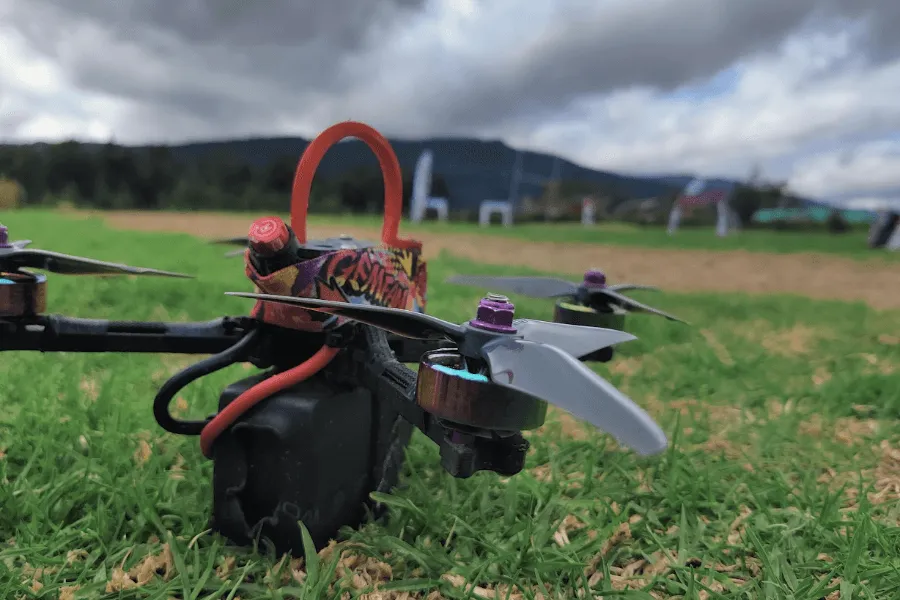
Weight Considerations: Agility vs Stability
Motor weight is directly tied to performance characteristics.
Racing Motor Weight
- 28–33g
- Lighter = faster direction changes
- Less rotating mass = sharper response
Racing priority: keep the quad ultralight for speed.
Freestyle Motor Weight
- Weight is not as sensitive
- Heavier motors add stability
- Durability > weight savings
Freestyle priority: predictable, smooth flight; stable arcs during flips and rolls.
Durability and Build Quality
Your motors will last longer if you don’t fly them too fast or do risky tricks. They’re just a spare part of a drone, so you’ll have to change them eventually.
However, you should know that different flying styles will affect the motor in different ways. This will help you understand when a motor is good for racing. Here we will explore some of them.
Durability Requirements for Racing Drone Motors
Copper Quality: Copper is one of the main parts of racing goblins’ motors. If the copper is not good, the motor will change colour. The motor will burn reddish or darker until it simply burns out. This is one of the main reasons why drone racing pilots have more burned motors than broken ones. Therefore, it is important to choose a drone racing motor that can withstand high temperatures, so it does not damage the drone during a flight.
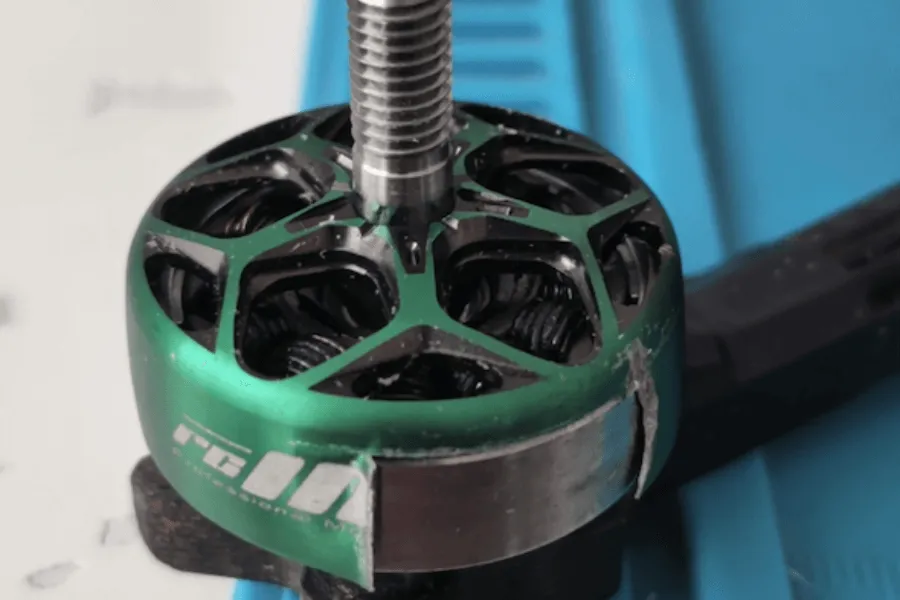
Bell Hardness: The quality of the bell is important because if we are flying with very light motors, the bell may be too thin or made of materials that are not very resistant. If a motor receives an impact from the side of the bell, it may bend and hit against the stator, which stops the motor from rotating. The upper part of the bell may have breaking points. If a motor is hit very hard, it can break and the bell will also be damaged.
Durability Requirements for Freestyle Motor
FPV freestyle motors are used in different environments, while racing motors are usually used on green areas in soccer fields. This makes them more versatile.
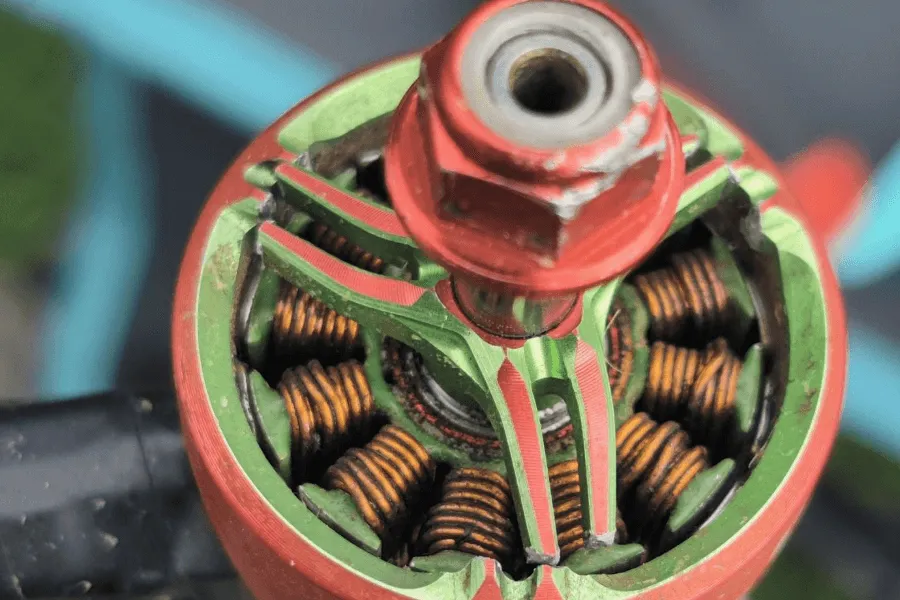
Freestyle motors are usually more durable than racing motors because they are made of better materials. The quality of the bell and the central axis are very important because we can return to closed environments continuously, which increases the possibility of hitting walls. Walls, columns and other elements can damage the motor. Bearings are also important because they can break a freestyle drone.
Heat Dissipation
Reaching high speeds also means reaching high temperatures. Racing drone motors have to have a better cooling system because they have to maintain a constant speed. This is built into two main parts of the motor.
Bell design: The motor hood is the first component that helps to dissipate heat inside the motor. When we pick up a motor and look at the top, we will notice a design or pattern. This design allows air to enter the motor better when the motor is running at high speeds. This helps to cool the copper of the motor and avoid burnout.
Motor height: The height of the stator in relation to the motor base affects how well the motor dissipates heat. Motors with a taller stator prevent heat build-up in the lower part of the motor and allow more air to circulate, cooling the entire component. This affects the external dimensions of the motor. Some motors perform better than others.
Which Motor is Suitable for Beginners
If you’re a new pilot, don’t worry about the type of motor for drone racing or freestyle. Focus on developing your skills and learning to enjoy different types of flight. Understand the KV ratings for your electronics.
KV is a unit of measurement for motors. It estimates the power of a motor based on RPM and volts. As a beginner, it is ideal that you use low KV motors with fewer cells in your drone. The more KV you have, the more power and torque you will get. When you are just starting to fly, it will be harder to control your drone.
As a tip for beginners who are not clear yet whether they like FPV drone racing or want to do freestyle, the ideal motors would be 1750 KV motors for drones 6S and 2500 KV motors for drones 4S.
Compatibility with ESCs and Propellers
When choosing a motor for your drone, you need to think about other things that can affect its performance. This is why you should think about how compatible your motor is with the ESCs and propellers. The right mix of these three components will give you better performance.
ESC Requirements for High-Speed Racing Drone Motor
If you want to go fast, use high-KV motors. The more KV you need, the more current they use. You’ll need more amperage, so get ESCs that support constant current peaks. In racing, peak current consumption is constant, so current delivery capacity is important. Choose a current delivery capacity of at least +45 Amps. For how to choose an ESC for a racing drone, check this article: Choosing the Best ESC for Racing Quadcopter: A Comprehensive Guide
ESC Requirements for FPV Freestyle Motor
Freestyle flights are smoother and more fluid, so current consumption is lower. Some peaks are lower, but when you make a power loop or punch, those moments are temporary. The rest of the flight is smoother. The motors won’t need high ESCs, but they may have high current peaks. 35 or 40 Amp should be fine.
Propellers Compatibility
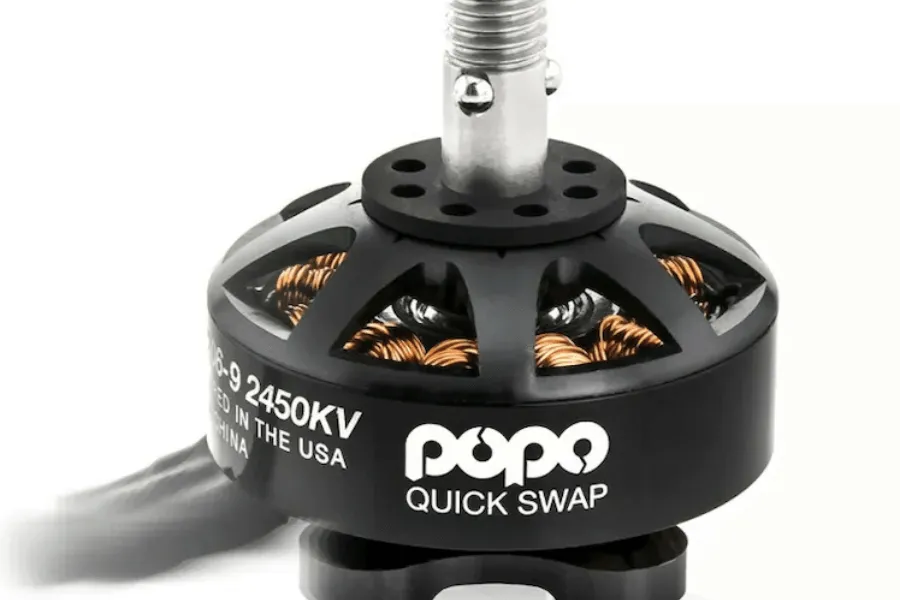
You also need to think about how compatible your propellers are with your motors. There are two main types of propeller, one of which is a conventional one. This has a propeller that goes through the centre of the motor and fits with a nut at the top. The second is a system called Popo, which has small spheres that are introduced with the propeller to avoid loosening. It is simple and practical, but for safety, use the conventional system. I think it is more convenient to use the conventional system.
The type of propellers you use affects the current consumption, so the transmitters are important in ESC selection. If you use propellers with a lot of pitch, they may burn the ESCs. If the propellers have a lot of pitch, they may use more current from the ESCs, which could burn them. The transmitters are important in choosing ESCs because they affect the current consumption.
If you use propellers with a high pitch, they can overheat more easily because they grip the air more. This makes the motor work harder. A propeller with a low pitch generates less airflow, so less resistance to the motor, which uses less current to the speed ESCs.
FAQ
What is the main difference between FPV racing motors and freestyle motors?
Racing motors prioritize maximum speed, acceleration, and fast throttle response, while freestyle motors focus on smooth control, torque, and stable power delivery for tricks and cinematic flying. Racing prefers 2207 motors; freestyle prefers 2306 motors.
Why do racing drones prefer 2207 motors?
Because 2207 motors have higher stator volume, which produces more thrust and faster acceleration. This makes them ideal for tight gates, high-speed cornering, and maintaining high RPM for racing.
Are 2306 motors only for freestyle?
Not strictly, but 2306 motors offer:
- Smooth throttle
- Better low-end control
- Stable behavior during tricks
This makes them the best choice for freestyle pilots who want predictable movement and fluid transitions.
Which motor size is better: 2207 or 2306?
It depends on your flying style:
- 2207 → Racing (more thrust, faster acceleration)
- 2306 → Freestyle (smooth and precise control)
There is no “best,” only the one that fits your purpose.
Does motor KV affect racing and freestyle performance?
Yes.
- Higher KV → more RPM, more speed → better for racing
- Lower KV → smooth throttle, better control → ideal for freestyle
Example:
- Racing: ~2100KV on 6S
- Freestyle: ~1700–1950KV on 6S
Can I use racing motors for freestyle flying?
Yes, but they may feel:
- Too snappy
- Too sensitive at low throttle
- Less smooth during tricks
Freestyle motors provide better balance, stability, and control accuracy.
Do freestyle motors last longer than racing motors?
Usually yes. Freestyle motors are built with:
- Stronger bells
- Thicker material
- Better bearings
- Reinforced shafts
Racing motors often sacrifice durability for lighter weight, and they burn out more often due to heat.
Conclusion
If you’re a racing drone pilot or a freestyle pilot, it’s important to choose a motor that works well with other parts of the drone, like propellers and ESC motors. These parts make the drone powerful and reliable, and help it fly smoothly. Aesthetics also matter. You want your drone to look good.
You also want a powerful drone that allows smooth and fluid flights. You need to choose the right motors for your drone to improve your flight skills.