
Choosing your first FPV radio controller—or deciding whether it’s time to upgrade—is one of the most important decisions in your FPV journey. Unlike motors, propellers, or batteries that may be replaced regularly, a quality transmitter often stays with you for years and becomes the centerpiece of every build.
Among today’s FPV brands, RadioMaster has earned a reputation for offering some of the most versatile and feature-rich transmitters on the market. From the ultra-portable Pocket to the flagship TX16S MKII Max, there’s a controller designed for almost every type of pilot.
The challenge is that the best RadioMaster controller isn’t necessarily the most expensive one. A beginner learning in a simulator has very different needs from a freestyle pilot flying 5-inch quads every weekend or a long-range enthusiast pushing kilometers away from the launch point. Whether you’re buying your first radio or replacing an older transmitter, this guide will help you choose the right model for your flying style.
Quick Comparison Table
| Controller | Best For | ELRS | Size |
|---|---|---|---|
| RadioMaster Boxer | Best Overall | ✅ | Medium |
| RadioMaster GX12 | Best Value | ✅ | Compact |
| RadioMaster Pocket | Beginners | ✅ | Small |
| RadioMaster TX16S MKII Max | Advanced Users | ✅ | Large |
| RadioMaster Zorro | Gamepad Users | ✅ | Compact |
Short on time?
- Best overall: RadioMaster Boxer
- Best for beginners: RadioMaster Pocket
- Best value: RadioMaster GX12
- Best premium radio: TX16S MKII Max
- Best gamepad controller: Zorro
How We Chose These RadioMaster Controllers
Rather than simply comparing specifications, we evaluated each controller based on real-world flying scenarios. Every recommendation considers how the transmitter performs during daily use, not just what’s listed on the spec sheet.
Flight Feel
Smooth, precise control is essential for freestyle, racing, and cinematic FPV flying. We looked at gimbal quality, stick resolution, switch placement, and overall control feel.
ELRS Performance
ExpressLRS has become the preferred radio protocol for most FPV pilots thanks to its low latency, excellent range, and active open-source development. Controllers with powerful internal ELRS modules and room for future expansion received higher scores.
Comfort and Ergonomics
A radio may feel comfortable during a five-minute test, but not after multiple battery packs. We considered grip design, weight distribution, button layout, and suitability for both thumb and pinch pilots.
Portability
Some pilots travel with their gear every week, while others primarily fly at local fields. Compact controllers such as the Pocket and GX12 are easier to carry, whereas larger transmitters often provide additional switches and customization.
Long-Term Value
Instead of focusing solely on price, we evaluated which controller offers the best ownership experience over several years. Factors such as firmware support, accessory compatibility, repairability, and community adoption all contribute to long-term value.
Top 5 RadioMaster FPV Controllers
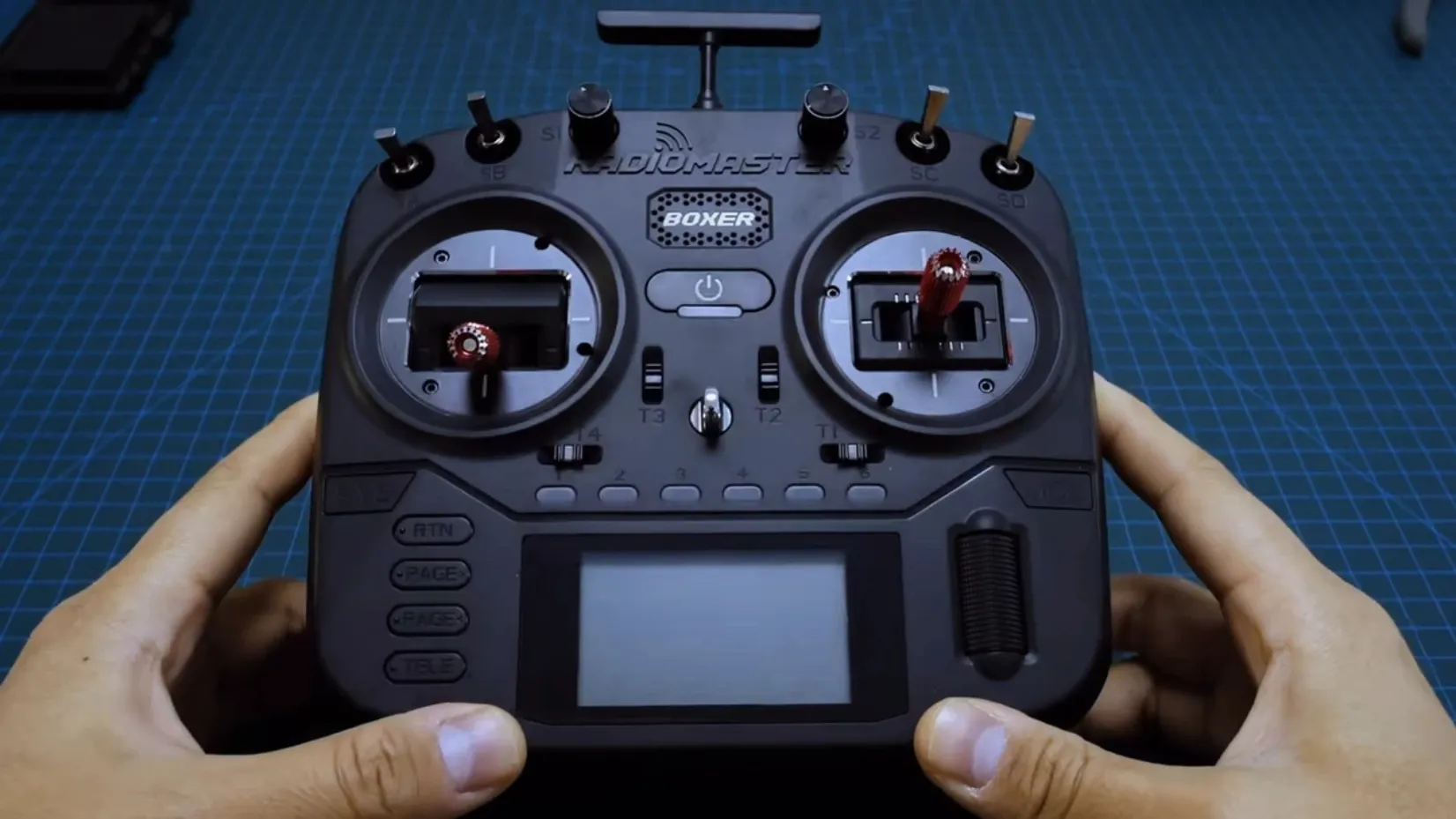
RadioMaster Boxer– Overall FPV Radio
For most FPV pilots, the RadioMaster Boxer strikes the ideal balance between size, performance, and price. It delivers the feel of a full-size transmitter without the bulk of larger radios like the TX16S, making it one of the most recommended controllers in today’s FPV community.
Unlike ultra-compact controllers, the Boxer features full-size Hall-effect gimbals that provide smooth, accurate stick movement. This makes precise throttle control easier for beginners while giving experienced freestyle pilots the responsiveness they expect for advanced maneuvers.
The ergonomics are another major advantage. The slightly larger grip fits comfortably in both thumb and pinch styles, and the balanced weight reduces fatigue during extended flying sessions. Whether you’re practicing in a simulator, flying freestyle, or exploring long-range routes, the Boxer feels equally capable.
Its internal ExpressLRS module supports up to 1W output power, providing excellent range and reliable signal quality without requiring an external module. Combined with EdgeTX, USB simulator support, and an external module bay for future upgrades, the Boxer remains a transmitter that can grow alongside your skills.
Pros
- Full-size Hall-effect gimbals
- Excellent ergonomics for most pilots
- Powerful internal ELRS module
- External module bay for future expansion
- Outstanding balance between portability and functionality
Cons
- Larger than compact travel radios
- More expensive than entry-level models
Best For
- Freestyle pilots
- Intermediate and advanced users
- Long-term FPV investment
- Pilots who want one radio for every type of flying
Our Verdict
If you only plan to buy one FPV controller, the RadioMaster Boxer is the safest recommendation. It offers premium flight performance without the size and cost of flagship transmitters, making it one of the best overall values in the RadioMaster lineup.
RadioMaster GX12–Mid-Range FPV Controller
The RadioMaster GX12 represents a new generation of FPV transmitters. Designed to bridge the gap between compact travel radios and full-size controllers, it combines modern hardware with a lightweight, portable form factor that appeals to today’s freestyle pilots.
Compared with the Pocket, the GX12 offers noticeably better ergonomics and additional features without becoming significantly larger. Compared with the Boxer, it’s easier to carry while still delivering the precise control needed for aggressive freestyle flying.
One of its standout features is support for the latest ExpressLRS technologies, including dual-band options on selected versions. This provides greater flexibility for pilots who fly in different environments or require improved link reliability.
The controller also embraces RadioMaster’s modern design philosophy, with intuitive controls, EdgeTX support, customizable switches, and improved portability for pilots who frequently travel to flying locations.
For many pilots entering the hobby today, the GX12 offers perhaps the best balance between performance, portability, and price.
Pros
- Excellent price-to-performance ratio
- Compact and lightweight
- Modern ELRS capabilities
- Comfortable for everyday flying
- Easy to transport
Cons
- Smaller grip than the Boxer
- Fewer switches than larger radios
Best For
- Freestyle pilots
- Everyday FPV flying
- Travelers
- Pilots upgrading from entry-level transmitters
Our Verdict
If portability matters but you don’t want to compromise on performance, the GX12 is one of the smartest choices in the current RadioMaster lineup. It delivers many flagship-level features in a smaller, more travel-friendly package, making it an excellent option for both newer and experienced FPV pilots.
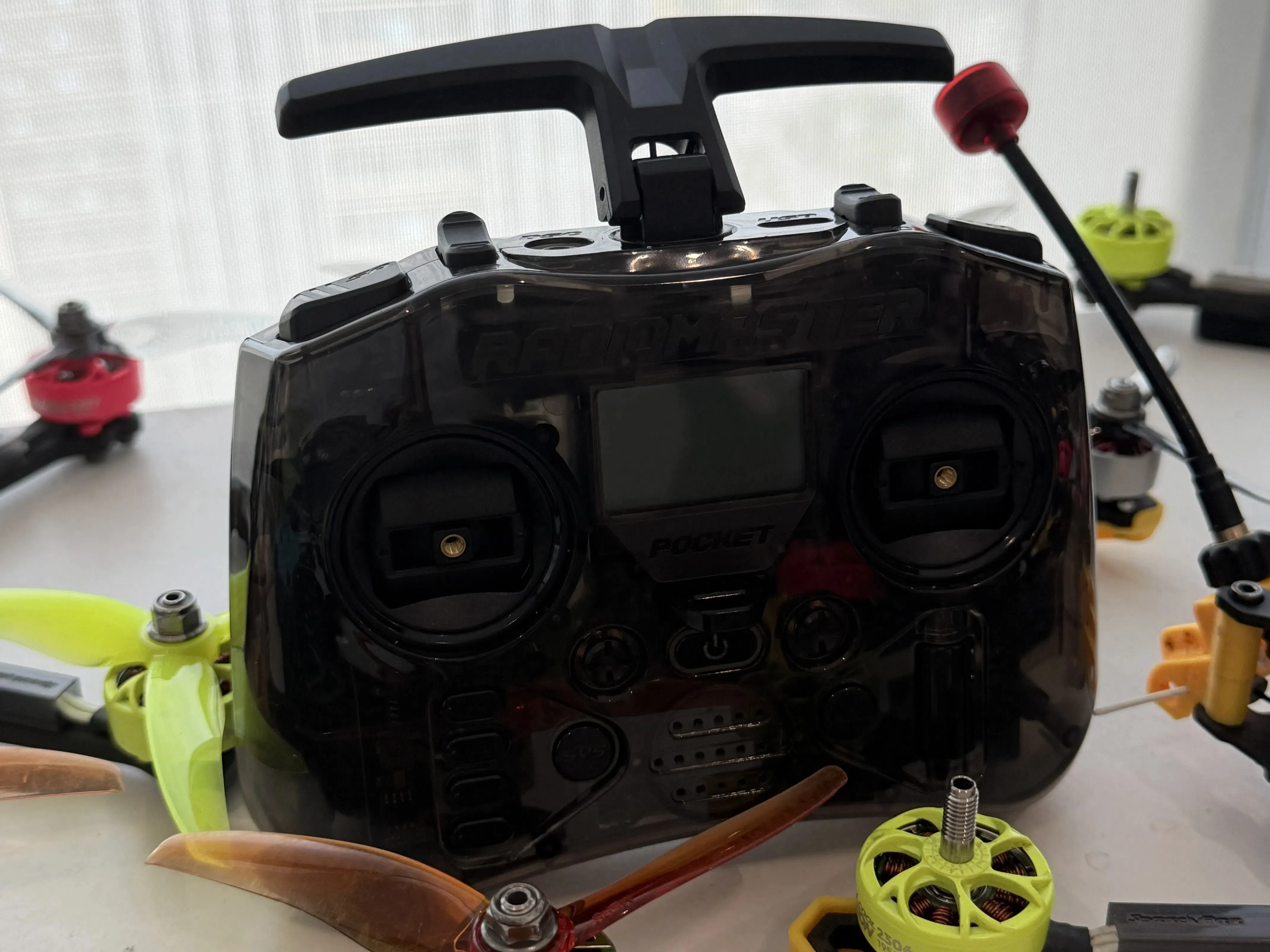
RadioMaster Pocket– Budget FPV Controller
Starting FPV doesn’t have to mean spending hundreds of dollars on your first transmitter. The RadioMaster Pocket proves that an affordable radio can still deliver a reliable flying experience, making it one of the most popular choices for beginners entering the hobby.
Despite its compact size, the Pocket includes Hall-effect gimbals, runs EdgeTX, and is available with an internal ExpressLRS module. These features were once reserved for higher-end transmitters, but RadioMaster has packaged them into a lightweight, travel-friendly design without sacrificing core functionality.
The Pocket is especially well-suited for simulator training. Its USB connectivity allows pilots to practice in simulators like Liftoff or VelociDrone before flying a real quad, helping build muscle memory while avoiding costly crashes.
For pilots who mainly fly small whoops, 3-inch drones, or casual freestyle builds, the Pocket provides more than enough performance. However, as flying skills improve and flight sessions become longer, some users may find its smaller grip less comfortable than mid-size controllers such as the GX12 or Boxer.
Pros
- Affordable entry into the FPV hobby
- Compact and lightweight
- Hall-effect gimbals
- ExpressLRS available
- Excellent for simulators
Cons
- Smaller grip may not suit every pilot
- Fewer switches than larger transmitters
- Less comfortable during extended flying sessions
Best For
- First-time FPV pilots
- Simulator practice
- Tiny Whoop and micro drone flying
- Travelers looking for a backup radio
Our Verdict
If you’re buying your first FPV controller or working with a limited budget, the RadioMaster Pocket offers exceptional value. It delivers the essential features most pilots need while leaving room to upgrade later as your flying style evolves.
RadioMaster TX16S MK3– Premium Radio
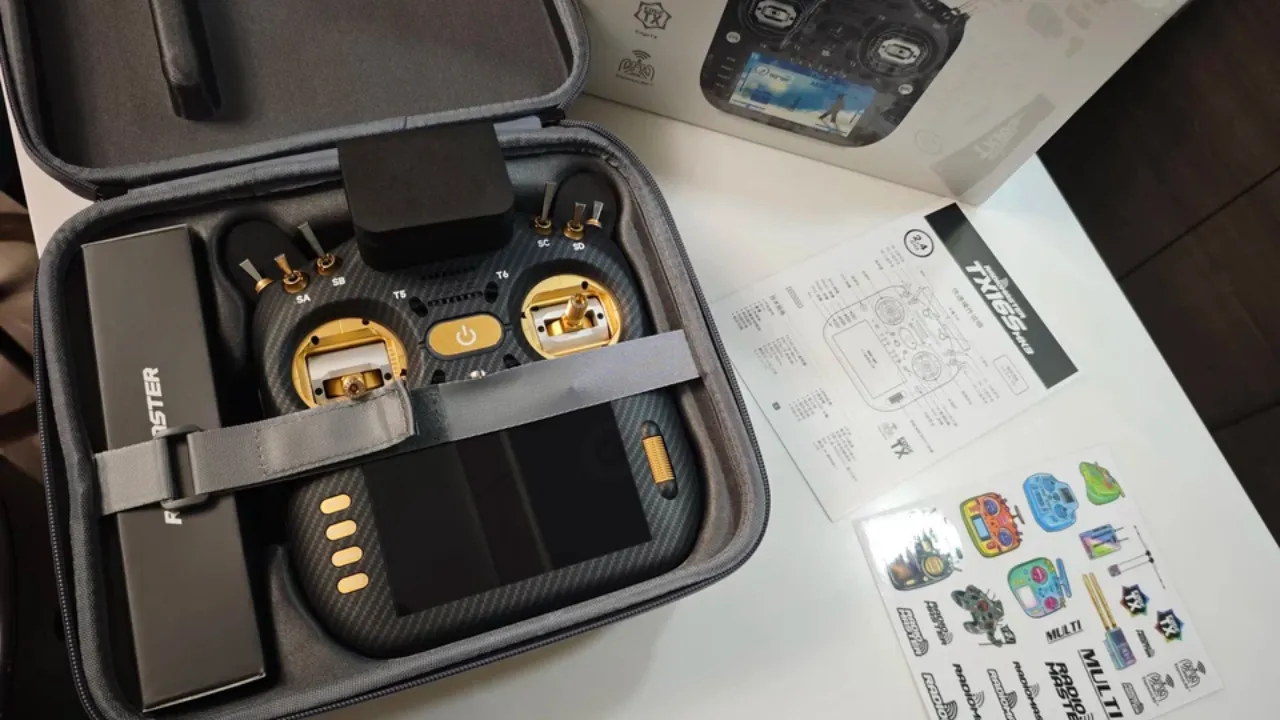
The TX16S MKII Max remains RadioMaster’s flagship transmitter, designed for pilots who want maximum customization, advanced controls, and support for a wide variety of aircraft.
Its large color touchscreen, full-size Hall-effect gimbals, numerous switches, sliders, and rotary knobs make it a favorite among experienced pilots who fly multiple platforms. While many FPV pilots use the TX16S, it’s equally popular with fixed-wing enthusiasts, helicopter pilots, and UAV operators who require additional control channels.
One of the TX16S’s biggest strengths is flexibility. Combined with EdgeTX and the external JR module bay, it supports numerous radio protocols and can easily adapt as new technologies emerge. For users who frequently tune models, adjust mixes, or switch between aircraft, the larger display also makes navigation and configuration significantly easier than on smaller transmitters.
However, those same advantages come with trade-offs. The TX16S is noticeably larger and heavier than the Boxer or GX12, making it less convenient for travel. Many freestyle pilots who only fly FPV quads now prefer lighter transmitters that are easier to carry and more comfortable during long flying sessions.
Pros
- Large touchscreen display
- Premium Hall-effect gimbals
- Extensive switches and controls
- Highly customizable with EdgeTX
- Excellent multi-protocol support
Cons
- Largest and heaviest option in this list
- Higher price
- More features than many FPV pilots actually need
Best For
- Experienced FPV pilots
- Fixed-wing and RC aircraft enthusiasts
- Professional UAV operators
- Users managing multiple aircraft
Our Verdict
The TX16S MKII Max is not the best choice for everyone—but for advanced pilots who value customization and versatility, it remains one of the most capable radio transmitters available.
RadioMaster Zorro– Gamepad Style Controller
For pilots who prefer the feel of a gaming controller, the RadioMaster Zorro offers one of the most familiar and comfortable layouts in the FPV market.
Instead of the traditional box-style design, the Zorro adopts a gamepad-inspired shape that feels natural for thumb flyers and anyone coming from console gaming. This ergonomic design has made it particularly popular among younger pilots and DJI users transitioning into custom FPV drones.
Although compact, the Zorro still supports EdgeTX, Hall-effect gimbals, and internal ExpressLRS, giving it nearly all the capabilities of larger transmitters. It’s also easy to pack into a backpack, making it a convenient choice for pilots who frequently travel or hike to flying locations.
That said, its compact grip isn’t ideal for everyone. Pilots who fly using a pinch grip or spend hours flying multiple battery packs often find mid-size controllers like the Boxer more comfortable over time.
Pros
- Comfortable gamepad-style design
- Compact and portable
- Excellent for thumb pilots
- EdgeTX and ELRS support
- Great travel companion
Cons
- Less suitable for pinch grip
- Smaller battery capacity than larger radios
- Limited physical controls compared with flagship models
Best For
- Thumb flyers
- Gamers entering FPV
- Travelers
- Casual freestyle pilots
Our Verdict
If you enjoy the feel of a console controller and prioritize portability, the RadioMaster Zorro is an excellent choice. It combines modern FPV features with an intuitive design that’s easy to pick up and enjoyable to fly.
RadioMaster Controller Comparison: Pocket vs Boxer vs GX12 vs TX16S
Choosing between RadioMaster controllers can be confusing because many models share similar features, including ExpressLRS support, EdgeTX firmware, and Hall-effect gimbals.
The biggest differences are not only specifications—they are about how you fly, where you fly, and how much room you need for future upgrades.
Below are the most common comparisons between RadioMaster transmitters.
Pocket vs Boxer
The Pocket and Boxer are two of the most popular RadioMaster controllers, but they target very different pilots.
The Pocket focuses on affordability and portability, while the Boxer is designed as a long-term everyday transmitter with better ergonomics and more control space.
| Feature | RadioMaster Pocket | RadioMaster Boxer |
|---|---|---|
| Size | Compact | Medium |
| Portability | Excellent | Good |
| Gimbal Size | Small | Full-size |
| ELRS Support | Yes | Yes |
| Long Flying Comfort | Average | Excellent |
| Beginner Friendly | Excellent | Excellent |
| Long-Term Upgrade | Good | Excellent |
GX12 vs Boxer
The GX12 and Boxer are probably the closest competitors in RadioMaster’s current lineup.
Both are designed for serious FPV pilots, but they approach the problem differently.
The Boxer prioritizes maximum comfort and traditional radio ergonomics, while the GX12 focuses on portability and modern design.
| Feature | RadioMaster GX12 | RadioMaster Boxer |
|---|---|---|
| Design Goal | Portable performance | All-around professional use |
| Size | Smaller | Larger |
| Weight | Lighter | Heavier |
| Travel Friendly | Excellent | Good |
| Comfort | Very Good | Excellent |
| Freestyle Flying | Excellent | Excellent |
| Long Sessions | Good | Better |
TX16S vs GX12
The TX16S and GX12 represent two different generations of transmitter design.
The TX16S follows the traditional “professional RC transmitter” approach, while the GX12 represents the newer trend toward compact, specialized FPV radios.
| Feature | TX16S MKII Max | GX12 |
|---|---|---|
| Size | Large | Compact |
| Display | Large touchscreen | Smaller interface |
| Controls | More switches | Simplified layout |
| Portability | Average | Excellent |
| FPV Focus | General RC + FPV | FPV-focused |
| Beginners | Medium | Easy |
Zorro vs Pocket
Both the Zorro and Pocket are designed for pilots who want a lightweight transmitter, but their designs appeal to different users.
| Feature | RadioMaster Zorro | RadioMaster Pocket |
|---|---|---|
| Design | Gamepad Style | Traditional Mini Radio |
| Grip Style | Thumb Flying | Thumb / Small Hands |
| Portability | Excellent | Excellent |
| Beginner Friendly | Excellent | Excellent |
| Simulator Use | Excellent | Excellent |
Which RadioMaster Controller Is Best for You?
There is no single “best” RadioMaster controller for every pilot. The right choice depends on your current skill level, flying style, and future plans.
For Beginners: RadioMaster Pocket
The Pocket provides everything needed to start learning FPV without a large investment.
Pair it with:
- FPV simulator
- ELRS receiver
- Beginner-friendly drone build
For Pilots Building Their First 5-Inch FPV Drone: RadioMaster Boxer
A 5-inch freestyle drone requires precise control and comfortable handling. The Boxer provides the confidence needed for aggressive flying while remaining easy to use.
For Freestyle and Cinematic Pilots: RadioMaster GX12 or Boxer
Choose:
- GX12 → if portability matters
- Boxer → if comfort matters
Both are excellent choices for modern FPV flying.
For Advanced RC Users: RadioMaster TX16S MKII Max
If you operate multiple aircraft platforms, the TX16S provides the flexibility and customization you need.
Frequently Asked Questions
Which RadioMaster controller is best for beginners?
The best RadioMaster FPV controller for beginners is the RadioMaster Pocket because it offers an affordable way to start learning FPV without sacrificing essential features.
It supports ExpressLRS, works with popular FPV simulators, and provides enough performance for beginners learning stick control before moving to real drones.
However, if you already know that FPV will become a long-term hobby, upgrading directly to the RadioMaster Boxer can be a better investment because it offers improved ergonomics and more comfortable controls for extended flying sessions.
Should I buy GX12 or Boxer?
Choose the GX12 if you value portability and travel-friendly design. Choose the Boxer if you want better comfort and a controller that can handle years of FPV flying.
Does RadioMaster use ELRS?
Yes. Most modern RadioMaster controllers support ExpressLRS (ELRS), which provides low latency, long range, and reliable performance for FPV flying.
Can I use RadioMaster with Liftoff Simulator?
Yes. RadioMaster controllers can connect to popular FPV simulators such as Liftoff, VelociDrone, and Uncrashed through USB.
Conclusion
Choosing the best RadioMaster FPV controller depends on your flying style, experience level, and future plans.
For most FPV pilots, the RadioMaster Boxer is the best overall choice thanks to its excellent balance of comfort, performance, and long-term value. It is suitable for everything from freestyle flying to everyday FPV builds.
If portability is your priority, the RadioMaster GX12 offers a great combination of modern features and a compact design. For beginners looking for an affordable way to start FPV, the RadioMaster Pocket provides everything needed to learn and practice.
Advanced users who need maximum customization may prefer the RadioMaster TX16S, while pilots who enjoy a gamepad-style feel will appreciate the RadioMaster Zorro.
No matter which model you choose, investing in a reliable ELRS radio is one of the best decisions you can make as an FPV pilot. A good controller will not only improve your flying experience but also stay with you through multiple drone builds and years of flying.
Ready to build your next FPV drone? Explore our FPV radio controllers, receivers, and complete build components at MEPSKING to find the right setup for your flying style.