
If you build or repair FPV drones long enough, you will eventually run into a noisy quad, hot electronics, random video interference, or a build that feels harder to tune than it should. In many of those cases, one small and cheap part helps more than people expect: the capacitor.
Here is the short answer first:
- Yes, most 4S and 6S FPV drones benefit from a capacitor.
- A capacitor helps reduce voltage spikes and electrical noise from the ESC and motors.
- On analog builds, it often improves video noise.
- On digital builds, it can still help with power stability, dropped frames, and overall reliability.
- For many 5-inch FPV drones, a low-ESR capacitor in the 470uF to 1000uF range is a common choice.
- The best place to install it is usually directly across the main battery pads on the ESC or AIO board.
If you want the practical answer from a real FPV pilot: I would add a capacitor to almost every 5-inch or larger quad, and I would strongly consider one on any build that runs 4S, 6S, larger motors, or a power-hungry digital system.
Introduction
What Is an FPV Capacitor?
One of the most prevalent parts of an electronic system is a capacitor. Almost all electronic component used in our FPV drones, as well as practically all other electronic equipment, has many capacitors. Although capacitors exist in a wide variety of sizes and shapes, their capacitance to store charge generally increases with size. The most popular application of a capacitor is supply voltage smoothing. This type of application for a capacitor is known as decoupling.
An FPV capacitor is a component soldered into the drone’s power system to absorb voltage spikes and smooth electrical noise. In simple terms, it works like a tiny, fast power buffer.
When your motors accelerate, brake hard, or change load suddenly, the ESC generates electrical ripple and back-EMF noise. That noise can travel through the power system and affect:
- the ESC
- the flight controller
- the VTX
- the camera
- the receiver
- the gyro signal
A capacitor helps reduce that noise before it causes visible or invisible problems.
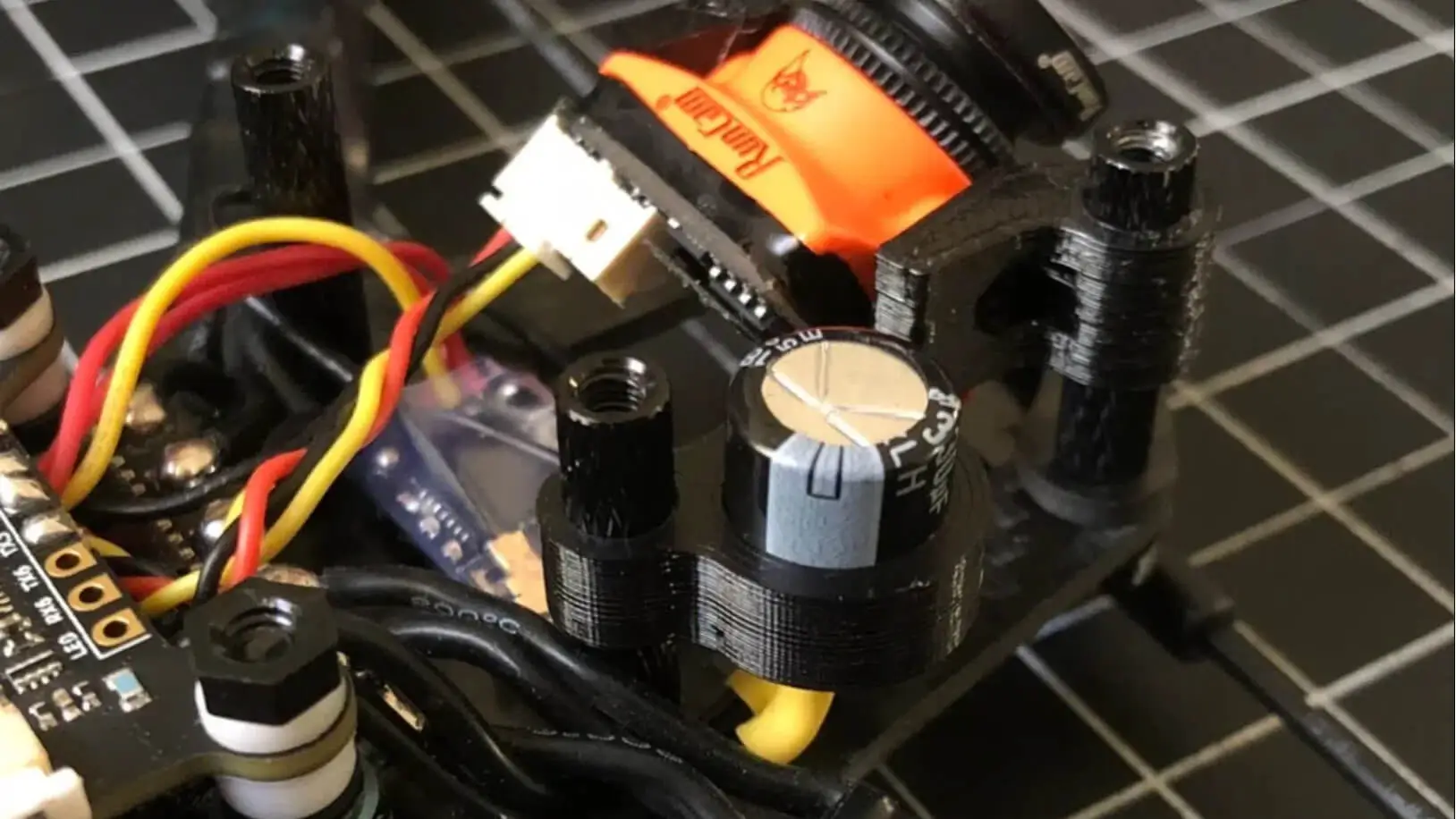
The Benefits of Extra Capacitors in FPV Drones
In essence, the FETs in our ESC are switches. To power the motors, they rapidly switch on and off tens of thousands of times per second, which can produce a great deal of noise and electrical spikes. The issue gets worse as technology develops and makes stronger motors, ESCs, and greater battery voltages possible. It can make the difference between an amazing first-person perspective drone and one that is entirely unflyable, therefore the noise problem is really important.
While the motors spin up or while the drone is making fast movements, drone capacitors can aid to lessen electrical noise and voltage spikes. Capacitors can also aid in lowering the quantity of interference produced by the power supply, which can enhance the quality of the analog video stream captured by the drone’s camera. More noise is produced by larger motors and high-current ESCs, necessitating larger or more capacitors.
Surface mount capacitors are used for filtering in ESC and FC, although they are typically insufficient because of the limited physical area. In conclusion, increasing the number of capacitors in our FPV drone can offer the following advantages:
- ESC/motor-generated electrical noise is filtered to lessen interference with ESC, radio, and video signals.
- Enhancing flight performance by gyro signal “cleaning up”.
- Safeguarding devices against harmful voltage spikes. By acting as a buffer, capacitors stop any extra energy from getting to the sensitive parts.
- Having enough capacitors for drone at the input power can assist minimize video noise in your FPV feed if you fly analog.
Do You Need a Capacitor on an FPV Drone?
For many builds, yes.
From a real builder’s perspective, I would break it down like this:
Usually yes
- 5-inch freestyle quads
- 5-inch racing quads
- 6-inch and 7-inch long-range quads
- 6S builds
- high-current builds
- quads with digital VTX systems like DJI or Walksnail
- builds with long battery leads
- quads that already show signs of power noise
Sometimes optional
- tiny whoops
- very small 2-inch or 3-inch builds
- low-power AIO builds with short wiring and clean onboard filtering
That said, even if a quad flies “fine” without a capacitor, adding one can still improve long-term reliability. That is why many experienced FPV builders treat a low-ESR cap as standard practice on anything bigger than a tiny whoop.
Signs Your FPV Drone Needs a Capacitor
If you are unsure whether your quad needs one, look for these clues:
- analog video gets noisier when you raise throttle
- motors come down hotter than expected
- the quad is harder to tune than it should be
- random desync or unstable behavior appears under punch-outs
- digital video feels less stable than expected
- you run a 6S powertrain with aggressive braking
- your ESC or FC seems unusually stressed after crashes or hard throttle changes
One of the most common real-world symptoms is simple: the quad looks okay on the bench, but once you punch throttle, the video feed gets ugly or the tune starts to feel rougher than it should.
Do Digital FPV Systems Still Need a Capacitor?
Yes, often.
A common beginner mistake is thinking capacitors are only for analog FPV. That is not true.
Analog systems show noise more obviously, usually as lines or interference in the feed. Digital systems hide some of that better, but they are still affected by noisy power. On digital builds, bad power can show up as:
- unstable video performance
- frame drops
- reduced range consistency
- extra stress on sensitive electronics
So even though digital systems filter noise better than analog, I still recommend capacitors for many digital FPV builds, especially on 4S and 6S freestyle quads.
What Type of Capacitor Should You Use for an FPV Drone?
For most FPV drone builds, the answer is simple:
Use a low-ESR electrolytic capacitor.
That is still the most common and practical choice because it gives you a lot of capacitance in a relatively small package.
What to look for
- low ESR or low impedance
- the correct capacitance value
- a voltage rating with proper headroom
- physical size that fits your frame
- trusted brands if possible
Common FPV-friendly capacitor families often mentioned by builders include low-ESR lines from Panasonic, Rubycon, and Nichicon.
What Size Capacitor for FPV Drone Builds?
This is where most people want a direct answer.
Quick recommendations
- Tiny whoops / very small micros: often none, or 220uF to 330uF if needed
- 3-inch and light 4-inch builds: 330uF to 470uF
- 5-inch 4S freestyle/racing: 470uF to 1000uF
- 5-inch 6S freestyle/racing: 680uF to 1000uF
- 7-inch long-range: 1000uF or even 2 x 1000uF if space and weight allow
- X-class / cinelifter / very high-current builds: often multiple capacitors in parallel
My practical rule
If I am building a normal 5-inch 6S freestyle quad, I am usually comfortable with a good low-ESR 680uF to 1000uF cap, depending on the ESC, frame space, wiring, and how hard the build is driven.
If I am building a smaller 4S quad, 470uF is often enough.
If the build is very noisy or space allows, using more capacitance is usually fine.
What Voltage Rating Should You Use?
This is just as important as capacitance.
The capacitor’s voltage rating must be safely above the highest voltage your build will see, including spikes.
Safe starting points
- 12S: 63V or higher
- 2S: 16V
- 3S: 16V or 25V
- 4S: 25V minimum, 35V preferred
- 5S: 35V or 50V
- 6S: 35V minimum, 50V preferred
- 8S: 50V or 63V
In every situation, confirm that the capacitor’s voltage rating is greater than the system voltage. Here’s a recommended chart for maximum capacitor voltages based on various LiPo battery sizes:
| LiPo Cell Count | Nominal Voltage | Full Charge Voltage | Recommended Capacitor Voltage |
| 2S | 7.4V | 8.4V | 16V |
| 3S | 11.1V | 12.6V | 25V |
| 4S | 14.8V | 16.8V | 35V |
| 5S | 18.5V | 21.0V | 35V or 50V |
| 6S | 22.2V | 25.2V | 50V |
| 8S | 29.6V | 33.6V | 63V |
| 12S | 44.4V | 50.4V | 100V |
- For 4S, I like 35V if space allows.
- For 6S, I strongly prefer 50V if the frame can fit it.
Yes, many pilots use 35V on 6S successfully. But if you want more headroom and more peace of mind, 50V is the safer answer.
Is 35V Enough for 6S FPV?
Sometimes yes, but it is closer to the edge than many pilots realize.
A fully charged 6S LiPo is 25.2V, so a 35V capacitor technically clears that. But real FPV builds do not see only ideal battery voltage. They also see spikes, braking events, and electrical stress.
That is why many experienced builders prefer 50V capacitors on 6S, especially if the quad is:
- powerful
- heavy
- digital
- noisy
- long-range
- using long battery leads
If you have room, 50V is the more conservative choice.
Capacitor Size Chart
The size of the frame affects the motors and ESCs that are employed, which in turn affects the size of the capacitor:
| Frame Size | Common Battery Voltage | Typical ESC Rating | Recommended Capacitor |
| 2-3 inch (Micro) | 2S-4S | 10-20A | 220µF – 330µF 25V |
| 4-inch | 4S-6S | 20-35A | 330µF – 470µF 35V |
| 5-inch (Freestyle/Racing) | 4S-6S | 30-50A | 470µF – 1000µF 35V-50V |
| 6-7 inch (Long Range) | 6S | 30-60A | 1000µF – 2200µF 50V |
| X-Class / CineLifters | 6S-12S | 60A+ | 2200µF+ (Multiple capacitors in parallel) |
Select a capacitor with a voltage rating that is at least 20% more than the maximum battery voltage.
- Use a 25V or 35V capacitor for 4S (16.8V maximum).
- Use a 35V or 50V capacitor for 6S (25.2V maximum).
- 8S or above (33.6V maximum): Make use of 63V or greater.
What Is Low ESR and Why Does It Matter?
ESR means equivalent series resistance.
In plain English, lower ESR means the capacitor can react faster and more effectively to the kind of electrical ripple and spikes that happen in FPV power systems.
For FPV use, low ESR matters because we are dealing with:
- fast motor switching
- sudden throttle changes
- active braking
- noisy power rails
- sensitive electronics
So if you buy a capacitor for a drone, do not just match uF and V. Make sure it is actually a low-ESR or low-impedance capacitor.
How to Install a Capacitor on FPV Drone?
Where Should You Solder the Capacitor on an FPV Drone?
Best answer: as close to the ESC battery input as possible.
On most modern quads, the best place is:
- directly on the 4-in-1 ESC battery pads
- directly across the XT60 or XT30 input pads on the ESC
- on the AIO board battery input pads if you are using an AIO
Why this location works best:
- it filters noise close to the source
- it protects the whole power system more effectively
- it is usually shorter and electrically cleaner than mounting farther away
Common mistake
Do not treat the battery connector itself as the best mounting point if it places the capacitor far away from the ESC and board. The farther the capacitor is from the source of the noise, the less effective it becomes.
How to Install a Capacitor on FPV Drone?
The install itself is simple, but polarity matters.
Basic steps
- Confirm capacitance and voltage rating.
- Identify positive and negative capacitor legs.
- Solder the capacitor across the main battery pads on the ESC or AIO.
- Keep leads as short as practical.
- Insulate the legs with heat shrink.
- Secure the capacitor so it cannot vibrate into the frame.
Important note
- Electrolytic capacitors are polarized.
- If you solder them backward, they can fail violently.
The negative side is usually marked clearly with a stripe.
What If the Capacitor Does Not Fit?
This happens a lot on tight freestyle frames and compact builds.
If space is limited:
- shorten the legs carefully
- use short silicone wire extensions
- move the capacitor slightly away from the board
- secure it with TPU, foam tape, or zip ties
- keep wire length as short as possible
For 6S builds, if you relocate the capacitor with wire, use wire thick enough to avoid adding unnecessary resistance. Short, thick wire is better than long, thin wire.
Should the Capacitor Touch the Carbon Frame?
No.
Carbon fiber is electrically conductive, and letting the capacitor legs or exposed body contact the frame can cause:
- shorts
- unstable behavior
- damaged electronics
- failures after crashes
Always insulate the legs, and ideally protect the whole cap if it sits close to the frame.
Is It Bad to Add Too Many Capacitors?
In normal FPV builds, not really.
Adding more capacitance usually does not create the kind of “over-filtering” problem that beginners worry about in this context. In fact, multiple capacitors in parallel can work very well.
Still, there are practical tradeoffs:
- more weight
- more space used
- more complexity in mounting
- more chances to damage something in a crash
So the better rule is not “add as many as possible.”
It is “add enough for the build, and do it cleanly.”
Can a Capacitor Fix FPV Video Noise?
Often, yes, especially on analog builds.
If your analog video gets worse on throttle, a capacitor is one of the first things I would try. It is not the only possible fix, because video noise can also come from:
- poor grounding
- bad camera power
- noisy VTX power
- antenna issues
- damaged components
- poor soldering
But adding a capacitor to the ESC power input is one of the cheapest and most effective first steps.
Can a Capacitor Fix Hot Motors or Bad Tune?
Sometimes it helps, but only if electrical noise is part of the problem.
A capacitor can reduce noise that affects the gyro and power system. That can make tuning easier and sometimes reduce odd behavior. But if your motors are hot because of:
- bent props
- bad filters
- poor PID tune
- mechanical vibration
- damaged bearings
- motor timing or ESC settings
Then a capacitor alone will not solve it.
Do Capacitors Wear Out?
Yes.
Electrolytic capacitors do age, especially with:
- heat
- voltage stress
- crash damage
- long-term use
Signs of a bad capacitor include:
- bulging
- leaking
- cracked insulation
- unstable performance
- recurring noise that was not there before
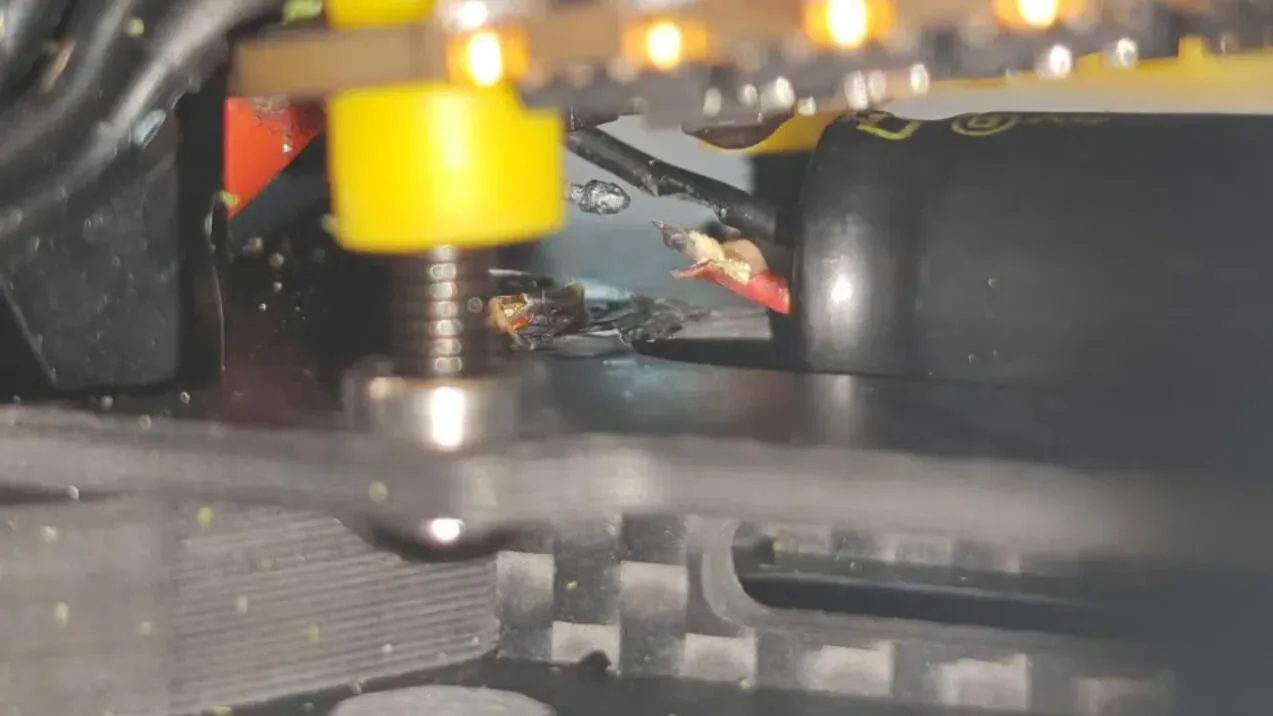
If a capacitor gets unusually hot, looks swollen, or has been smashed in a crash, replace it. It is cheap compared with an ESC, FC, or VTX.
My Recommendation as an FPV Builder
If you want the short version of what I would actually do on my own bench:
- On a 5-inch 4S quad, I would usually add a 470uF to 1000uF low-ESR cap.
- On a 5-inch 6S quad, I would usually add a 680uF to 1000uF low-ESR cap, and I would prefer 50V if space allows.
- On a 7-inch long-range quad, I would not skip the capacitor.
- On a tiny whoop, I would usually only add one if there is a specific reason.
A capacitor is cheap, easy to add, and can prevent expensive problems. For most FPV drones larger than a whoop, I see it as good practice rather than an optional luxury.
Final Verdict
If you are asking whether you need an FPV capacitor, the answer for most 4S and 6S builds is yes.
A good low-ESR capacitor helps:
- protect your electronics
- reduce voltage spikes
- smooth power noise
- improve analog video cleanliness
- support more stable digital performance
It will not fix every problem on a bad build, but it is one of the cheapest and most effective upgrades you can make to the power system of an FPV drone.
If you are building a freestyle, racing, long-range, or digital quad, I would strongly consider it standard equipment.
FAQs
Why Should You Not Let Capacitors Touch Drone Frame?
Letting capacitors touch the drone frame can lead to several issues:
- Short Circuits – If the capacitor’s leads or body make direct contact with the carbon fiber frame, it could cause a short circuit since carbon fiber is conductive. This may result in power failure or even permanent damage to your drone’s electronics.
- Electrical Noise & Interference – Capacitors help filter voltage spikes and noise in the power system. If they touch the frame, improper grounding or unintended electrical paths could introduce noise or instability in the system, affecting video transmission (VTX) and flight controller performance.
- Physical Damage – The vibrations and impacts during flight or crashes can cause the capacitor to rub against the frame, leading to wear on the insulation, potential breakage, or even desoldering from the PCB.
How to Avoid This:
- Use Heat Shrink Tubing – Cover the capacitor leads with heat shrink to insulate them.
- Secure with Zip Ties or TPU Mounts – Fix the capacitor away from the frame using a zip tie, double-sided tape, or a 3D-printed TPU holder.
- Proper Positioning – Mount the capacitor in a location where it won’t move or touch the frame, such as tucked next to the battery lead or secured to the ESC.
Keeping capacitors properly insulated and secured will ensure the longevity and reliability of your FPV drone’s power system.
Do Capacitors Wear Out?
Due to elements like high temperatures and high voltage stress, electrolytic capacitors used in FPV drones have a finite lifespan. An electrolytic capacitor’s capacitance may drop and it may leak or bulge as it ages. The power supply may become unstable and noisy as a result, which could impair the devices’ functionality. Drone capacitors should be inspected and replaced on a regular basis; even if they appear to be “ok,” it may still be worthwhile to do so.
Where do you put a capacitor on an FPV drone?
Usually across the main battery pads on the ESC or AIO board, as close to the power input as possible.
Does a capacitor help digital FPV?
Yes. Digital systems still benefit from cleaner power, even if they hide visible noise better than analog systems.
Can too much capacitance hurt an FPV drone?
In most normal FPV builds, not really. The bigger limits are usually space, weight, and clean mounting rather than electrical overkill.