
When building or upgrading your FPV racing drone, one of the most critical decisions you will face is choosing between a 4S vs 6S battery. This choice dictates your drone’s power, weight, and the longevity of your electronics.
In this comprehensive guide, we will break down the exact 4S battery meaning, explore 6S nominal voltage, answer whether 4S actually travels faster than 6S, and highlight the exact batteries you need from the MEPSKING store to maximize your specific build.
4s Battery VS 6s Battery: What is the Difference?
To understand the performance gap, we must first answer the most common beginner questions: what is a 4S battery, and how does it differ from a 6S?
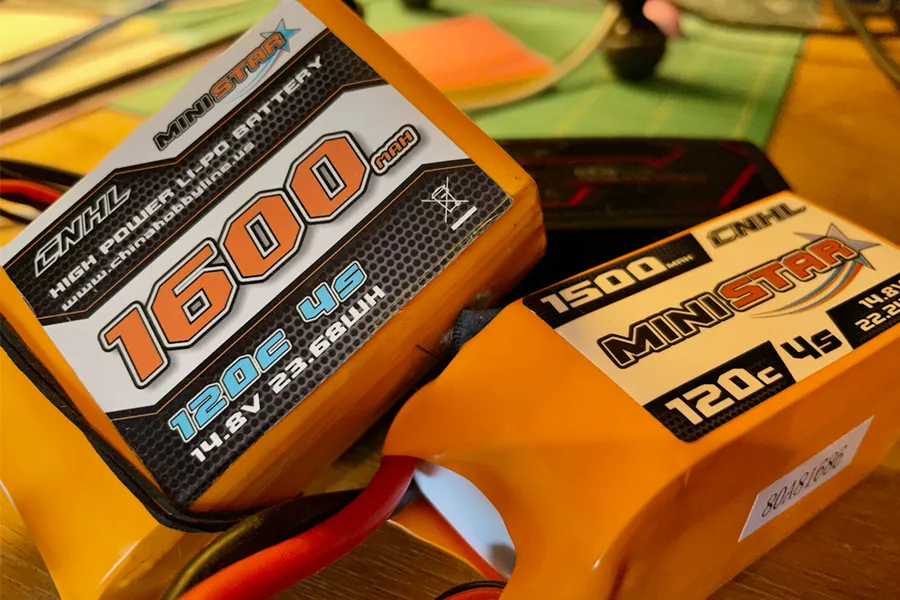
4S Battery Meaning: The “S” stands for cells connected in Series. A 4S pack contains four 3.7V cells, giving it a nominal voltage of 14.8 volts. Because of their lower voltage, 4S batteries are lighter, more forgiving, and highly recommended for pilots mastering throttle control.
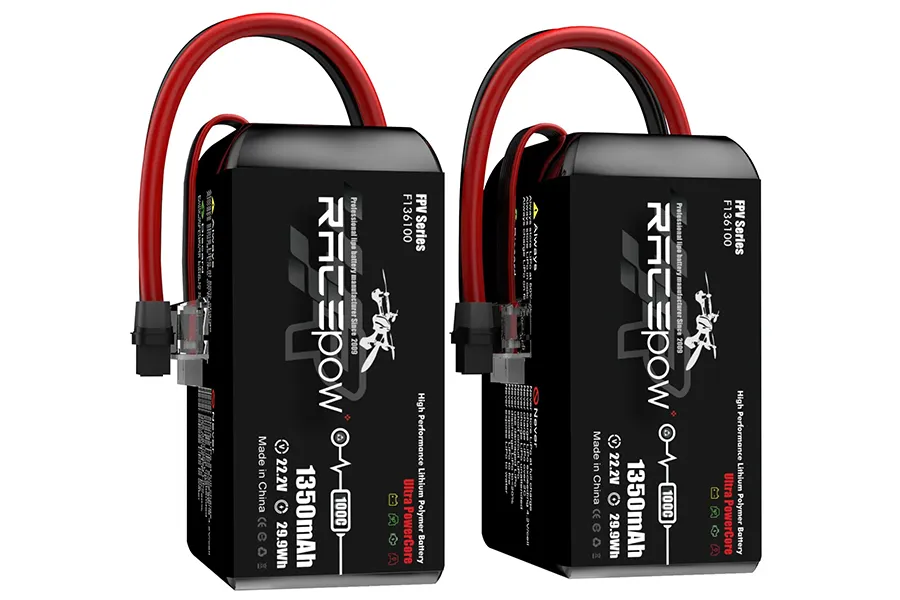
6S Drone Battery Specs: A 6S pack consists of six cells. The 6S nominal voltage is 22.2V (fully charged at 25.2V). This higher voltage allows the drone to deliver massive power at a lower current, making it the absolute standard for professional FPV racing.
When compared to the 4S battery, the 6S battery’s higher voltage allows it to give more power and better performance. However, it may lose power more quickly, which results in shorter flight periods. Check here to learn more about FPV battery last time.
Power, Voltage, and Amp Draw (The Math Behind 6S)
An object’s power is a measurement of its work capacity, calculated by P = I * V (Power = Current * Voltage). Racing quads can consume about 2,500 watts (2.5 kilowatts) of power during a maximum speed punch-out.
The main limitation with a 4S LiPo is that it relies on massive current to generate that power. Based on a 2.5kW burst, a 4S battery (14.8V) must deliver approximately 169A of current (2500W / 14.8V =169A). Supplying this much current creates extreme heat and puts massive stress on the battery cells, leading to severe voltage sag and reducing the pack’s overall lifespan.
The magic of a 6S pack lies in its voltage. Because the nominal voltage increases to 22.2V, the current required to hit that same 2.5kW drops drastically to roughly 112A (2500W / 22.2V =112A). Less current means significantly less heat, minimal voltage sag, and a much longer lifespan for your battery packs and electronics.
Battery Capacity and Weight
One common misconception is that because 6S batteries typically have lower mAh ratings, they offer less flight time. In reality, total energy is measured in Watt-hours (Wh), calculated by multiplying Voltage and Amp-hours (Wh = V *Ah).
Let’s compare a typical 5-inch drone setup:
- 4S Battery (1300mAh): 14.8V * 1.3Ah = 19.24 Wh
- 6S Battery (850mAh): 22.2V * 0.85Ah = 18.87 Wh
As you can see, a 6S 850mAh pack holds almost the exact same usable energy as a 4S 1300mAh pack, meaning they will provide roughly the same flight time, provided the total weight of the drones is similar.
Motor kV
Your battery voltage must dictate your motor KV selection.
- For 4S Builds: High KV motors (2400KV–2750KV) are required to make up for the lower voltage. A classic 4S 1300mAh-1500mAh pack is the perfect weight balance here.
- For 6S Builds: Low KV motors (1600KV–1950KV) are essential to prevent burning out your electronics. Because of the higher voltage efficiency, smaller capacities like the CNHL 6S 1100mAh or 1300mAh are the sweet spot for 5-inch racing and freestyle.
(Note: Never run high KV 4S motors on a 6S battery without limiting motor output in your flight controller, or they will overheat instantly.)
| Feature | 4S Battery | 6S Battery |
|---|---|---|
| Voltage | 14.8V | 22.2V |
| Weight | Lighter | Heavier |
| Speed | Moderate, good for beginners | Faster, higher thrust |
| Efficiency | Lower efficiency | More efficient (less current for same power) |
| Flight Time | Slightly shorter | Can be longer with proper tuning |
| Price | More affordable | Higher cost |
| Best For | Beginners, budget builds, casual flying | Competitive racing, long range, pro pilots |
Top Battery Recommendations by Flight Style (MEPSKING Picks)
We don’t just sell generic packs; we stock targeted solutions. Here is how to match the battery to your mission using our premium inventory:
The 6S Racing & Freestyle Advantage
When pushing a 6S setup, the battery’s discharge rate (C-Rating) is crucial. You need a pack that delivers explosive burst power.
- MEPSKING Pro Pick: CNHL Black Series V2 1300mAh 6S 130C LiPo. Its massive 130C discharge rate perfectly complements 6S efficiency, giving you instant throttle response out of the sharpest corners. For extreme durability, check out our Boslipo and Tattu 6S options.
The 4S Long-Range Advantage
While standard 4S is great for beginners, it is also the undisputed king of Long-Range FPV. For sub-250g cruisers, you need capacity, not extreme acrobatic punch.
- MEPSKING Pro Pick: Flywoo Explorer 4S 3000mAh Li-Ion Battery. This pack provides extended flight times that a heavy 6S racing setup simply cannot reach, making it the ultimate choice for cinematic mountain surfing.
The Micro & Whoop Setup
Building a tiny indoor flyer?
- MEPSKING Pro Pick: Shop our ultra-lightweight BETAFPV LAVA & BT2.0 1S/2S Series for unmatched micro performance.
Technical Synergy: Matching Hardware to Your Battery
The biggest advantage of a 6S setup over a 4S setup is electrical efficiency. A 6S battery reaches peak wattage at a significantly lower amp draw than a 4S battery. This keeps your components cooler.
However, to unlock this efficiency, your hardware must match.
- Flight Controller (FC): To handle the precision required by 6S without bottlenecking your system, we highly recommend building your stack around a Thobby F7 Flight Controller. Its superior STM32 processing ensures your drone feels completely “locked-in” at high speeds.
- Motors: If you are standardizing a fleet for 6S racing or managing a team, check out our neon 2306 Brushless motor. Buying in bulk ensures you always have exact-spec spares ready for tournament day.
Speed & Responsiveness: Do 4S Travel Faster Than 6S?
A high-impression question we frequently see is: do 4S travel faster than 6S? The short answer is No. Because a 6S battery operates at a much higher voltage (22.2V vs 14.8V), the motors generate more thrust, resulting in a significantly higher top speed and far superior acceleration.
More importantly, 6S offers unmatched responsiveness. Motors can change RPM more consistently under heavy loads because 6S setups suffer from far less “voltage sag” (the sudden drop in power during a hard punch-out).
Choose 4s battery VS 6s battery for your racing drone?
- Choose 4S Battery if you are a beginner, on a budget, or prefer a lighter build.
- Choose 6S Battery if you want higher performance, professional racing speed, or long-range efficiency.
Keep in mind that switching from 4S to 6S often requires upgrading your motors, ESC, and even propellers to handle the higher voltage safely.
Pros and Cons of 4S Batteries
If you are just entering the FPV hobby or building a dedicated long-range cruiser, 4S is a fantastic starting point.
Advantages (Pros):
- Beginner-Friendly Throttle: The lower voltage caps the top speed, making it much easier to learn altitude control without over-correcting.
- Lightweight & Affordable: 4S packs are generally cheaper to buy and lighter to carry, which is perfect for staying under the 250g weight limit.
- Ideal for Long Range: When paired with high-capacity Li-Ion packs (like the Flywoo 4S 3000mAh), they offer incredible efficiency for low-throttle cruising.
Drawbacks (Cons):
- Severe Voltage Sag: During aggressive flips or full-throttle punch-outs, you will feel a noticeable drop in power as the battery struggles to deliver high amps.
- Higher Heat Generation: Pushing high current through the system puts more thermal stress on your ESC and motors.
- Lower Top Speed: Simply cannot match the raw thrust of a 6S racing rig.
Pros and Cons of 6S Batteries
If you are flying 5-inch freestyle or competing in local races, 6S is the undeniable industry standard.
Advantages (Pros):
- Zero Voltage Sag: Because it draws fewer amps, a 6S battery delivers consistent, punchy power from the first second of the flight to the last.
- Higher Efficiency & Cooler Electronics: Lower amp draw means less energy is wasted as heat, protecting your expensive flight controllers and ESCs.
- Massive Torque & Responsiveness: Motors spool up faster, giving you instant recovery out of dives and tight corners.
Drawbacks (Cons):
- Higher Initial Cost: Both the batteries and the high-end chargers required to maintain them are more expensive.
- Heavier Weight: The addition of two extra cells makes the pack inherently heavier, requiring careful motor KV matching.
- Hardware Restrictions: You must use lower KV motors (e.g., 1750KV) and ensure your entire stack is rated to handle 25.2V; otherwise, you risk instantly burning your components.
Can you use 4S battery on 6S FPV drone?
Yes, you can. Plugging a lower voltage 4S battery into a 6S drone is safe, but because the motors are low KV (designed for 22.2V), the drone will feel extremely sluggish and underpowered. Warning: The reverse is NOT true. NEVER plug a 6S battery into a dedicated 4S drone without scaling down the motor output limit in Betaflight. Doing so will instantly fry your motors and ESCs!
When will you need to fly 8S battery?
It is necessary for you to use motors with the proper KV. For 8S, a range of 1200–1500 KV works well, which is similar to 1600–2000 KV for 6S. Similar to how 6S motors can be flown on 4S battery, 6S motors that are compatible with an 8S voltage can still be flown in Betaflight with a 75% power limit. It also requires an FC/ESC stack that is 8S compliant. Here’s a breakdown of when and why you’d need to fly an 8S battery:
High-Power Freestyle or Racing Builds
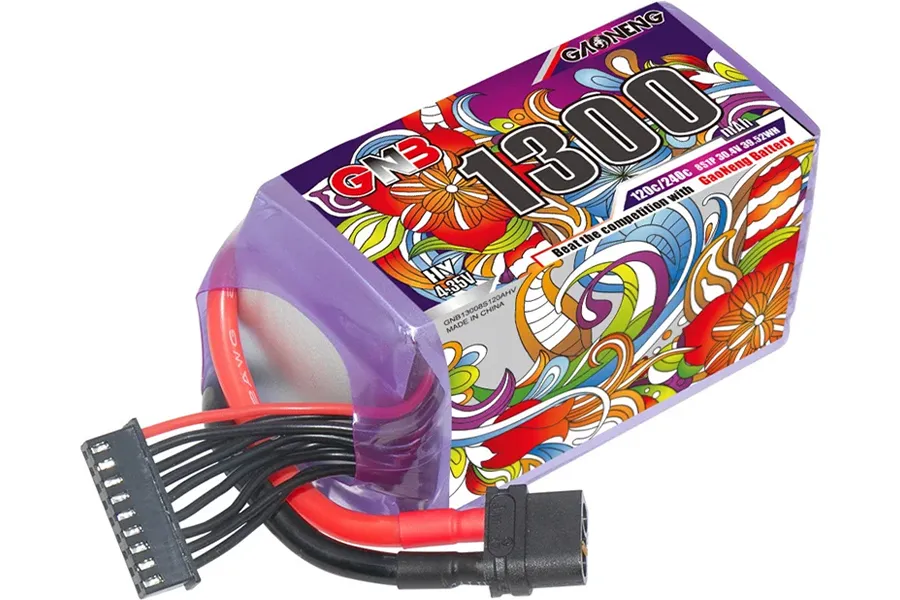
- 8S batteries deliver 29.6V (3.7V × 8 cells), which means more power at lower current.
- This gives extremely fast throttle response, perfect for pro-level racing or aggressive freestyle tricks.
Heavy-Lift & Cinematic Drones
- If you’re carrying large cameras (e.g., RED, Blackmagic, DSLR rigs), an 8S setup provides the extra torque needed.
- The higher voltage helps manage bigger motors and props more efficiently.
Long-Range Flights
- On large drones, 8S improves efficiency by reducing current draw, which translates into cooler electronics and longer flight times when paired with big-capacity packs.
Professional Applications
- Industrial inspection, mapping, or heavy-lift cinematography often require 8S because of the payload demands and reliability at higher voltages.
Advantages of 8S LiPo battery
The primary lesson to be learned from the aforementioned essay is that a greater voltage can accomplish a given quantity of power delivery at a lower current. As a result, your battery, the XT60 connector, the wires, the ESC, and the motors all get less heated. Lower current also lessens battery voltage sag, which improves throttle response and control and keeps the aircraft operating at a steady state of performance for the duration of the flight.
Many of the benefits of switching from 6S to 8S remain the same, including lower voltage sag and increased efficiency from fewer system losses. But the returns start to decrease as the voltage keeps rising. Therefore, as we’ll discuss next, it’s critical to balance these advantages against any potential disadvantages of higher voltage.
- Higher efficiency (less amp draw for the same power output)
- More powerful — ideal for big motors and large propellers
- Reduced heat stress on ESCs and wiring
- Supports heavier payloads
Cons of 8S LiPo battery
- More expensive batteries and components
- Heavier weight
- Requires ESCs and motors specifically rated for 8S
- Not beginner-friendly — tuning can be trickier
Do you recommend 8S LiPo battery?
8S batteries are becoming more common in FPV, but they’re definitely not for every pilot. Although building an 8S drone is enticing, I would personally advise delaying for the time being. First of all, the endeavor will probably be expensive. Purchases of brand-new 8S batteries and appropriate chargers are required. There is a limited selection of motors and ESCs. Durability can be an issue with 8S even when it is accessible, since most components are only tested for 6S, and extensive testing for 8S has not yet been done.
Second, because an 8S LiPo battery has more cells, there is a greater chance of damage.
In summary, with the correct configuration, 8S should be able to outperform 6S in terms of flight performance because it is, theoretically, more powerful and responsive. It does, however, come with some serious drawbacks, including greater prices and a dearth of dependable hardware solutions. It might not fit every flying style, too. It may become a more viable option if more manufacturers work on creating and testing 8S-compatible components over time. As usual, the decision to swap should be based on your own demands and flying style.
Frequently Asked Questions (FAQ)
1. Can I use a 6S battery on a 4S drone?
No. Your drone must be designed to handle 6S voltage; otherwise, it may damage your components.
2. Does a 6S battery always give longer flight time?
Not always. While more efficient, flight time depends on tuning, flying style, and weight.
3. Is 6S always better than 4S?
Not necessarily. For beginners, 4S is easier to fly and more cost-effective. 6S is ideal for advanced pilots.
4. Which battery is best for freestyle drones?
Both work well—4S is lighter for smooth tricks, while 6S gives more punch for acrobatic maneuvers.
Final Thoughts
Choosing between a 4S and 6S battery comes down to your goals as an FPV pilot. Beginners and budget-conscious flyers may prefer the simplicity of 4S, while professional racers and performance seekers will benefit from the power of 6S. 8S battery is for high-performance, heavy-lift, or pro cinematic drones where power and efficiency matter most
Ready to upgrade your drone? Check out our collection of FPV LiPo Batteries and find the perfect match for your build.