
In FPV racing, every millisecond of response time matters. The flight controller (FC) is the brain of your drone, responsible for processing sensor data and translating pilot inputs into precise motor commands.
A high-quality racing flight controller can significantly improve control accuracy, reduce latency, and stabilize aggressive maneuvers on the track.
In this guide, we will explain how FPV flight controllers work, compare F4 vs F7 processors, discuss gyro choices such as MPU6000 and ICM20602, and help you choose the best flight controller for FPV racing in 2026.
👉 Explore the collection of Flight Controllers on MEPSKING.
Importance of the Best Racing Drone Flight Controller
Imagine a Formula One car without its onboard computer. Sure, it might move, but the precision control and lightning-fast reflexes needed to dominate the track? Out of the question. The same principle applies to FPV racing drones. The racing flight controller acts as the brain, constantly analyzing data from gyroscopes, accelerometers, and other sensors to adjust motor speeds and maintain balance. The best racing drone flight controller translates into smoother, more predictable flight, granting you the edge you need to shave milliseconds off your lap times and leave your rivals in the dust.
In summary, the selection of the flight controller directly influences the racer’s ability to control the drone with precision, navigate through courses effectively, and ultimately achieve success in the competitive world of FPV racing. Choosing the best racing drone flight controller is a strategic investment for enthusiasts aiming to maximize their racing capabilities and overall enjoyment of the sport.

Key Considerations in FPV Racing Flight Controller
Flight Performance of Racing Drone Flight Controller
The flight performance is heavily influenced by the racing drone flight controller, which serves as the central nervous system of the drone. The flight controller plays a crucial role in determining how the drone responds to pilot inputs and external conditions. Here are key aspects of flight performance associated with FPV racing flight controller:
Gyro and Accelerometer Specifications
These sensors detect the drone’s orientation and movement. Higher sampling rates and resolutions translate to quicker and more accurate response times, crucial for pulling off those daring, last-minute maneuvers.
Each FPV racing flight controller would include two fundamental sensors: an accelerometer and a gyro. The term “inertial measurement unit” (IMU) refers to them all together. While the accelerometer measures acceleration, the gyro uses gravity to determine your drone’s orientation or spin. Since we fly in acro mode in FPV racing, the gyro is all that is needed. Therefore, to free up the processor, the accelerometer can be switched off.
InvenSense makes the IMUs that are most frequently used. The MPU and ICM series are the two that are offered. The most often used IMU in FPV is the MPU6000. Its sampling rate is up to 8 kHz. The ICM20602 offers the best sampling rate and the least amount of noise, so if you want to utilize a gyro with a greater sampling rate, go for it. To lessen any noise, make sure it arrives soft-mounted on the racing drone flight controller.
PID Tuning Capabilities
Proportional, Integral, and Derivative (PID) loops fine-tune the flight controller’s response to sensor data. PID is a way to fix a mistake from the different sensors, like gyroscopes, mounted on an FC. PID tuning is a completely different topic that needs its own guide because it’s a highly challenging process. To put it simply, the FC must to interpret user input and carry it out correctly. We need the FC’s help to get the quad to orient as needed because we are not actually flying it. Three parameters, referred to as PID, carry out the orienting procedure. The way a quad is handled and behaves is determined by these three elements. Best racing drone flight controller offers deeper tuning options, allowing you to tailor the flight characteristics to your specific preferences and flying style.
Low-latency Processing
Every millisecond counts in FPV racing. Look for FPV racing flight controller with low processing latency to minimize the delay between pilot input and drone response, ensuring razor-sharp control.
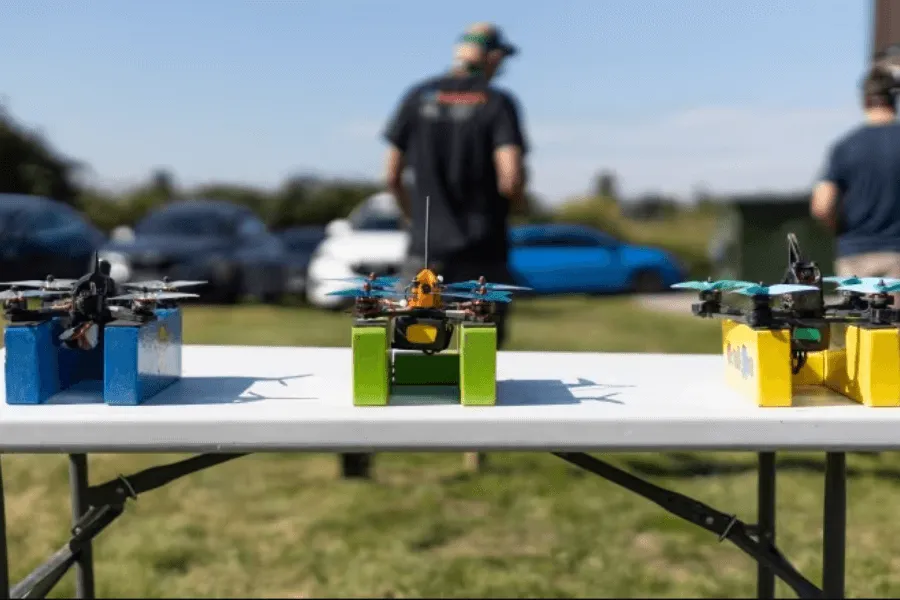
4 vs F7 vs H7 Flight Controllers Explained
When choosing a flight controller for FPV racing, the processor type plays a major role in performance and compatibility. The most common processors used in modern flight controllers are F4, F7, and H7, each offering different levels of processing power and features.
F4 Flight Controllers
F4 flight controllers have been widely used for many years and remain a popular option for budget racing builds.
Key characteristics of F4 FCs include:
- Moderate processing power
- Lower cost compared to newer processors
- Limited UART ports
- Sometimes require signal inversion for certain receivers
While F4 processors can still handle most Betaflight tasks, they may struggle when running very high loop rates, advanced filtering, or multiple peripherals simultaneously.
F4 boards are typically recommended for beginner racing drones or lightweight builds where cost is a priority.
F7 Flight Controllers
F7 flight controllers are currently the most popular choice for competitive FPV pilots.
Compared to F4 processors, F7 chips offer:
- Faster processing speed
- More UART ports for additional devices
- Native signal inversion support
- Better compatibility with modern receivers and digital systems
These advantages allow F7 flight controllers to run higher loop rates and more complex Betaflight filtering, which can improve flight stability and responsiveness during aggressive racing maneuvers.
For most FPV racers, F7 flight controllers offer the best balance between performance, price, and reliability.
H7 Flight Controllers
H7 processors represent the newest generation of flight controller hardware and provide significantly higher computing power.
H7 flight controllers feature:
- Much faster clock speeds
- Higher processing capacity
- Increased memory
- Support for future firmware developments
However, H7 boards are still relatively new and can be more expensive. For many racing pilots, the performance difference between F7 and H7 may not be noticeable in real-world flying.
H7 flight controllers are generally used by advanced pilots, experimental builds, or future-proof setups.
Best Gyros for Racing Drones
The gyro sensor (IMU) is one of the most critical components on a flight controller. It measures the drone’s angular movement and allows the flight controller to stabilize the aircraft in real time.
Different gyro models offer different levels of noise resistance, sampling rates, and vibration tolerance.
MPU6000
The MPU6000 has long been considered one of the most reliable gyros for FPV drones.
Advantages include:
- Excellent vibration resistance
- Stable performance on noisy frames
- Highly predictable flight characteristics
Because racing drones experience strong vibrations during rapid acceleration and sharp turns, MPU6000 remains a preferred option for many racers.
ICM20602
The ICM20602 is another widely used gyro in modern flight controllers.
Key benefits include:
- Higher sampling rate
- Lower latency
- Good performance for high-performance builds
ICM gyros generally provide faster sensor updates, which can help improve responsiveness during fast racing maneuvers.
However, they may require cleaner builds with good vibration isolation to perform at their best.
How to Choose the Right FC for Your Build
Selecting the right flight controller depends on your drone type, experience level, and racing goals. Here are a few practical guidelines.
For Beginners
If you are building your first racing drone, simplicity and reliability should be your priorities.
Recommended setup:
- F4 or F7 processor
- MPU6000 gyro
- Standard 30.5×30.5 mounting pattern
This configuration is affordable, easy to configure, and widely supported by the FPV community.
For Intermediate Racers
Pilots who already have experience with Betaflight tuning may want a more capable flight controller.
Recommended features include:
- F7 processor
- ICM20602 gyro
- Blackbox logging for tuning
- Multiple UART ports for GPS or telemetry
This setup offers better performance and flexibility for racing optimization.
For Advanced Builds
Professional racers or highly customized builds may benefit from the newest hardware.
Recommended features:
- F7 or H7 processor
- High-quality gyro
- Advanced filtering support
- Expanded UART availability
These flight controllers provide more processing headroom and allow pilots to experiment with aggressive tuning settings.
Compatibility of Drone Racing Flight Controller
Drone Frame Compatibility
The diagonal distance between two engine mounting holes is commonly used to determine the frame size. For a wide range of uses, including aerial photography and cinematography, racing, and freestyle flying, a 5′′ FPV drone frame is a popular choice. These frames can be found in a range of sizes and designs to accommodate various flying needs and styles. They are usually composed of sturdy materials like carbon fiber or fiberglass. Selecting the appropriate dimensions and form is crucial for both FPV racing and freestyling. You should select a lighter, thinner frame for drone racing flight controller because of its weight-saving qualities.
Not all flight controller fit every drone frame. Ensure compatibility with your chosen frame size and layout to avoid headaches during installation, most commonly drone racing flight controller’s have a mounting pattern of 30.5mm x 30.5mm, or 20x20mm.
ESC Compatibility
These days, 4in1 ESCs are frequently offered as a stack with FPV racing flight controller and are meant to be plugged and played with. It’s vital to double check before connecting, though, as the plugs and connections between ESC and FC from different brands may not be compatible. If this happens, you risk burning your racing flight controller. It is recommended to utilize “AIO (all in one) FC” if you want to use single ESC, which is an individual ESC mounted on the arms. These FCs have an integrated power distribution board, or PDB. However, this is out of style; 4in1 ESC is the newest fashion. In actuality, it’s growing harder and harder to locate a single ESC these days.
Firmware Support
Among the main flight control firmwares that are frequently used when flying a small quad are Betaflight, Raceflight, and KISS. Every firmware is tailored to do a certain task.
- Betaflight: With its user-friendly graphical user interface (GUI) and ongoing development by its creators, Betaflight is the most preferred choice. With little to no coding knowledge needed, Betaflight is an incredibly powerful and versatile flight controller firmware that is ideal for beginners. The fact that Betaflight supports a vast number of flight controllers is another important benefit.
- Raceflight: Raceflight is another flight control software that is only intended for acro and racing drones. Unlike other apps, Raceflight removes codes that are not necessary (like GPS). Raceflight was able to free up processor resources to perform other helpful tasks, such as executing faster looptimes, by removing these scripts. The firmware to use is Raceflight if your primary interest is racing. When choosing a racing flight controller, keep in mind that some models, like the Revolt F4, can run Raceflight.
- KISS: FlyDuino has developed a closed source firmware known as KISS (keep it simple stupid). KISS products are strong and modern in regards to current market trends. KISS is closed source and runs on proprietary boards made by KISS, just like Raceflight.
Durability and Build Quality of Racing Quad Flight Controller
- Material and Construction: FPV racing is a rough-and-tumble affair. Opt for controllers built with high-quality materials like carbon fiber and shock-absorbing mounts to withstand inevitable crashes and tumbles.
- Vibration Dampening Features: Powerful motors generate significant vibrations, which can interfere with sensor readings and flight stability. Choose a racing quad flight controllerwith built-in vibration dampening to ensure smooth, precise flight.
- Resistance to Environmental Factors: Rain, dust, and even the occasional rogue beer shower are all par for the course in FPV racing. Choose a controller with water-resistant coatings and conformal coatings to protect sensitive electronics.
Best Flight Controller for Racing Drone
T-Hobby Mini Racer F7 Flight Controller
The T-Hobby Mini Racer F7 Flight Controller is engineered for pilots who demand lightning-fast response and stable control in high-speed FPV racing. Powered by an STM32F722 processor, this board delivers exceptional processing power and precision. It supports MPU6000 gyro, Betaflight, and BLHeli_32 ESCs, ensuring smooth performance even under extreme maneuvers.
Its compact and lightweight design makes it ideal for 3–5 inch racing builds, while features like integrated OSD, Blackbox logging, and UART expandability provide professional-level tuning flexibility. Whether you’re building your first race quad or upgrading a pro rig, the T-Hobby Mini Racer F7 stands out as one of the best flight controllers for FPV racing drones in 2025 — combining reliability, speed, and precision in a single compact board.

THOBBY F7 PRO Flight Controller
The T-HOBBY F7 PRO Flight Controller is designed for serious FPV racers who pursue ultimate speed, stability, and precision. Equipped with a powerful STM32F722 processor and the highly reliable MPU6000 gyro, it ensures ultra-smooth flight performance and rapid response during aggressive maneuvers.
With features such as integrated Betaflight OSD, Blackbox data logging, multiple UART ports, and support for BLHeli_32 ESCs, the F7 PRO offers outstanding expandability and tuning flexibility. Its compact, lightweight, and durable design makes it perfect for both professional FPV racing drones and high-performance freestyle builds.
If you’re looking for a flight controller that delivers precision, speed, and reliability, the T-HOBBY F7 PRO is one of the best choices for racing drones in 2025.

MEPS F7 Racing Flight Controller
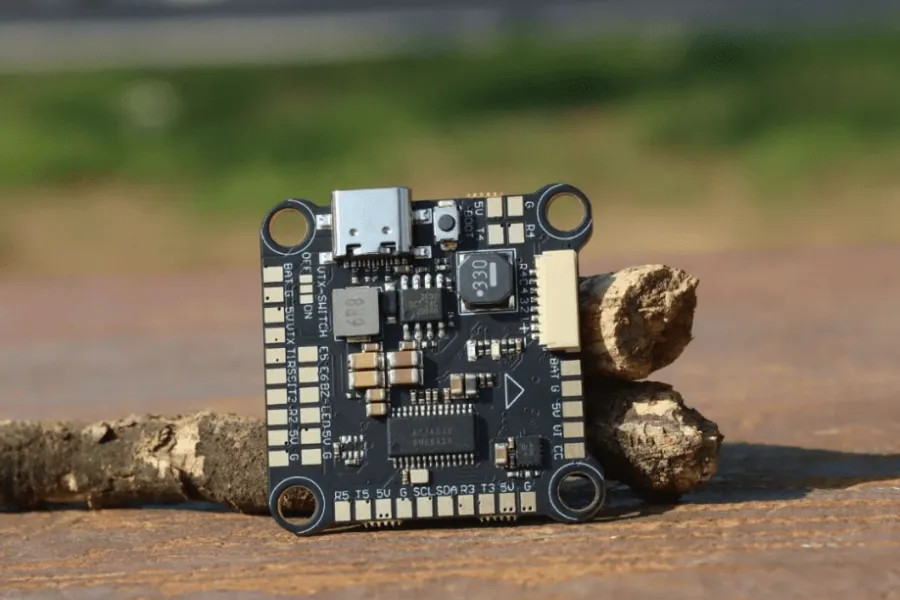
Introducing the MEPS F7 Racing Flight Controller, a large 30×30 drone flying controller that uses an STM32F722 microcontroller and is intended for analog constructions. This F7 Racing Flight Controller is a dependable option for your FPV racing drone because it features the widely used AT7456E chip for OSD overlay creation.
Constructed with simplicity and effectiveness in mind, the MEPS F7 Racing Flight Controller is easy to construct because to its rational layout and generously sized solder pads. One notable addition that gives you more setup freedom for your drone is the ability to designate a transmitter switch to operate the VTx power regulator. The MEPS F7 is a good choice if you’re looking for the best flight controller for racing drone.

FlightOne MillivoltOSD Racing Quad Flight Controller
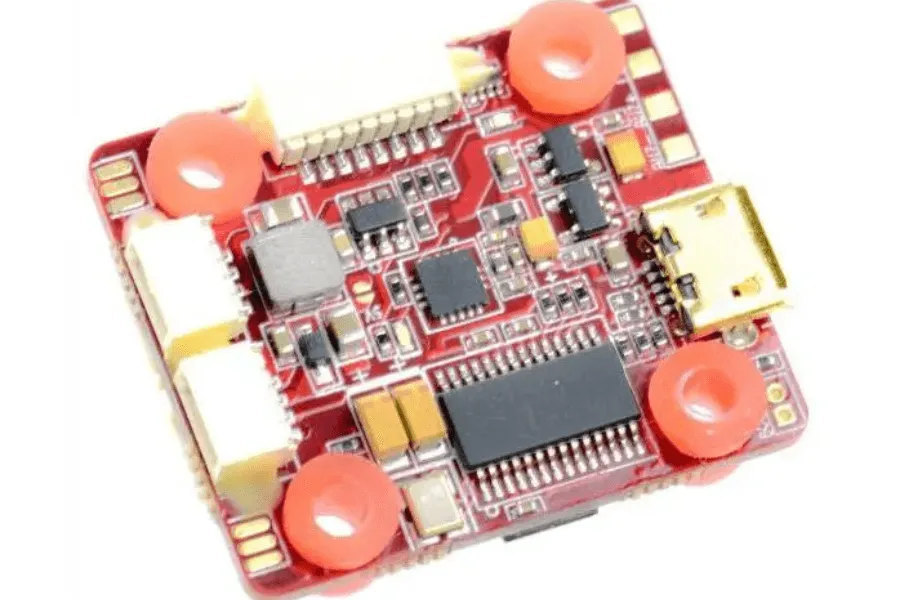
Racing-specific goods are produced by FlightOne. This is something you should absolutely think about if you enjoy racing, because I think it is one of the best flight controller for racing drone. A F4 CPU powers the FlightOne MillivoltOSD FC. It can support a variety of radio frequencies and comes with built-in OSD and telemetry capabilities. Moreover, it has a 20602 gyro with a sampling rate of 32 kHz and soft mounting grommets.
Remember that the MillivoltOSD is powered by FlightOne, which is optimized for racing, even though its stats may not seem outstanding when compared to other FC. This indicates that it performs better in racing than other FC using the exact same specs but operating on Betaflight.
Foxeer Mini F722 V3
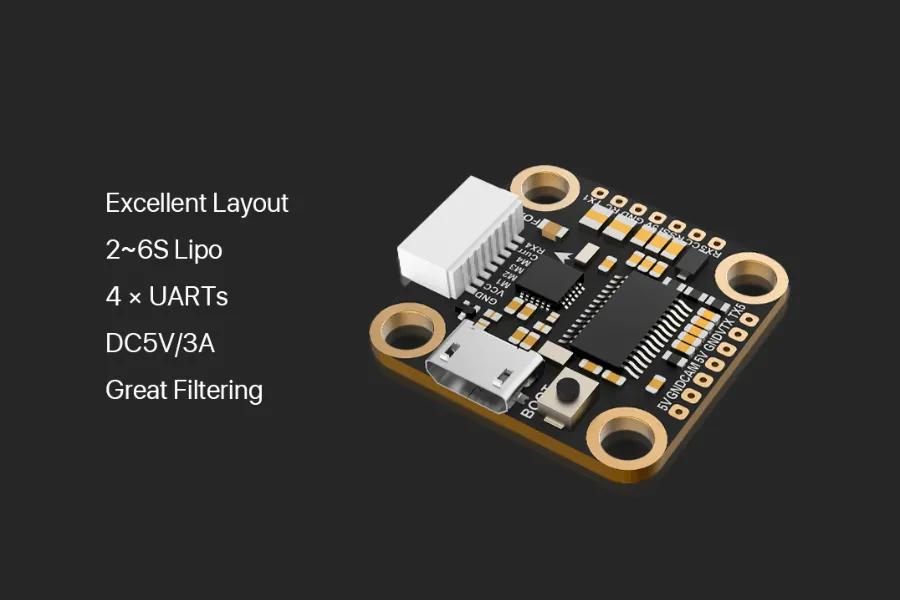
Because of its compact size, the Foxeer Mini F722 Pro V3 is a mini FC that is appropriate for racing drones. It is including Four UARTs, which makes it typically plenty for drone racing. This makes it one of the best flight controller for fpv racing.
Furthermore, it is equipped with all the standard functions, such as buzzer, OSD, and black box. This F7 FC’s integrated pass through facilitates soldering if you intend to use TBS Crossfire. But since it doesn’t have a DJI connection connector, you’ll need to solder if you want to utilize DJI.
MEPS Mini F7 HD & Analog Flight Controller for Freestyle
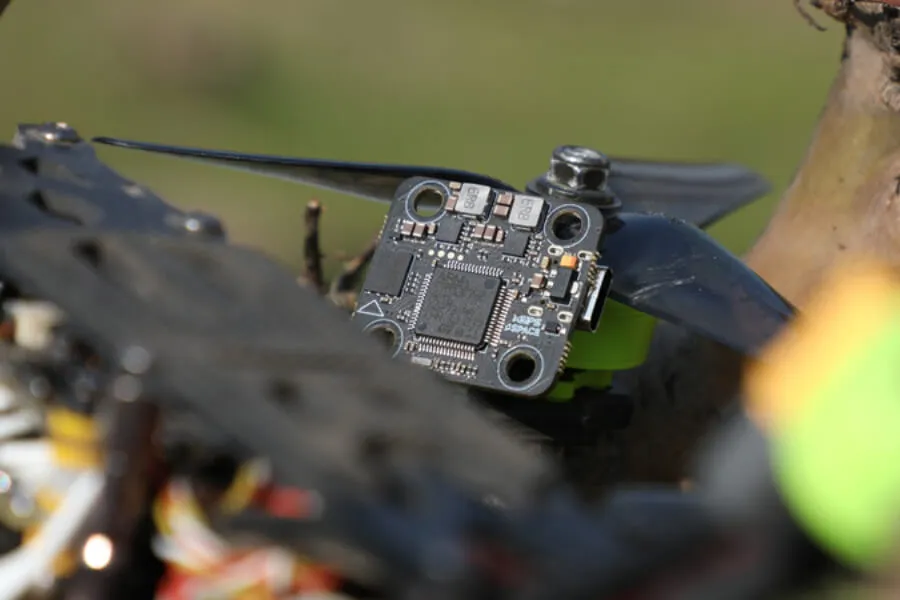
This FPV flight controller, which is built with the STM32F722 microcontroller, offers remarkable performance and quick processing, guaranteeing pilots a steady and comfortable flight. Convenience-minded in design, the board has a 6-pin plug&play interface that enables immediate, solder-free connection to HD Digital VTX. As a result, it is the best option for freestyle and racing drones since it is compatible with Betaflight firmware. It is one of the best racing flight controller.
The MEPS MINI F7 distinguishes out among other flight controllers for quadcopters due to its small 20×20 shape. This is the go-to micro flight controller whether you’re creating a micro quadcopter or looking for the ideal 20×20 F7 flight controller.
T-MOTOR F7 FPV Drones Flight Controller
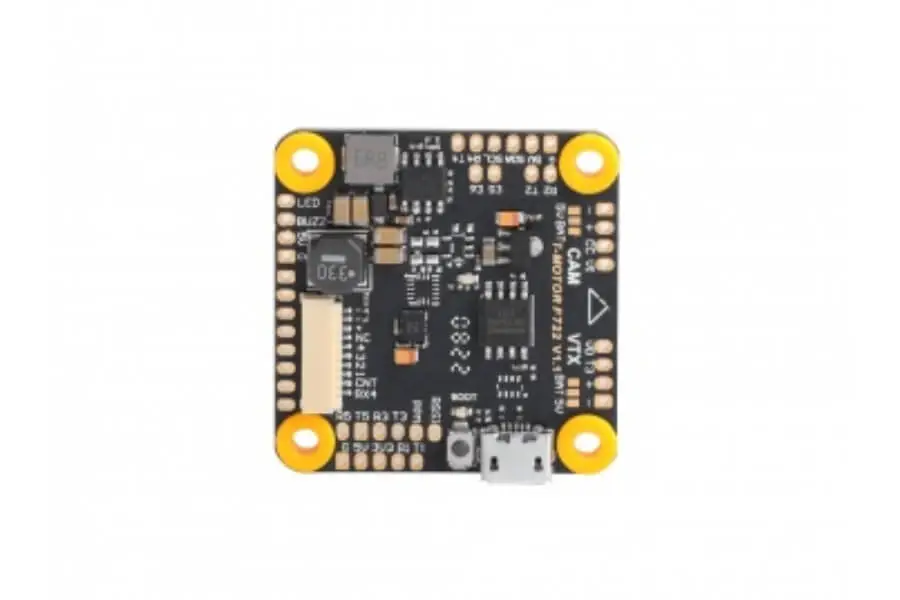
The T-MOTOR F7 FPV drone flight controller is a popular choice for both beginner and experienced pilots. It boasts a powerful STM32F722 processor, multiple communication ports, and advanced features. However, like any hardware, it has its own advantages and disadvantages. The STM32F722 processor offers smooth and responsive flight performance, even under demanding conditions. This is crucial for precise maneuvers and fast reactions. And the controller is built with high-quality materials and robust construction, making it resistant to crashes and harsh environments. But it comes with a higher price tag compared to some budget options. This might be a consideration for beginner pilots on a tight budget.
Common Flight Controller Problems
Even with high-quality hardware, flight controllers can sometimes experience issues. Understanding common problems can help you troubleshoot quickly.
Drone Not Arming
One of the most common problems is a drone that refuses to arm.
Possible causes include:
- Safety checks failing in Betaflight
- Throttle not at zero
- Receiver signal not detected
- Accelerometer calibration issues
Checking the Betaflight arming flags can help identify the exact cause.
Unstable Flight or Oscillations
If your drone shakes or oscillates during flight, the issue may be related to:
- Excessive frame vibration
- Incorrect PID tuning
- Loose flight controller mounting
- Propeller imbalance
Ensuring the flight controller is properly soft-mounted can significantly reduce noise and improve stability.
Sensor Errors
Sometimes Betaflight may display gyro or accelerometer errors.
This can happen if:
- The gyro overheats
- The board is damaged during a crash
- Firmware settings are incorrect
Updating firmware and recalibrating sensors can often solve the problem.
FAQ
What is the best flight controller for FPV racing?
Most competitive FPV racers prefer F7 flight controllers because they offer faster processing speeds, better compatibility with modern hardware, and enough performance headroom for advanced Betaflight filtering.
Is F4 still good for FPV racing?
Yes. F4 flight controllers can still perform well for racing drones, especially in budget builds. However, F7 boards provide more flexibility and are generally considered a better long-term option.
Which gyro is best for FPV racing?
The MPU6000 is known for its excellent vibration resistance and stability, while ICM20602 offers higher sampling rates and faster response. Both gyros are widely used in modern racing flight controllers.
Do racing drones need H7 flight controllers?
Not necessarily. While H7 processors are more powerful, most FPV racing builds run perfectly well on F7 flight controllers. H7 boards are mainly used for advanced or experimental setups.